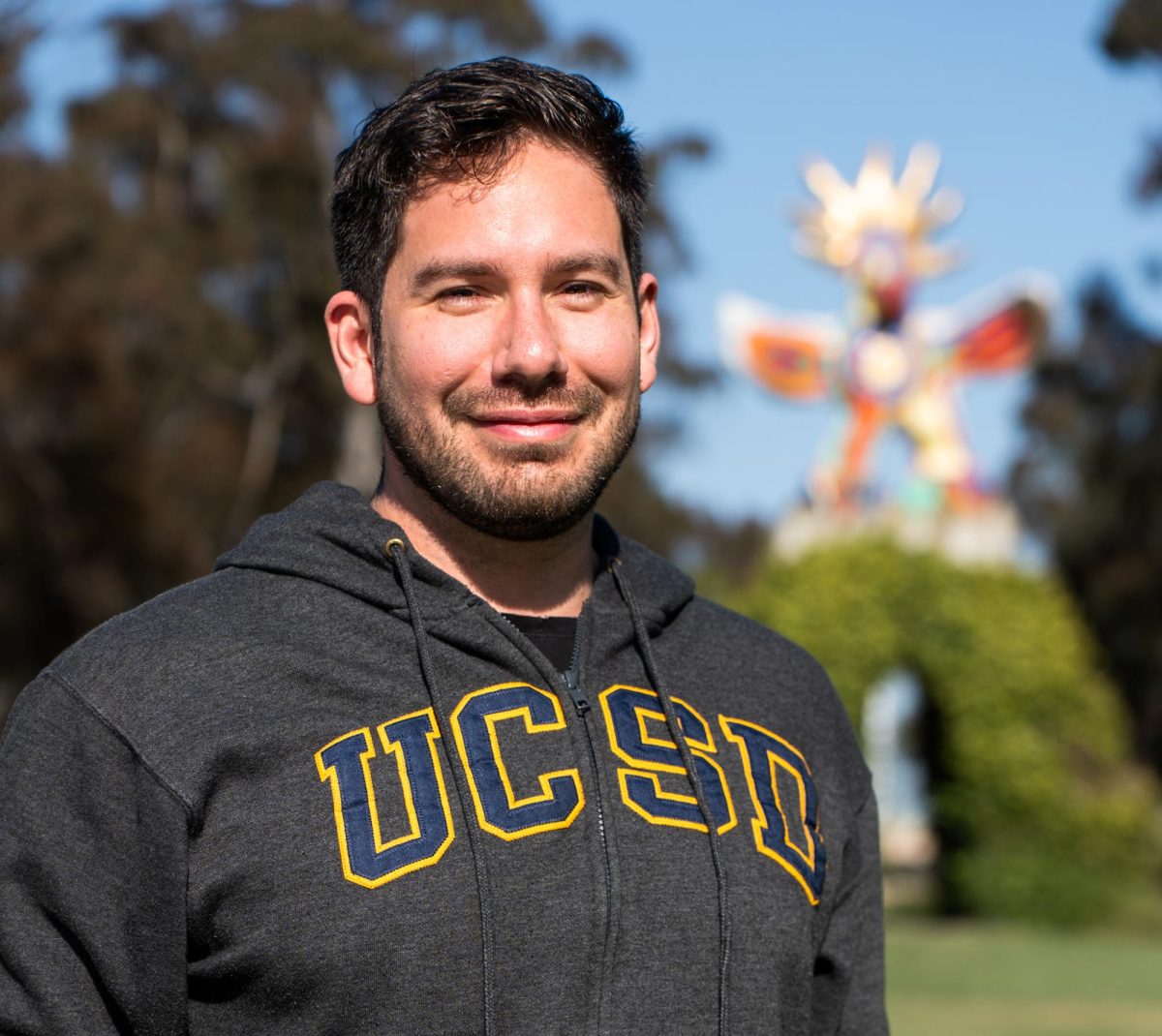
The ability to think. It's to be able to pay attention to details.
What's the worst job you've ever had?
I was a dishwasher; it was a hard job.
What is your ideal job?
I'm a pre-med, so I'm going to med school, and my ideal job is to be a surgeon.
How important is love to you?
I think it's important, because I think it gives balance between your personal life and your work schedule.
What's your favorite part of San Diego?
I like Torrey Pines. There's an area over there that's green where you can play sports and then go and surf, which I'm not going to have time for in a year or so.
What is your opinion of affirmative action?
I think that we should be balanced socially in education or the hospital environment or whatever. I think the more diverse people have to be, the better it is.
What's your favorite book?
""Contact,"" by Carl Sagan. Since I'm a neuroscience major, I like things to think beyond.
If you could accomplish one political goal, what would it be?
Since I'm an immigrant, I think [the government] should allow more immigrants to come to this country.
What do you hate being told?
That I can't do something. I'm extremely competitive, so I believe I can do anything.
What one thing would improve your life most right now?
I'm extremely stressed out now and studying all day long. So just to keep the energy and keep working hard.
In the past 40 years, UCSD has seen a number of significant changes in the ethnic makeup of both the faculty and the student population. Known as a campus that is host to a Caucasian and Asian-American majority, UCSD has historically lacked strong numbers of African-American, Native-American, Mexican-American and Latino students.
Guardian file photo
The controversial issue of racial diversity has been debated by students and faculty for years, particularly surrounding affirmative action.
The practice of using race or gender as a factor in employment and education became a matter of national importance in 1961, when President John F. Kennedy required that all government contractors take ""affirmative action"" to expand job opportunities for minorities. This effort to improve the lot of those perceived as hampered by their gender or race became common practice.
In 1978, affirmative action was first challenged in the U.S. Supreme Court in the University of California v. Bakke case, in which the Supreme Court upheld the use of race as one factor in choosing among qualified applicants for admission. However, in that same case the Supreme Court also ruled unlawful the practice of reserving 16 seats in each entering class of 100 for disadvantaged minority students at the UC Davis Medical School. This apparent contradiction only further clouded the issue as opponents and supporters of affirmative action became more vocal.
Guardian file photo
The UC Regents took action when they voted to end all affirmative action in 1995, under resolutions SP-1 and SP-2. This meant that the University of California would no longer use race, gender, ethnicity or national origin as a factor in the admissions process. This policy took effect in 1997 for graduate students and 1998 for undergraduate students.
Regent David Flinn said during the regents' affirmative action hearing in San Francisco, ""There is no dispute ... amongst this board, that diversity in the student body, in the faculty, in the University of California is a very, very important thing. But I think what people [miss] sometimes is what it is that the other side is complaining about.""
But this vote was not met without considerable opposition. Students from all over the UC system protested a meeting of the regents in 1995 at which the regents debated the resolutions, and rioting was feared, although the protesters were peaceful. Those criticizing the policy called it racist and unfair.
Another blow was dealt to affirmative action in 1996 when Proposition 209 surfaced. Following the regents' lead, voters approved the California Civil Rights Initiative in November of 1996. The proposition stated that California ""shall not discriminate against, or grant preferential treatment to, any individual or group on the basis of race, sex, color, ethnicity, or national origin in the operation of public employment, public education or public contracting."" This would essentially abolish all affirmative action programs in the state in employment or education.
In March 1996, a student-run demonstration blocked the intersection of La Jolla Village Drive and Villa La Jolla Drive, disrupting traffic and refusing to disperse, according to police officials. Eighteen students were arrested.
The student protestors also received publicity when they attracted former presidential candidate and Rev. Jesse Jackson to visit and speak at UCSD in an anti-Proposition 209 rally in October 1996. In his speech Jackson said, ""We need a state that is color-inclusive and color-caring, not colorblind. No rational person wants to be blind.""
The following November, once the measure had been approved by California voters, another student protest against Proposition 209 occurred when 40 students voiced their opinions through a campuswide protest.
Dressed in red T-shirts and green armbands, the students held a press conference in Revelle Plaza then marched through campus chanting, among other things, ""Pete Wilson, you liar, we'll set your ass on fire!"" They advocated university-wide noncompliance to the proposition: Their demands were not met.
Proposition 209 did find some student support.
Then-Revelle junior Veron Stanley said, ""When I was admitted I think there were only 90 black students on the whole campus, and that's kind of awkward. But obviously, if you're not qualified, then get out.""
The most visible student activism, however, has continued to be in favor of fostering diversity through the reinstatement of affirmative action. While clear on their intent to comply with state law, UCSD's administration has heard these opinions and has sought to address them.
In general, the university has responded to such protests and rallies about a lack of campus diversity with different university programs intended to help attract more applicants from underrepresented ethnic groups and retain them by making the campus environment more welcoming and supportive.
The steps are detailed in Chancellor Robert C. Dynes' 10-point Diversity Action Plan, which was proposed and enacted in 1999.
Among the pledges for improving UCSD's diversity-promoting efforts are increasing the then-current scholarship base three-fold, annually awarding $1 million in undergraduate scholarships by the year 2002.
Dynes also pledged to form the Center for Research in Educational Equity, Assessment and Teaching Excellence, a UCSD-designed, comprehensive initiative to increase the number of underrepresented students who achieve UC-eligibility to enroll at UCSD. The program would use outreach programs to target K-12 students.
Another significant part of Dynes' Diversity Action Plan is the establishment of a UCSD Diversity Council. This council is not an administrative council; but rather, a council composed of faculty, staff and students, in the effort to represent many voices of the UCSD community.
The Diversity Action Plan promised to increase funding for underrepresented clubs or groups on campus, such as the African-American Student Union and the Lesbian, Gay, Bisexual and Transgender Association.
There are some signs that progress is being made as the administration would like. In February 2001, the number of applications for underrepresented minorities, in some cases, rose.
However, as the number of overall applications rose as well, this may not reflect actual improvement: In 2001, African-American students submitted 3.1 percent of the fall 2001 freshman applications, up only slightly from last year's 3 percent; Mexican-American students submitted 9.3 of the whole, a rise from 8.4 of the total freshman applications; and Latinos submitted 3 percent of the applications received, the same as from the previous year.
Many students feel that this has not sufficiently increased enrollment of students from underrepresented ethnic groups.
In March, students gathered in Price Center Plaza to support the reinstatement of affirmative action. The name of the rally, 52-33-28, refers to the number of African-American freshman students enrolled in UCSD in 1998, 1999, and 2000 respectively. It drew attention to the continuing decline in minority enrollment, despite the swelling number of students coming to the university.
Perhaps responding to such concerns, in May the UC Regents voted to repeal SP-1 and SP-2, initiatives that banned affirmative action. However, this did not change the status of affirmative action in admissions because Proposition 209 is a statewide policy banning the use of affirmative action.
But the symbolic gesture has earned praise.
A.S. Vice President External Dylan de Kervor said, ""Even though Prop. 209 is still in place, the act of rescinding SP-1 and SP-2 is a huge act of goodwill toward the underrepresented students on our campus, and it's paving the way for future progress.""
Students rallied and marched in favor of affirmative action once again in October 2001. The participants highlighted the falling number of African-Americans, Native Americans, Mexican-Americans and Latinos in UCSD's applicant pool -- down from 13 percent in 1997 to less than 2 percent in 2000.
Although many UCSD students have decided that affirmative action should be reinstated, legislators, the public and the courts continue to wrestle over this thorny issue of differing concepts of fairness and opportunity. A January 2000 Gallup/USA Today poll showed 58 percent of Americans favoring affirmative action for minorities and women, up from 55 percent in 1995. Court rulings remain murky on the issue. And here at UCSD, we are living the debate -- for better or worse.
Features Editor Claire J. Vannette contributed to this article.
Every year, scads of our valuable beer-drinking money is wasted on such trivial things as tuition fees and textbooks. The various ways of acquiring financial aid are well-documented, but nobody seems to be giving out pamphlets on getting cheaper textbooks for students.
This is quite a pity, considering it is possible to get, say, ""Fundamentals of Physics"" by Halliday and Resnick ($120 at the UCSD Bookstore) for $25, or ""Calculus Early Transcendentals"" Stewart ($100 at the UCSD Bookstore) for $24. These books are brand new, and in most cases indistinguishable from the ones sold in the bookstores you may be familiar with. At most, they might have the words ""International Edition"" printed somewhere on them.
The international edition of a textbook is printed by the same publisher as the domestic edition, and as the name implies, is sold for profit in other countries. However, they can be up to five times cheaper than the domestic version.
Before exploring the reasons for this price discrepancy, some detail regarding the costs of publishing a textbook may be helpful.
According to publishers, the world of textbook publishing is a cutthroat business with very little profit. Only a small number of copies are printed, the warehousing costs are massive and new editions of books come out frequently, making the previous edition nearly impossible to sell. Furthermore, textbooks now usually come in color with elaborate diagrams, and therefore are much more difficult to write and typeset than your average fiction bestseller.
According to the NACS College Store Industry Financial Report 2001, for each dollar spent on a textbook, 75.4 cents go to the publishers, almost all of which goes toward the above-mentioned expenses, leaving only 7 cents as profit.
Most of these costs are one-time costs: paying the writers, editors and contributors their advances; creating the design of the textbook; and setting up the presses to print it. After all, once the textbook is written, it's written. Also, new revisions, while representing a significant amount of work in their own right, rarely require as much effort as the first edition.
Ongoing costs to the publisher include the cost of shipping, which, according to the report, is 1.4 percent of the price, and the cost of paper and the actual printing the book. According to the report, the printing cost takes up 31 percent of the retail price, but this no doubt includes the one-time costs of typesetting and such. The price goes down if large quantities are printed and the price goes up if there are many color pages. Surprisingly, there is no appreciable change to the cost between printing hardback and paperback.
So why is the international edition so much cheaper than the domestic edition? Unfortunately, there does not appear to be any conclusive explanation.
None of the publishers that were contacted were interested in explaining their pricing decisions or revealing their profit margins. The foreign bookstores that were interviewed provided some rather surprising answers -- according to one shopkeeper, international editions are cheaper because they are printed locally. However, most international-edition textbooks have the words ""Printed in the USA"" on the information page.
Another answer received was that textbooks were cheaper because they were bought in bulk -- something that is done by bookstores in the United States as well as abroad. Some even claimed that the international editions were cheaper because they were printed on thinner paper, but this does not hold with observation -- international editions are overwhelmingly indistinguishable from domestic editions. Also, the material cost of printing a textbook is only a trivial fraction of the total cost involved.
It's not due to the differences in currency, as the textbooks are being sold at a fraction of the equivalent value of U.S. dollars, and any benefit of currency differences to operations is unlikely to affect the price by such significant amounts.
Additionally, some analysis suggests that the cost of selling these textbooks overseas would probably be higher than selling them locally. After all, the books have to be shipped over longer distances, and foreign chains of distribution have to be established.
Whatever the reason, it's not charity on the part of the publishing houses. International editions are sold for profit in commercial bookstores worldwide. Prices may vary widely from country to country based on the vagaries of currency and demand, but all are substantially lower than domestic prices. Even developed countries like the UK and Australia enjoy the benefits of the international edition.
For students feeling the pinch at the bookstore checkout this quarter, the lure of cheap international textbooks may be appealing, but the publishers apparently took this into account: It's illegal to import or sell international editions in the United States.
The only recommendation may be to cut back on the beer budget and reserve more cash for books.
New option for commuters creates room for everyone
An additional 380 ""S"" parking spaces became available Jan. 5, 2001 when the new Pangea Parking Structure in Thurgood Marshall College opened.
Lyon Liew Guardian
The structure, which has been in construction since August 1999, also contains 309 ""B"" spots, 161 ""A"" spots, 104 metered visitor spots and 18 handicapped spots.
Students believe that the new structure will make parking everywhere on campus much easier.
""Hopefully it will alleviate the parking problems in Muir,"" Muir sophomore Adam Roston said. ""Parking there has become virtually impossible past 8 a.m.""
-- By Matt Schrader
1.8.01
UCSD to receive science institute
University to partner with UC Irvine and local businesses
Gov. Gray Davis announced at a press conference Dec. 7, 2000 that UCSD, in partnership with UC Irvine, will receive an Institute for Telecommunications and Information Technology, as one of three California Institutes of Science and Information.
""Cal-(IT2) will seek to merge the twin marvels of the Internet and wireless communications to forge the new information age,"" said UCSD Chancellor Robert C. Dynes.
Researchers and students working with the institute and its partner UCI will study modes of transformation from the use of slower modems to faster broadband Internet connections as the Internet becomes more a part of the physical world.
-- By Lauren I. Coartney
1.11.01
Flood wreaks havoc at Tioga Hall
Muir students experience the effects of a faulty drainpipe
After days of pounding rain from last week's winter storms, UCSD is finally dry, with the exception of Tioga Hall.
A small flood occurred Jan. 11, 2001 on the ground floor of John Muir College's Tioga Hall. Water quickly spread throughout the south side of the building in the early hours of the morning, prompting 17 residents to seek higher ground.
Susan Rindlaub, a Muir freshman, awoke just after 8 a.m. to find an inch-and-a-half of water on the floor of her room.
""I jumped out of bed in my socks and [the water] splashed up all around me,"" Rindlaub said. ""My stuff was floating in my room.""
The source of the water was a leaky drainpipe that was supposed to divert rain from the roof of the 11-story residence hall to the ground floor. However, a cap that was supposed to have sealed the pipe came loose, causing gallons of rainwater to pour into the common room between two adjoining suites.
-- By Kyle R. Biebesheimer
1.19.01
Club Ritmo jam-packed at opening
A.S. Programming opens new UCSD night club with performances by Tone Loc, Candyman, DVC
Jan. 19, 2001 marked the opening of UCSD's new live entertainment venue, ""Club Ritmo,"" which featured headliner Tone Loc with special guest Candyman.
The premiere, which was sponsored by the A.S. Council, took place from 8:30 p.m. to midnight at the Stage at Porter's Pub.
Tone Loc took the stage at about 10:30 p.m. to perform perennial favorites and his two most famous songs, ""Wild Thing"" and ""Funky Cold Medina.""
A.S. Production Manager Steve Evans reported that attendance averaged 500 people throughout the night. Toward the time of Tone Loc's performance, the number increased as Porter's Pub neared its maximum capacity, with almost 700 people in attendance.
-- By Alex J. Lee
1.20.01
A.S. Council, athletic dept. unveil new mascot
Revamped Triton debuted at UCSD men's basketball game
After years of student anticipation of the arrival of an identifiable spirit leader, the A.S. Council and the athletic department finally revealed the new Triton mascot on Jan. 20, 2001 at halftime of the UCSD men's basketball game against California State University Dominguez Hills.
Assistant Athletic Director Ken Grosse said the new costume stands about 6'5"" with an oversized head, a toga-like outfit, flowing hair, a beard and long muscular legs.
""People will really be impressed,"" said A.S. President Doc Khaleghi. ""I am proud to be at a school that has this mascot.""
The Triton has always been the school's nickname, although no mascot existed until recently.
-- By Matt Schrader
1.25.01
A.S. Council to fund Anti-Zionism Week
Controversial event raises questions about money
Amid objections from the Union of Jewish Students, the A.S. Council is funding the Muslim Student Association's Anti-Zionism Week, to be held Jan. 29 to Feb. 2, 2001.
At last week's A.S. Council meeting, Vice President Finance Matt Powell suggested funding the event from a fund created in 1994 specifically for controversial issues.
The council voted against Powell's motion, and instead decided to fund the event through the Student Organizations Unallocated fund, the fund through which most student organizations receive money.
Jonathan Rotter, a recent UCSD graduate, said he feels that many council members do not see how offensive the term ""Anti-Zionism Week"" is to Jewish students.
""Certainly they made the claim that they're required by law to fund things in a content-independent manner,"" he said. ""But it's hard for me to imagine that if someone had proposed an anti-Asian week that they would have gotten funding. It's my feeling that they don't understand that, to us, Anti-Zionism week is equal to Anti-Semitism week.""
Muslema Purmul, treasurer of the MSA, agreed with the council vote.
Purmul said she feels that Anti-Zionism Week is being misunderstood by many.
""I think that the reaction that has been voiced is too harsh considering what Anti-Zionism Week is all about,"" she said. ""I feel we're being judged before we've had a chance to say anything.""
-- By Vincent Gragnani
2.5.01
Change in code pushes lawyers out of hearings
Students can no longer have attorneys at campus hearings
Revisions to the Student Code of Conduct, eliminating a student's right to attorney representation during hearings of misconduct, took effect fall quarter 2000.
The right to have attorney representation at hearings has been a student right at UCSD since 1978, when the first draft of the Student Code of Conduct was created.
Nick Aguilar, the director of student policies and judicial affairs, said that students have not lost a right because they never had a constitutional right to representation by attorneys.
""There is no constitutional right to be represented by an attorney in administrative hearings,"" Aguilar said.
-- By Parisa Baharian
2.9.01
UCSD freshman dies in fall at Blacks Beach
Active Revelle student falls 200 feet from cliffs to the beach below
Revelle freshman Gilbert F.D. Nunez Jr. fell to his death from the cliffs above Blacks Beach on Feb. 9, 2001 at about 5 p.m. He was 18.
Nunez and some of his friends had gone to the cliffs to study just after 4 p.m. The victim strayed from the group to climb on a rock at the edge of the cliff when he lost his balance and fell.
""He was an avid climber -- he was practically a monkey,"" recalls Revelle freshman Becky Bowen, a friend of Nunez. ""He was climbing and slipped and fell to his death.""
-- By Kyle R. Biebesheimer
3.1.01
Missing student dies in car crash
Students turned out for vigil in Joshua Eber's honor
A crowd gathered at the Muir quad at 9 p.m. the evening of March 1, 2001 to remember the passing of Muir senior Joshua Eber.
Eber had been missing since Feb. 26, 2001. The Thursday night gathering was intended to be a candlelight vigil for the missing student.
However, the event turned into a memorial service.
Eber was killed in a car accident near Las Pulgas Road, off Interstate 5 at Camp Pendleton. He was 22.
-- By Steve Lehtonen
4.5.01
A pair of swimmers makes a big splash
Watanabe and Lopez set five school records, two NCAA records at Nationals.
Going into the NCAA Division II Swimming and Diving Championships on March 14 to March 17 in Canton, Ohio, neither sophomore Jennifer Watanabe nor junior Sandra Lopez had much trepidation about going head-to-head against the other top Division II swimmers from around the nation, and neither had many expectations for reaching the championships.
But on the first day of competition, Watanabe set a school record in the 200-yard individual medley with a time of 2:04.41.
On day two, Watanabe came back to win the 400-yard individual medley with a time of 4:22.68, which is also a school record.
Day three belonged to Lopez, as she set both a Division II and a school record en route to winning the 100-yard breaststroke with a time of 1:03.20.
On the final day of competition, Lopez set another NCAA record and school record in the 200-yard breaststroke with a time of 2:16.74. Watanabe captured her third title of the competition in the 200-yard backstroke event with a time of 2:00.61, which is yet another school record.
-- By Isaac Pearlman
4.13.01
A.S. presidency goes to Dodge in Unity landslide
Members of One slate, independents fail to secure executive positions
The Unity slate accomplished its goal April 13, 2001 as its candidates swept the A.S. Council election by winning all 22 races that they ran in.
""Honestly, I wasn't expecting all 22 of our slate members to all win,"" said A.S. President-elect Jeff Dodge. ""That is kind of unheard of, but I think it just shows that we are a good group of people and that we are going to do good things for the A.S.""
The Unity slate, led by Dodge, Vice President Internal-elect Jenn Brown and Vice President Finance-elect Sam Shooshtary, campaigned for almost two months. The members said the work they put into their campaign was their ultimate key to victory.
-- By Matt Schrader
4.27.01
Campus Life Fee rejected with record turnout
Record 33 percent of students vote, defeating fee increase by 3-2 margin
Despite receiving the highest voter turnout in UCSD's history, the Campus Life Fee Referendum failed to pass by over 750 votes, thereby eliminating the possibility of an annual student fee increase of about $210.
The A.S. Election Committee released the results April 27, 2001 showing that 2,739 students voted in favor of the fee increase and that 3,492 voted against it.
Of the school's 18,600 students, 6,231 undergraduate, graduate and medical students voted last week contributing to a 33 percent voter turnout -- the highest in UCSD history.
""There were too many issues being tacked onto it,"" said A.S. Services and Enterprises Commissioner-elect Colin Parent. ""It ended up making the whole thing controversial.""
-- By Matt Schrader
5.17.01
Regents rescind SP-1 and SP-2
RE-28 passed unanimously after 11th-hour revision
In response to controversy surrounding dropping rates of minority admissions to the University of California, the UC Board of Regents unanimously voted to rescind SP-1 and SP-2, the policies that banned race-based admission and hiring in the university.
The resolution, named RE-28, rescinds policies that critics say discourage minorities from applying to schools in the UC system.
Regent Judith Hopkinson, the resolution's author, stated that it will not resemble affirmative action, which is banned by the California Constitution as a result of the 1996 passage of Proposition 209.
-- By Lauren I. Coartney
5.31.01
Sixth College curriculum approved
Academic Senate finalizes new college's general education
The Academic Senate voted unanimously to approve the Committee on Education Policy's recommendation for the Sixth College Detailed Academic Plan in its final meeting of the year.
The Sixth College Steering Committee, which includes undergraduate student representatives, submitted the plan. Gabriele Wienhausen, provost of Sixth College, presented the plan at the meeting.
Sixth College's theme, ""Culture, Art and Technology,"" is also the name of the required general education core sequence designed to embrace the exploration of interactions among the three. The C.A.T. sequence is highly interdisciplinary and integrates learning in arts and humanities, social sciences, and science and engineering.
-- By Rebecca Wood
9.14.01
Students charged for mandatory insurance
Regents require health insurance for undergrads
Starting fall quarter 2001, the UC Board of Regents is requiring all UC undergraduates to have health insurance. The mandate was made Sept. 14, 2000 after about five years of debate, said UC Regents spokeswoman Mary Spletter.
The measure was recommended by UC President Richard Atkinson and was passed ""almost unanimously,"" Spletter said.
While the university has long required health insurance for its graduate and international students, Spletter explained that ""changes in the health care situation have made it more critical for all students to have health insurance.""
-- By Claire J. Vannette
9.18.01
UCSD students stranded after terror attacks
FAA shutdown leaves many without a way back to school
Many UCSD students are having trouble getting to campus in time for the new academic year because of the Sept. 11 terrorist attacks on the East Coast.
Commercial flight schedules are still unpredictable a week after the Federal Aviation Administration's decision to ground all flights in response to the attacks.
Campus departments are prepared for students who will be returning late due to increased air travel security precautions and repeated airport shutdowns.
""We're not going to take any adverse actions based on individuals not being here on time,"" said Vice Chancellor of Student Affairs Joseph Watson. ""I think everybody wants to be understanding and accommodating. This is a time of great emotional stress and we're working together as a community and a campus to make sure everybody comes through this positively.""
-- By Lauren I. Coartney
10.11.01
'The Koala' accused of printing hate speech
UCSD humor newspaper faces allegations of racism
Some students and groups have condemned The Koala for running what they call racist mock advertisements and personal ads in its first issue of the school year.
Within the ""Forum on the Greek System"" section of the Sept. 24, 2001 issue, an announcement informed readers of a fictitious fraternity named Chi Kappa Alpha, nicknamed ""The Chikes.""
The issue also included two personal ads containing anti-Asian messages. One read, ""To all the Asians: Nobody likes you, good day,"" while another suggested that an option should be added to housing forms to exclude Asians.
-- By Evan McLaughlin
10.17.01
UCSD to get a new graduate school
Management school to open its doors in fall 2003
Ushering in a new era for both UCSD and the San Diego regional economy, the UC Regents unanimously approved plans for a graduate management school Oct. 17, 2001 at their meeting in San Francisco.
Current plans have the management school enrolling full-time students for the Master of Business Administration degree by fall 2003.
According to a ""Business Week"" survey, San Diego is the only major metropolitan area in the country without a management school in the top 50 rankings.
-- By Charlie Tran
10.24.01
Women's soccer loses at home
Tritons end 22-game winning streak with first home loss since 1998
In its first home loss since 1998, the UCSD women's soccer team lost 1-0 to Cal Poly Pomona in overtime at Triton Soccer Stadium on Oct. 24, 2001.
After a scoreless game during regulation, Bronco freshman forward Lisa Araujo scored just 59 seconds into the sudden-death overtime to lead 11th-ranked Cal Poly to victory.
With this win, the Broncos snapped a Triton 22-game home winning streak. Cal Poly also snapped the Tritons' nine-game winning streak.
This contest spotlighted two of the top National Collegiate Athletic Association Division II women's soccer teams. The Broncos were the Division II national runners-up in 1999 and the Tritons won the Division II National Championship in 2000.
-- By Courtney Field
11.23.01
Tritons stun crosstown rival SDSU
Women's basketball beats Division I Aztecs in first meeting since 1978
Inside a practically empty Cox Arena at San Diego State University on Friday night, the UCSD women's basketball team began its season against the Division I Aztecs in the two teams' first meeting since a 33-72 Triton loss Nov. 28, 1978.
However, this year's Tritons refused to let history repeat itself when they stunned SDSU 63-59. The Aztecs had previously lost only one game to another San Diego university.
Triton head coach Judy Malone gave credit for the victory to the team's offense.
""We ran our offense effectively -- that was the difference,"" she said.
But Triton guard Ali Ginn gave credit to a different source.
""I'd like to thank the San Diego Union-Tribune,"" she said. ""They wrote an article saying we would be an easy victory for SDSU, which we posted in our locker room. It was a good motivating factor for us.""
-- By Isaac Pearlman
11.26.01
UCSD admissions undergo revision
School adopts 'comprehensive review' policy
UCSD has revised its undergraduate admissions policy to comply with the UC Board of Regents' newly adopted standards of comprehensive review.
UCSD's new process, which will first be implemented in fall 2002, will involve three ""reviews,"" or phases.
The initial review will consider a mix of academic criteria. Applicants' grade point averages will be examined, along with test scores and the number of UC-required A-G courses taken beyond the minimum required.
UCSD admissions personnel will also take into account other factors in the first review, including ""eligibility in the local context,"" low family income, first-generation college attendance and ""educational environment"" -- which is identified as attending schools in the state's fourth or fifth performance quintiles.
It is once again that time of the quarter when stress runs high and sleep is at a minimum. It is finals time and it is approaching at full speed.
Sara Stauch Guardian
Many students rely on their finals as a means of digging their grades out of the gutter. The 10 weeks prior to finals are spent slacking off, partying, sleeping or finding any other form of procrastination that would prevent studying. And now the activities of the past have caught up. The only solution left is to actually crack open the books and study hard, study long and study productively.
There are a wide variety of techniques used in studying to successfully get an A.
First and foremost, the environment where a person chooses to work should be one that is suited to his individual needs. If the student cannot concentrate in complete silence, then studying on the eighth floor of Geisel Library is probably not the place for such a person, just as studying in a noisy coffee shop would not be the place of choice for someone who needs complete silence.
Sara Stauch Guardian
Said Marshall senior Tien Dang, ""I like to go to CLICS because they have good lighting and the computers work really well there. It is not too quiet; neither is it too noisy.""
Second, it is not recommended to wait until the last possible moment to learn a quarter's worth of work.
Ronald T.C. Boyd wrote in his article, ""Improving Your Test-Taking Skills,"" that it is best to study from the beginning of the course.
""It is smart to prepare a little bit each day,"" Boyd's article reads. ""Preparing for a test gradually lets you absorb the material, make connections between concepts and draw conclusions. Studying each subject every night will save you the agony of having to cram on the night before a test.""
Such preparation can help eliminate the stress resulting from the feeling of being unprepared.
Ben Mlynash, a Muir junior, can attest to the aftereffects of waiting until the last minute to study.
""Procrastination is an addiction,"" he says. ""Once you start, you do not go back, and when you realize it, you are screwed.""
Third, study groups can be useful when used as more than a means to socialize and procrastinate.
Diane Loulou's article, ""Making the A: How To Study for Tests,"" states that ""study groups allow students to combine resources; members share an academic goal and provide support and encouragement.""
Loulou also suggests ""an agenda for each meeting to avoid wasting time.""
Revelle junior Eric Gorinstein has a similar belief toward study groups.
""They're great as long as you've studied before getting there,"" Gorinstein says. ""I feel that they are better for review or just approaching the material from a new perspective but not for learning.""
Fourth, it is crucial to be organized. Having legible and detailed notes can provide an added source of material to learn from. Books sometimes assume the reader knows some previous information. Often in lecture, teachers go over the material in the reading, but in more detail and with better explanations.
Said Marshall senior Elana Segal, ""I outline lecture notes and compare them with the texts in order to understand a professor's teaching style.""
Fifth, it is pertinent to understand what type of test the final is going to be. There are many types of tests. Each type of test requires different tactics for test preparation and performance. Loulou's article suggests the following tips to effectively master the different types of tests professors throw at students.
Multiple choice: When faced with a multiple choice test and two answers seem alike, choose one of the two similar answers.
True/false: If a question has the word ""never,"" ""rarely"" or ""always"" in it, usually the question is false.
Open-book: Bookmark important pages and write down formulas that are necessary on a separate sheet of paper to save time.
Short answer: Use flashcards to study. This will help the student identify key words that might need to be defined on a test.
Essay: Make an outline before writing the actual paper. When forming the paper, it is important to get to the point and restate the question at the beginning.
When asked what her favorite type of test is, Muir junior Korin Lee responded, ""I think multiple-choice questions have their benefits because you have a 25 percent chance of guessing the correct answer. However, short answer questions allow much room for bluffing, so both have their benefits.""
Many UCSD students find that different testing situations suggest different studying approaches. As for which strategy will prove most useful -- only time will tell.
It is 3 p.m. on a Friday afternoon at the Food Co-op. Five employees move from the back room where they hang out into the store to dance spastically. Two of them break dance, one hops on a pogo stick and another freaks like he is in a gangster rap video.
Leo der Stephanians Guardian
These students are some of the 14 core members who consistently work at the Food Co-op. They get $8 an hour to amuse themselves -- and customers -- as described above. Oh yeah, they also work.
Employees and volunteers run the register, price the products, clean, deal with food vendors and make changes to their store. They are also responsible for the financial well-being of the co-op. Since there is equal status among the employees, decisions are made collectively.
Sandwiches, soups, egg rolls and baked goods are prepared and made in the small kitchen in the back of the store. In the office, binders keep the co-op's records in order. They have a computer to play the MP3s that are the source of their in-store music. Upon request, you might be able to get them to play Michael Jackson's entire Thriller album.
Kenrick Leung Guardian
Monica Bennett, one of the employees, said that this informal atmosphere and cooperative working environment make the job enjoyable.
""It is an alternative to systemic jobs,"" Bennett said. ""Everyone knows how everything works here and there is a great sense of camaraderie. Because I know everyone here so well and I feel so much a part of the community, I want to look out for everyone and be busy helping.""
Shaun Fuller has worked at the co-op for the past nine months.
""The Food Co-op creates a nexus, a little community for like-minded people,"" Fuller said.
The co-op, established in 1978, is a completely student-run organization. In addition to the paid employees, the co-op uses volunteers who can offer their help for as many hours a week as they like. Volunteers who work more than two hours a week get a 25 percent discount on food.
Because no one is in charge at the co-op, decisions are made democratically. The cooperative has a general framework that it uses to govern what foods to sell. It also selects as a group what products to promote.
Several criteria are used to determine what products will be sold, and which ones will not make the cut.
Employees scrutinize the vendors from which they buy, hoping to avoid, as Fuller said, ""companies of ill repute."" They investigate company procedures that are alegedly unjust to workers or unfriendly to the environment.
The co-op also tries to stay away from products that are produced as a result of death or maltreatment of animals, with the exception of dairy products. The co-op does not sell food that has chemical additives such as artificial preservatives or sugar sweeteners, and works hard to minimize the use of saturated fats.
""Most importantly,"" Fuller said, ""we want to serve food that's good, healthy and not too pricey.""
Bennet explained other reasons for the co-op's business practices: ""We hope to create a general consciousness about what tou are putting in your body, knowing what you put into your body, being autonomous.""
Each item needs 100 percent approval from the members, so any member can block a product from being sold at the co-op. On Sunday evenings, meetings take place to discuss changes that will be made to the store, including which products to stock. The co-op welcomes anyone who is interested to attend and voice his opinion.
Besides offering healthy food from ""friendly"" companies, another function of the Food Co-op is to be a source of information. Flyers are posted around the store to inform customers about the war in Afghanistan or make them aware of organizations that address certain issues -- generally liberal ones.
""I like their flyers about activist groups and how to get involved with different groups,"" Muir senior Christina said. ""You don't get too much of that point of view anywhere else on campus.""
A point of pride at the Food Co-op is that despite its commitment to low prices, it is financially self-sufficient. It can prove difficult to sell health food at a low cost.
The Food Co-op's assets are modest: As of June 30, they totalled $15,000 in furniture, refrigerators, office equipment, products and cash in the bank. The profit it generates is enough to cover its almost $250,000 in annual expenses.
However, emergencies do happen. The University Centers Advisory Board paid for the co-op's tile floor and the oversight committee paid for its installation. The head of the student centers who also pitches in every once in a while to help maintain the facilities.
Despite this, the Food Co-op tries to maintain autonomy from university-affiliated bodies. In fact, over the 20 years of the co-op's existence at UCSD, it has had several clashes with school administrators over the use of student fees and the administrative control of student facilities.
The Student Cooperative Union is an advocacy group for students' interests. They have historically argued that student fees are increased to support projects initiated by the administration, which students have been convinced are important and necessary.
The projects are supported by student referendums. The union argues the referendums are unfairly promoted because of the use of administrative clout and propaganda to generate student support for certain issues. The building of RIMAC Arena and the use of the Price Center by commercial businesses were two such contested items.
The union has also had an ongoing conflict with the university over the autonomy of the student centers. The University Centers Board was originally independent of the university administration and made decisions regarding the student centers, including the co-ops.
This board was changed to the current University Centers Advisory Board, which plays a slightly less direct role in the running of the centers. The board makes recommendations, which the administration can either heed or discard.
The co-op may be unorthodox in its organization and subject to conflict with the administration, but students enjoy it nonetheless.
""I come here more often than other places on campus because it's cheaper, healthier and I am not supporting big business, but a co-op -- and 50-cent bagels are good too,"" one student commented.
I love journalism. It is more than a job: It is a passion. Some people have said that it goes back to my love of writing. I think it goes far beyond that. There is something about the entire process of finding the perfect story and watching it materialize that puts a smile on my face.
This is why I slave at the Guardian for minimal pay. For me, the compensation is in the result. I can think of nothing more satisfying (save for woman-related activities) than walking through the halls of campus on a Monday or Thursday morning and seeing students reading an article that I wrote or gazing at a page that I laid out.
I have known little of the ways of work other than journalism. My mother told me to get a job when I was 16. After dragging my feet for a few months, I stumbled across an ad in the local paper that announced the opening of a sports reporter position. The ad said that the position was open to students and that no experience was necessary. It seemed like the least amount of work that I could possibly do while still getting paid, so I decided to apply.
The interview was short and general. The writing test was elementary. The sports editor called me back a week later and offered me the job, which I happily accepted. Not only did I now have a cake job, but I was also getting paid to watch sports. It was a dream come true.
It was a small-town paper with a readership of only around 30,000 people. My first assignment was to cover a Little League game. I watched the game, timidly conducted only two interviews and proceded to write a piece-of-shit article. When I opened the paper the next day, I was ecstatic to see my name in the byline. My level of excitement soon dropped when I saw that I was looking at a different article than the one I had turned in; most of it had been rewritten.
While most young writers would have been discouraged by this, I was still hooked. I raced to the sports department of the paper (which consisted of only two people) and begged for them to teach me. I was like a sponge, ready to soak up any bit of knowledge that they had to offer. After I wrote my next article, I stayed later and watched them hack my article to shreds, learning what I had done wrong and filing the information away for future use. Soon my articles needed no hacking, just small touches.
I worked at that paper until I came to college. I spent many nights covering high school sports, a few college games and even a pro game or two. I worked my way up to a regular news reporter, covering my own beat. When I left, the managing editor told me that there would always be a job open for me. That is something I took great pride in.
Whenever I told people that I worked for the local paper, they would always ask me if that was something that I wanted to do for a career. I usually smiled and told them that a journalist's life wasn't for me. The idea of becoming a professional journalist was something that I had only briefly flirted with. After seeing the long, hard hours that the editors at the paper had to put in for the peanuts that they made in salary, I decided that undergraduate study in political science followed by law school would be the better choice.
I came to the Guardian with an extremely cocky attitude. I had worked in the professional ranks of journalism for over two years when I joined this paper. I knew how to lay out a section, how to write and edit articles and what I thought to be a lot of Associated Press style (which I later learned was next to nothing).
As I spent countless hours at this paper, pouring my heart and soul into a publication that most people glance over once before depositing in the trash, I built a strong bond with the other students on staff. There we were, a group of students who, for the most part, do not aspire to become professional journalists, putting out a quality paper twice a week. I came to call these coworkers friends. We shared a common bond of striving for excellence.
I was faced with a rough decision last year. After not getting a position that I had worked very hard for, I began to question my desire to return to the paper. I wanted to become the paper's managing editor, which is one step below the editor in chief. I wanted the responsiblility and the pride that came with that position. I felt that I was ready for it, but the staff found a better candidate.
The loss forced me to think about why I came to the paper in the first place. None of us are paid very well in relation to the time and energy that we invest on a daily basis into this paper. We certainly don't receive any positive recognition from the campus. It is a truly thankless job.
But then I thought back to the days when I first began to work in journalism. I remembered the pride that I felt when someone read my articles. I remembered how satisfied I felt after producing a quality section. I also remembered how much I loved the paper. It was more than that, though; I loved the people. We had been friends. That much I never questioned. What I hadn't realized was that we had become a family. We shared in each other's triumphs as well as mourned with each other's sorrows. That was why I came back this year. My family needed me.
Now, I have conceded that ours is a thankless job. I don't expect people to come up to us on Library Walk and tell us that we wrote good articles or put out a quality issue. In fact, I expect criticism. I welcome it. It is the only way that we can improve and better serve the campus.
This is why I was so in favor of the Guardian message board on the paper's Web site. I was eager to see what feedback people had for us. Imagine my surprise when I looked on the message board and found some of the lamest comments I could possibly think of. I'm not up here saying that some of my articles are not worthy of criticism. I'll be the first to admit that they are. All that I am asking for are intelligent criticisms -- original ones, at least.
The first one that I take issue with is a comment about my column about Barry Bonds. In the article, I call Barry Bonds an egotistical jerk who isn't the premiere power hitter in the game. I said that he had a good lineup around him and a ballpark that was built specifically for him to hit homeruns in. The comments stemming from this article were disappointing at best.
One of the ones that irks me the most is one that states I am a horrible sports writer who has never met Bonds personally so I shouldn't judge his personality and make assumptions. The comment went on to say that PacBell Park is not a hitter's park and is, in fact, a pitcher's park.
Allow me to retort. While this person thought that I shouldn't make assumptions, they in fact made a few fatal ones of their own. Namely, I have been a professional sports writer. I have covered a Giants game in person and have met Bonds. There is a reason that he is known throughout the sports community as an egotistical jerk: He is one. Even if I hadn't met him, all I need to point out to prove my point are the numerous occasions in which he has called himself the best baseball player to ever play the game, or the time that he actually thought about wearing No. 24 for the Giants -- a number retired for the great Willie Mays.
As for thinking that PacBell Park was not built for Bonds to hit homers in: why, then, does it have one of the shortest porches in right coupled with a breeze that always blows out that way?
The other comment that got to me was some moron who responded to a couple of my articles by using the words of Triumph the Insult Dog, popularized by Conan O'Brien, and saying that my articles were something ""for [him] to poop on."" Come on, can't you even think of your own insults? That's pretty lame.
There was also a comment that said that the person didn't want to see my opinion in the sports column and that I was paid to write about sports. If you're not supposed to put your opinion into a column, then what are you supposed to put into it?
I bring up these instances not to sound like a third-grader getting in a name-calling contest (although I invite those two half-wits to come out of their cave-like dorms of Internet porn and soap operas and stumble up to the Guardian office for one anytime), but rather to illustrate a point. We, the staff of this fine paper, put this rag out for you, the students. We do so for little pay and even littler respect from the masses.
I'm not saying that you have to love everything we publish and praise us for it, but don't resort to unsubstantiated name-calling. I'm not here to be crying about it like a child, but am here more as a big brother looking out for my younger siblings and elderly grandparents, whom I feel obligated to protect.
I welcome your criticisms. Like I said before: I want to know what you think so that I can improve. But really people, would it kill you to dish out a compliment every now and then? Think about it.
""My entire car was filled to take over to the Women's Resource Center in Oceanside,"" said Emelyn A. Dela Pena, program director at the Women's Center. She spoke of last year's Thanksgiving Food Drive, an effort that was repeated this year with considerable success.
Continuing, she described the reaction of those at the Center who received what she carted over.
""The look on their faces when I arrived was amazing,"" Dela Pena said. ""All they could say was that we were going to fill their pantries for a while.""
Though the deadline for the Thanksgiving food drive has passed, the mission to provide for those in need continues as the Women's Center holds its Holiday Food Drive, which will run until Dec. 10.
Preferred items, which can be donated to the Women's Center, are any nonperishable food items or traditional holiday foods such as stuffing mix and gift certificates for turkey or ham.
""Last year was our first time doing a food drive, and the response was overwhelming,"" said Dela Pena. ""People from the community and from UCSD gave us a tremendous response.""
Accompanying the Holiday Food Drive is a Dress for Success Drive, in which the Women's Center is collecting interview-appropriate attire for low-income women. The nonprofit organization collects suits and professional wear and then distributes them to women as they move into the workforce.
""People have been mailing in suits all the way from San Francisco,"" Dela Pena said.
The coats, jackets and suits are draped and stacked in boxes around the back offices of the Women's Center, revealing the generosity of the San Diego community. Any outside contributions -- especially blouses and unopened makeup -- are greatly appreciated, according to Dela Pena.
In April, the Center held a cell phone donation drive and received over 120 donations.
""The cell phones all went to a 'Call to Protect' program, which activates them for service workers or victims of domestic violence,"" Dela Pena said.
In two days, most of us will be on our way back to our families for the upcoming holiday weekend. It's safe to say that we are more excited to get away from campus for a last breather before (gulp) finals than we are for that turkey Thursday night.
Kenrick Leung Guardian
Honestly now, how many of us actually think about how lucky we are to sit down to an array of mouth-watering, warm dishes, while there are many others around the world who are not as fortunate?
Forget the big picture and just peer into San Diego's community. There are many families that cannot even afford to have a little Thanksgiving dinner.
UCSD students can extend their hands this holiday season by signing up with the Adopt-a-Family project on campus through the Volunteer Connection Office located on the second floor of the Price Center.
According to Special Projects Director Kimmy Chela, a junior at Eleanor Roosevelt College, the project is targeted at many needy families that don't have the means to celebrate this holiday. Adopt-a-Family's objective is to provide them with a Thanksgiving dinner and an unforgettable season.
Chela said that this project has been an annual event at UCSD and attracts all organizations.
""Basically,"" she explained, ""we deliver a flier describing the project to every on-campus organization mailbox, and so far, more than 40 applications have been turned in. Our goal is to reach 75 families.""
This year, there has been an influx of people participating in this event, and other facilities have been used to find needy families, such as the Welfare Office, which in turn results in more families having a Thanksgiving dinner.
Thurgood Marshall College senior Megan Williams, who also works at the Volunteer Connection Office, explained that each group that fills out an application to adopt a family is then matched to a family.
""All we do is match them to the family,"" Williams noted. ""They contact the family and figure out how to bring them their Thanksgiving dinner."" The group or individual usually caters to what the family wants, whether that is raw ingredients, a hot and ready meal or even just money.
According to Williams, a variety of UCSD organizations have come forward. She listed residence halls, all the five colleges, the A.S. Council, different fraternities and sororities, the Triton Water Polo team, and Intervarsity Christian Fellowship.
Roosevelt junior Shannon Patal, the co-chair of ERC's Community Outreach Effort, is joining in the Adopt-A-Family project this year for the first time.
""We got a lot of positive feedback from students,"" she said, ""and we are excited to work together to help others.""
There are people who rely on such help to provide their families with dinner on Thanksgiving night.
San Diego resident Evelyn Cautivar is just one of the many people benefitting from this program. She is a single mother of four boys who took part in Adopt-A-Family last year and will again this year. Cautivas feels that the project aids many needy families here in San Diego.
""It is a hardship -- a struggle -- to buy food,"" she said, ""and this helps."" She added, ""A lot."" She described how her sons ""were really happy"" when they heard they were going to have a real Thanksgiving dinner last year, and were ""beyond excited"" when the meal actually arrived.
A.S. President Jeff Dodge, who has delivered food three times through Adopt-a-Family, feels that seeing the excitement on the children's faces is the best part.
""The parents keep trying to say thank you,"" he recalled, ""but the excitement of the kids just said it all -- that was all we needed to really understand just how much this dinner meant to them.""
On last year's delivery, Dodge explained that the A.S. Council went out the night before and bought the food, along with a few kitchen supplies, and the next morning met the family.
""We actually stayed and talked with the family for a little bit,"" he said. ""It was a very good experience. We all left feeling warm-hearted, especially because of the kids' excitement.""
Williams summed it up by saying that delivering the dinner and seeing the joy they bring makes participants feel like they are giving back.
""That is what Thanksgiving is about, right?"" she asked.
Sometimes even the jolly, bearded one needs some assistance. This holiday season, Volunteer Connection and the UCSD Staff Association will help bring Christmas to the sick and hungry of San Diego.
Starting Nov. 19, the UCSD community can make donations to this year's Toy and Food Drive. The drive calls for nonperishable food items and new, unwrapped toys and gifts -- anything from rattles to makeup to video games. Kaiser Permenente's Pediatrics Unit will distribute the toys this year to hospitalized children. Nonperishable food items from the drive will benefit less fortunate San Diegans via the San Diego Food Bank.
Mirium Khwaja, Warren senior and assistant director of Volunteer Connection, coordinated last year's Toy and Food Drive. In total, the drive collected 1,290 pounds of food and 800 toys last year, she said. The drive received the San Diego Food Bank's Bronze Fork Award for its contribution of food.
Volunteers spent the majority of their time wrapping boxes for the toys, which were then distributed at over 20 toy-deposit locations on campus.
In the end, the students from VC -- and Santa -- were able to deliver the toys to sick children at Hillcrest Medical Center.
""It was such a rewarding experience,"" Khwarja said.
The UCSD Staff Association initiated and managed the toy drive until three years ago, when Meredyth Potter White, head of the Staff Association's toy drive, saw the potential for working with a student organization to expand the existing drive.
Echoing Khwarja, White said of the effort, ""It's lots of work, but it's rewarding.""
Without the cooperation of VC it couldn't have been so successful, according to White.
Cooperation among students, faculty and staff has always been a goal for White. She has worked for over seven years with various campus organizations. In her experience, this has been the best coalition of two different groups.
""Who knows what else may come of this great collaboration?"" she said.
The Toy and Food Drive will operate at 29 locations around campus and runs from Nov. 19 to Dec. 6. Toys can also be donated at the 27th Annual Holiday Pancake Breakfast on Dec. 11. Tickets for the breakfast will be on sale at the Price Center courtyard Nov. 28 though Nov. 30. For more information on the Toy and Food Drive check out the UCSD Staff Association Web site at http://morpheus.ucsd.edu/sa or call Volunteer Connection at (858) 534-1414.
Robert James Stevenson loves Harry Potter books, ice cream sundaes and pizza. Like nearly all 5-year-old children, he loves to play games with his friends, go the beach and spend time with his family. He has a doting mother and two older sisters, and at first glance, he seems just like any ordinary young child.
Lyon Liew Guardian
But one year ago, Robert became a national statistic that would horrify the average American. Last year, like more than 750,000 other people in the United States, Robert and his mother, Pat, were homeless.
In October 2000, Robert's father, a British citizen who was residing illegally in the United States, was picked up by local immigration authorities and deported back to his homeland.
Pat, a 43-year-old who was trying to care for Robert and two daughters from a previous marriage, knew that her family needed help. It was then that a social worker directed Pat toward the St. Vincent de Paul's shelter.
Lyon Liew Guardian
St. Vincent de Paul Village is one of seven facilities, each known as one of Father Joe's Villages. Led by Catholic priest Joe Carroll, it is a large, transitional facility in downtown San Diego and is currently home to more than 865 residents, 163 of whom are children.
What began as a small operation in 1950, consisting of volunteers who handed out peanut butter sandwiches to the homeless, has become an extensive facility that houses not only hundreds of residents, but several programs and services, all of which are dedicated to providing the homeless with resources that they would not otherwise have access to.
While the facility prides itself on the structure and stability that it provides to its inhabitants, those who reside at St. Vincent's benefit from the numerous services that the organization offers.
These services include an assessment center, where clients receive individual case plans for educational competency and vocational testing. St. Vincent's also provides case management programs where long-term residents are paired up with a case manager who helps them with setting goals, monitoring finances, achieving tasks, vocational adult education programs, English as a Second Language, dyslexia, budgeting, computer, writing, career counseling, employment programs, psychological counseling services and chemical dependency programs There are several other programs designed to assist homeless individuals and families in the quest to regain stability.
In addition to these resources, St. Vincent's provides nearly 4,000 meals to both residents and nonresidents each day.
The intermediary facility has two options available to those in need. As participants of the short-term program, individuals can stay at St. Vincent's for up to 90 days free of charge. In the long-term program, residents can stay at the shelter for up to two years, and are required to commit themselves to a structured lifestyle and participate in certain courses like the case management program.
St. Vincent's also assists residents of the long-term program in obtaining employment and helps them to pursue higher education. All residents who are on the long-term track must use one-third of their income to pay rent and must place another one-third in a savings account. The remaining portion of their income may be used toward personal expenses and serves as spending money.
Mark Tsuchiya, a spokesperson for St. Vincent de Paul Village, is confident that the individuals being provided for by this organization benefit from the strict rules governing their stay at the facility.
""We try and instill a sense of responsibility in our residents,"" Tsuchiya said. ""Everyone has to pay rent, and our long-term residents are no exception. The result of this is that when they get back on their feet and go back into the real world, they are better prepared.""
Trina Poore, who is in the short-term program, came to St. Vincent's because she had nowhere else to go. One year ago she was living in her Imperial Beach apartment with her three children, ages nine to 11, when her landlord raised the rent. She was in the process of taking the rent increase to court when her apartment was robbed: She lost her entire savings.
With no way to pay the rent, Poore was not only bankrupt, she had no place to go; she was not in direct contact with her husband and had no one to depend on.
She called Infoline, an informational number that helps connect the homeless with emergency food and shelter services. The operator at Infoline directed her toward St. Vincent's, where she and her children enrolled in the Overflow Program. Through this program, Poore and her children were able to sleep at the shelter -- usually on mats in the dining room -- but during the daytime, they had to leave the property. From there, the family was chosen to go to the seasonal shelter until being transferred to St. Vincent's.
While Poore, who has epilepsy and Ortho-Arthritis, had a number of jobs prior to arriving at the shelter, she told of her difficulties in obtaining employment because of her disability and financial state. Although she has tried numerous times to maintain a steady job, she has had little success and has no choice but to depend on acquiring Social Security Income in order to provide for herself and her three young children.
""My biggest challenge is finding a job,"" Poore said. ""Unfortunately, no one seems to want to hire a disabled person, and no amount of qualifications is going to change that.""
Poore, who enjoys baking and dreams of pursuing a career in culinary arts, feels that her experience at St. Vincent's has made her more independent and has helped her to pursue her goals.
""After coming to St. Vincent's, I have much more confidence in myself,"" Poore claimed. ""I know that I can now make it by myself with my children and that I don't have to depend on my husband. I have learned that I can be successful without him if I need to.""
Through St. Vincent's, Poore has been able to attain legal assistance in order to pursue SSI. In addition, she has been able to enroll her children in reputable schools in the San Diego area and is currently saving money for renting a new apartment. According to Poore, the support of her children has contributed to the strengthening of her relationship with them.
""When we initially arrived here, they used to say to me, 'Mom, why do we have to be here?' and I had to explain our situation to them, even though they were not happy to be here,"" Poore said. ""Now they seem more understanding of our situation, and they have learned to accept it as reality.""
Bernie Mills, the residential services manager at St. Vincent de Paul's Village, promotes the several services offered by the organization.
""When clients come in, they are directed to go into programs and services right away,"" Mills said. ""One of these programs is the 'Challenge to Change': a three-week, five-days-a-week course that gives our clients thoughts and ideas in terms of what they need to do to make the changes available in their life. It is a motivational seminar, and it gives them direction in terms of what exactly it is they might want to do while they are here.""
In addition to these programs, St. Vincent's also provides a children's services program. Through this program, residents who work during the day are provided with free on-site child care. Mills stresses St. Vincent's commitment to bettering the lives of its residents.
""One of the most rewarding things about working here is the client contact,"" Mills stated. ""Nothing beats the feeling of knowing that you can make a decision that affects someone's life in a positive way.""
Perhaps the most sobering of stories is that of Laura Rubio, who came to St. Vincent's in June 2001 and entered the long-term program in October. Rubio, who has seven children, ages three to 16, was left homeless in 1999. With no money, no place to call home and a severe drug and alcohol addiction, Rubio's children were taken by Child Protective Services and placed into foster care.
She claims that she was in denial about her situation and was not ready for her situation to change.
""Thank God there is St. Vincent's,"" Rubio said. ""It is through their programs that I, as a recovering addict, have been able to understand my addiction, and I have learned how to prevent myself from venturing down the same destructive path.""
Rubio, who hopes to one day reunite with the children she left behind, credits her accomplishments to the shelter.
""This place has given me stability and a formal way to get started again in my life,"" she said. ""When a person is homeless, it is very hard for them to even think about staying sober, especially if you are an addict or an alcoholic. The shelter has helped me to have a warm bed, three meals a day and to get my mind straight so that I am able to focus on things that I need to be aware of to go forward in my life.""
While there are several families that reside at St. Vincent's, the majority of residents are single men and women who come to the facility to seek help for their financial and drug-related problems.
Mary Stephans, 32, first came to the shelter in May 2000 to get help for her drug addiction. After hearing about the program through her parents, Stephans decided to come to St. Vincent's because she wanted to get her life back on track.
""I really wanted to change and I wanted to grow up,"" Stephans said. ""I wanted to quit blaming other people for why I became homeless, for losing jobs and for my immature behavior.""
Stephans, whose husband currently has custody of their young child, attributed many of her successes at St. Vincent's to the structure with which the organization has provided her.
""I think the Challenge to Change program was very important to me, because prior to coming here, I did not see that my behavior was an impeding factor in my life,"" Stephans said. ""I'd just yell at people because that was my way of dealing with the problems I was having. They have rules here, and abiding by them has taught me the discipline that I will be able to use in the real world.""
For residents at St. Vincent de Paul's, the fact that the facility is home to an on-site medical and dental clinic, a career and educational center and counseling services, among others, is a motivating factor for those who utilize these resources.
""It's important to recognize that a homeless person has no resources,"" said St. Vincent spokesperson Mark Tsuchiya. ""Father Joe set out to provide all of the necessary resources for these people, on-site, because this would be the only way for them to seek and receive the help that they are in need of.""
With the holidays coming up, St. Vincent's has many festivities planned for its residents, including a traditional Thanksgiving meal and several Christmas-related activities. For children like Robert Stevenson, these activities have helped to sustain a sense of normalcy in the life of a young child who has experienced struggle first-hand.
While Robert has grown accustomed to his living situation, he still occasionally questions how long it will be before he and his mother will be able to claim a home of their own.
With a gleam in his eye and a bright smile on his face, Robert told his mother, ""Mommy, I want to move out. Can we leave this place? I want to live in a big house by the beach."" His mother reassured him that his dreams of owning a home of their own will one day come true.
Stevenson recently found out that her soon-to-be-ex-husband had somehow snuck back into the country. Although it has been difficult for her to do, Stevenson has not let him interact with Robert.
""He's hurt his son enough and I really don't need my son to get hurt anymore,"" Stevenson claimed. ""I'm not sorry at all that he's not a part of our lives anymore because I have got a better life now, and I'm better off without him. I have a great relationship with my kids and that's why I know that I am able to be independent and take care of my children rather than be dependent on him.""
Stevenson continued, ""While Robert doesn't understand the situation completely, he is angry with his father because he knows that he let our family down.""
St. Vincent de Paul's has aided thousands of people just like the Stevensons, and continues to provide a stable living environment for hundreds of men, women and children who are trying to pick up the pieces of their broken lives.
And so now, more than 50 years later, this shelter, which began with the small mission of feeding the hungry, has become a full-fledged transitional facility that caters to thousands of needy people each year.
The shelter, which is funded primarily by donations, has helped many San Diego citizens to gain employment, support their families and gain the financial and emotional independence that they so desperately needed. For Pat, there is at least some comfort to be gained in the fact that one of her two teenage daughters, who is currently living with Pat's parents, received a four-year scholarship to whichever college she chooses to attend.
As a mother, Pat dreams of a bright future for her children, especially Robert.
""I hope that my son learns from this, and I hope that he keeps his self-esteem up,"" Stevenson said. ""My son has known the hard part of life and he's known a better part of life, and he seems to thrive more on the hard part. As he grows older, I hope that he does not look down on people who are in our situation. Children like him are the face of our country's future, and I am confident that he will not judge people, but rather accept them for who they are.""