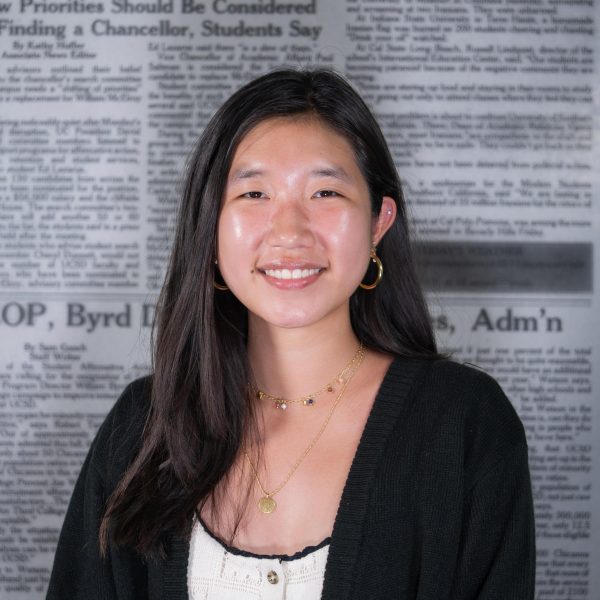
A couple of weeks ago, I had the opportunity to sit down with Ayumi Matsuda-Rivero, a seventh-year sociology Ph.D. candidate, to discuss her dissertation on the interplay between humor, pop culture, and multiracial identity. Her research uses data she collected by compiling user content on TikTok and conducting personal interviews with UC San Diego students to examine humor as a tool for identity formation.
“I think the most unexpected thing has been how important humor is to creating mixed-race identity — developing it, maintaining it, protecting it,” she said.
The idea for her dissertation first formed during her fourth year as a Ph.D. student. While scrolling through TikTok videos about multiracial identity, she noticed a common theme: Many creators were using humor as a way to relate with other mixed-race people.
“Humor has a lot of social power that people have overlooked,” Matsuda-Rivero said. “I think it is important to acknowledge that, because old-timey sociologists did not think that humor or pop culture were worth really exploring. That is changing rapidly. But this is society, right? This is part of what we deal with every day — why not look at it?”
Matsuda-Rivero decided to go into sociology because of the complex feelings she had about her own identity as a mixed person. When looking at existing research in the predominantly white field of sociology, she noticed a lack of studies on multiracial identity.
“I want to add to this — I feel like I have something worthwhile to say,” she said. “Part of it was driven by my own sense of identity, and the other part is that I think it’s interesting.”
Matsuda-Rivero’s research is grounded in critical multiracial theory, or “MultiCrit.” This theory emphasizes viewing society and race through a historical lens, recognizing that we live in a world where people are often assumed to be monoracial. “MultiCrit” also seeks to understand microracialization: being perceived as one race or another based on context.
Her work uses these key tenets to examine the relationship between humor and multiracial identity in the modern world. While Matsuda-Rivero’s work acknowledges that humor has always been a universal language, it specifically highlights how the rise of social media platforms such as Instagram and TikTok emphasize this phenomenon. These platforms allow and reward mixed-race creators that share their experiences through comedic storytelling, using humor as a tool to build connection and validate shared experiences.
Matsuda-Rivero’s research also reflects broader societal changes: As technology continues to advance and integrate into society, countless possibilities open up in this area of research. As a member of the next generation of researchers, she brings new perspectives that challenge antiquated ideas about methods and broaden the field of sociology.
For Matsuda-Rivero, TikTok was the natural site to collect videos — though unconventional in the research field — because of its popularity. Matsuda-Rivero has been gathering hundreds of TikTok videos since the Covid-19 pandemic. In addition to these TikTok videos, she has been interviewing mixed-race students at UCSD.
For Matsuda-Rivero, the core of her study lies in uplifting the experiences of mixed-race people. Because mixed-race identity formation remains largely unexplored in the field of sociology, she hopes her research will spark a larger effort to expand and highlight the topic. The goal is for her research to serve as a resource for future generations of mixed-race people and validate their experiences, just like it has validated hers.
“The things that I am uncovering and writing and presenting in an academic way, these are things that I have always kind of felt and known, but haven’t had the language or the academic language to actually express it,” Matsuda-Rivero said.