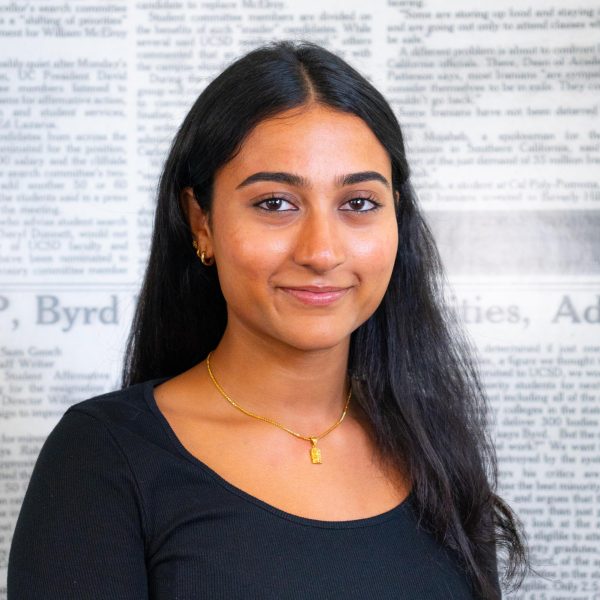
Sometimes, history feels fragmented. Catherine Potmesil, a seventh-year Ph.D. candidate in UC San Diego’s history department and daughter of a Vietnamese refugee, is figuring out how to address the holes in her own history. From working as a professor at a local community college to being a teaching assistant at UCSD, Potmesil is determined to inspire students to learn more about themselves.
Potmesil’s research focuses on critical refugee studies with special attention to Southeast Asian communities. Using firsthand interviews, Potmesil fills the gaps in historical archives documenting the post-Vietnam War experiences of Southeast Asian refugees, both in and out of refugee camps.
“When [refugees] build and talk about their experiences from memory, they are engaging in a form of knowledge production,” she said.
Potmesil is constantly looking for ways to hear refugee stories from refugees themselves. Growing up, she heard these firsthand accounts from her mother.
“My mom would always tell me as a kid, when I was 10 or 11 and trying to do math homework, ‘When I was your age, I was in a refugee camp, so you better be grateful,’” Potmesil said.
Raised in San Jose, California, a place with a vibrant Vietnamese population, Potmesil had been surrounded by people from similar backgrounds. When she began studying history as an undergraduate student at UC Santa Cruz, she encountered much more ethnic diversity in her community.
To see Vietnam for herself, Potmesil went with her mother to visit the refugee camp where she once lived. When they followed the directions, however, they found themselves at a strip of empty land covered with barbed wire.
People living in the area informed Potmesil and her mother that the refugee camp had been demolished a few months prior.
Although her mother did not have an outward reaction, Potmesil began to sob, devastated by the discovery.
“From what I’m seeing, the Vietnam that existed in the minds of these refugees is gone,” Potmesil explained. “That leaves a lot of second-generation folks kind of looking for something that doesn’t exist anymore. In a lot of ways, they’re looking for ghosts.”
The significance of second-generation memory is part of Potmesil’s research focus.
“I could not articulate why I was feeling such a sense of loss,” Potmesil said, reflecting on the reality that many of her second-generation interviewees shared the same sentiments.
Potmesil’s vision of refugee studies is for people to see past the traditional refugee narrative and its emphasis on resettlement in places like the U.S. as the end goal. By looking at how refugees built their own communities and developed a sense of belonging in these transient spaces, she seeks to reshape refugee studies in a way that researches communities themselves, rather than just their circumstances.
“Lots of scholars talk about this condition of statelessness that exists and that sort of violence that [results from] military violence and displacement,” Potmesil said. The existing research, however, centers colonial narratives; she believes this neglects much of the refugee experience and tries to counter this with her research.
“I am more looking at the bigger picture of legacies of U.S. colonialism and drawing on how these camps are actually more than just a temporary space,” Potmesil said.
Creating a whole picture of history requires more than just classic interview testimonials. Potmesil has found nontraditional modes of collecting knowledge, such as digital communities or art pieces, to be invaluable. Written discourse on platforms like Facebook hosts a wealth of information that is shared between older generations and younger people. These conversations offer Potmesil another dimension from which to view refugee experiences.
“I want to avoid this idea of extracting knowledge from communities,” she said.
In her interviews, she hopes to uphold these same principles: “I facilitate interviews in a way that ensures that [interviewees] have full ownership over that.”
Potmesil acknowledges the dichotomy between her goal to increase the accessibility of historical knowledge and completing her Ph.D. at a university with a colonial academic practice.
“This type of knowledge often reaffirms a colonial sense of holding power and keeping it behind tuition,” she said. “I’m trying to take an approach in which I can make knowledge more accessible.”
Potmesil is currently working on her dissertation as a step toward achieving the goal of making her community’s history better known.
“Speaking as someone from the community, I want to ensure that the community is able to articulate these things on their own terms rather than a sort of traditional academic term,” Potmesil said. “I want to make sure that these voices are not just used in a project, but that they are speaking.”