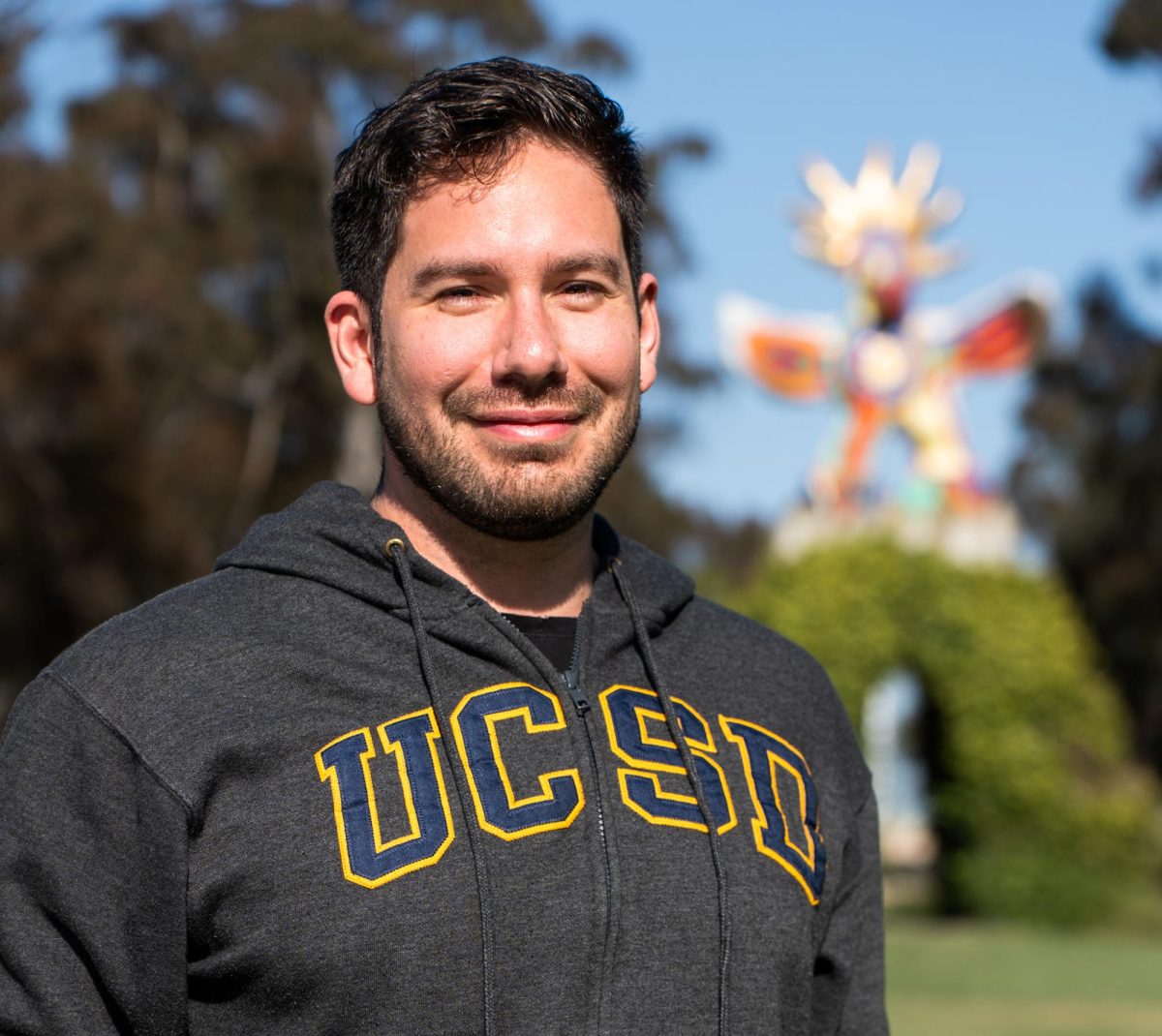
All Revelle College junior Thomas Dadourian needs for his new show — “Will It Chop” — is a samurai sword. But Student-Run Television, which is scheduled to resume programming on Channel 18 this week, will need more than that to overcome a tumultuous history and regain campus recognition.
Several members of A.S. Council may face impeachment, if their attendance records at Wednesday-night council meetings do not improve. According to the organization’s attendance policy, each member is allowed up to three absences per year.
If a member accrues more than three absences, he or she is eligible to be nominated for impeachment. This policy is usually enforced by the A.S. advocate general, a position which was vacant during Fall Quarter 2009.
However, new A.S. Advocate General Parminder Sandhu — appointed by the A.S. Council the first meeting of Winter Quarter — said he will begin the impeachment process for any members currently over the allowable limit if they receive additional absences.
The impeachment process begins when the advocate general submits an article of impeachment to congress. If two-thirds of the council votes to pass the article, it will be filed with the A.S. Judicial Board, which will then make the ruling.
“I feel the number of absences has been an impediment,” said Sandhu. “If you’re not at meetings, it’s hard to do business.”
Seven voting members on the council have three or more absences, and will face impeachment if they receive any more. These members include Biological Sciences Senator John Ehrhart (7.5 absences), Sixth College Senator John Condello (5.5 absences) and Thurgood Marshall College Senator Brian McEuen (4.5 absences).
Campuswide Senator Tobias Haglund and Muir College Senator Ryan O’Rear have all accrued 3.5 absences, and Campuswide Senator Carli Thomas has three.
One-half of an absence indicates that the councilmember stayed for only part of the meeting.
Eight nonvoting members — including AVP Concerts and Events Alex Bramwell, AVP Student Advocacy Chris Cruz, AVP Enterprise Operations Rishi Ghosh, AVP College Affairs James Lintern, AVP Diversity Affairs Jasmine Phillips, AVP Academic Affairs Jordan Taylor, AVP Local Affairs Aries Yumul and AVP Athletic Relations Donald Zelaya, have three or more absences as well.
Four voting members, including Social Sciences Senator Irfan Ahmed, Warren College Senator Josh Grossman, Arts and Humanities Senator Omar Khan and Campuswide Senator Bryant Pena, as well as one nonvoting member, AVP of Student Organizations Andrew Ang, are all one absence away from eligibility for impeachment.
The nonvoting members are currently moving to write an amendment into the A.S. Constitution that will not require them to attend meetings. This proposal will be discussed at this Wednesday’s meeting.
According to A.S. President Utsav Gupta, the A.S. Constitution does not allow for associate vice presidents to be impeached. He said they can only be removed by a resolution calling for an AVP’s removal.
Sandhu said he begin the impeachment process until after Week Three, meeting in order to allow time for councilmembers to clear previously unexcused absences.
At the first Sun God forum of the year, councilmembers complained that they were limited by security regulations. Two years after the administration pressured A.S. Concerts and Events into instituting a complete makeover of the annual Sun God Festival — tightening security and confining the festival to RIMAC Field — councilmembers are still trying to live up to A.S. President Utsav Gupta’s famous campaign promise to “uncage Sun God”.
Core members of A.S. Concerts and Events met with interested students at the first Sun God Festival 2010 Open Forum, held on Jan. 15, to discuss plans for this year’s concert format.
The majority of the two-hour town-hall meeting focused on the inefficient entrance policy and the diminished role of student organizations at the 2009 festival — as well as the possible inclusion of a Bear Garden in 2010.
AVP Concerts and Events Alex Bramwell said he is reevaluating the entrance policy — the issue that received the most attention at the forum. At last year’s festival, 19,000 students waited in line for up to four hours on the day of the event to receive their wristbands, due to unstrategic buildup of frantic students.
“Last year, there were about 1,000 student wristbands that we didn’t give out,” Bramwell said. “If people came at 1 p.m. in the afternoon, they got their wristbands immediately. But some people waited for two hours because they were afraid we would run out.”
Campus Events Manager Alex Kushner said an ideal entry policy would be where students could go straight from class to the festival without waiting in long lines. In 2008, students could pick up wristbands in the week leading up to Sun God, but A.S. Council ran out before the concert.
“The biggest fear we have is that we give out wristbands during the week, and then people don’t show up for the event,” Kushner said.
One student at the forum suggested that A.S. Council set up a wristband tracker on Facebook, so that people could log on the day of the festival and see how many tickets were still available.
In addition to entrance logistics, forum attendees discussed the declining role of student organizations ever since the festival was first confined to RIMAC Field in 2008. Last year, only four student orgs set up booths.
Bramwell said that A.S. Concerts and Events is looking into making the booths — which were moved to the west end of RIMAC Field last year — free for student orgs as an incentive.
Kushner noted that, as evidenced by last year’s festival, it is difficult for student orgs to generate competitive interest with the festival’s large-scale activities, like an inflatable obstacle course, a rock climbing wall and a dance tent.
“For the past 28 years, student organizations have been able to come up with something cool to attract students,” Kushner said. “But when there are 10,000 people heading over to the dance tent, it’s hard to compete.”
However, according to Gupta, this year’s Sun God will incorporate student organizations by allowing the setup of booths outside of RIMAC Field, on Library Walk.
Last year’s event marked the second Sun God Festival enclosed entirely by RIMAC Field. According to Bramwell, the A.S. Council is open to fielding events such as a Bear Garden in other locations on campus, but pressure from the administration to maximize security makes these activities unrealistic — despite campaign promises from Gupta to “uncage” the festival.
“Not having the feeling of Sun God on campus has been the No. 1 complaint,” Bramwell said. “But having people wandering around in a free-for-all is what we’re trying to avoid.”
According to Gupta, this year’s Sun God will actually be more of a campuswide event, with student orgs and college councils adding their own events.
“We’re not going to be able to bring back the smaller daytime concerts [in Price Center],” Gupta said. “But in terms of the rest of it, like booths on Library Walk, we’re bringing those back.”
Kushner expressed doubts about the ability to of orgs to handle the large crowds that turn out for the festival.
“We’re not in the business of preventing people from doing what they want,” he said. “But ... can student orgs weather the storm of [a Sun God-sized] onslaught?”
You may have seen him during UCSD’s first-day walkout or even leading discussions at various teach-ins since — probably in his signature short-sleeved button-up (variation of plaid, untucked) and jeans (always a faded blue). Despite his soft-spoken and level-tempered demeanor, professor Jorge Mariscal is a tenacious voice for social justice at the university.
Maybe it’s the inflated La Jolla gas prices. Or perhaps it’s the fact that it takes a hopeless half-hour to score a spot at Hopkins parking structure. Either way, one thing’s clear: Bicycles are booming.
But with popularity comes problems. The number of bike thefts on campus has risen in over the past year, and bike-related accidents are more frequent due to sheer number. But besides theft and bloody Library Walk collisions, bikers have also (ironically) had issues with parking. According to UCSD bicycle enforcement officer Ian Happle, parking is one of the more common, everyday obstacles that the eco-friendly alternative presents.
UCSD bicycle enforcement officers will impound any bicycles obstructing handicap ramps, fire exits or campus artwork. Bikes with flat tires, excessive dust or missing parts are usually tacked with a warning notice because their details indicate abandonment — and if these bikes aren’t fixed or relocated soon enough, they’ll soon be whisked away as well.
But at least your old friend will be going to a good cause. Impounded bikes are currently donated to the Donovan State Correctional facility in southeast San Diego, where inmates refurbish the bikes to send to children and nonprofit organizations. Bikes that can’t be fixed — no matter how many inmates grease their parts — are stored for the UCSD engineering department’s annual Junkyard Derby in May.
[caption id="attachment_13109" align="alignleft" width="226" caption="Brown bag the booze beforehand and you’ll be guaranteed a night brimming with the best kind of buzz: drunk renditions of your favorite Christina Aguilera single. J Music Studio 4620 Convoy St. San Diego, CA 92111 (858) 292-0759"][/caption]
To most San Diegans, the neon Korean characters hanging above J Music Studio are a testament to the modest charm inside. If it weren’t for the supplemental “Music Studios” afterthought, it’s doubtful anyone would even stop to peak inside.
But allow me to show you the light: J Music Studio is a diamond among all those mysterious Convoy St. gems, existing for what seems to be a sole purpose of letting patrons get sloppy drunk and sing like they were in the privacy of their own shower.
Upon entering the long-time San Diego establishment, karaoke hopefuls are offered a modest greeting: a small, cramped foyer, undecorated walls and a simple front counter manned by a tiny old Asian lady who speaks very little English. After a few moments of awkward communication, she will lead you down a hallway to a small, glass-encased room; all the while ignoring the indiscrete brown bags you and your friends are juggling. Once she’s closed the door, the boozing and belting can begin.
Unlike American romantic-comedy karaoke bars, where singing is often reserved for one brave volunteer on a center stage, J Music Studio styles its establishment on authentic Asian karaoke lounges. For an hourly rate, customers can rent out a private room stocked with a microphone, television, song menu, wrap-around couch and glamorous disco ball — fitting anywhere from four to 15, depending on if you’re going for intimate get-together or sweaty nightclub.
J Music Studio is intent on maintaining your privacy throughout the night — even when you’ve spilled so much beer your socks get soggy (to the tune of your favorite Journey ballad, of course).
This karaoke paradise is conveniently located amid several other indie Asian delights (read: Yogurt World, Tapioca Express, Tofu House), so you can enjoy dinner and drinks before you embark on your personalized musical journey — complete with a visual montage of ’90s-era Koreans interacting with nature behind lyrical prompts.
After a hectic finals week, college students can turn from Red Bull and Rockstar to a weekend alternative: Energy drinks like Four and Joose are infused with up to 12-percent alcohol, so that reaching the 4 a.m. mark can be a breeze. However, the half-decade old product — a popular and toxic combination — may soon be banned.
The Food and Drug Administration requested evidence on Nov. 13 from all companies that produce alcopop energy drinks — which also include 3AM Vodka and Liquid Charge — that their products are unharmful to consumers.
The FDA has never deemed caffeine safe in any amount when mixed with alcoholic beverages. Under the Federal Food, Drug and Cosmetic Act of 1938, any substance added to food is considered unsafe and unlawful until is has been approved by FDA regulation, and is subject to prior sanction before it can be stamped as Generally Recognized As Safe.
The FDA said in a press release that it was unaware of any existing GRAS under which the beverage would be deemed legal. If alcoholic energy-drink drink producers fail to provide evidence of either sanctions, the FDA will deem their beverages illegal and halt all sales.
However, a task force consisting of 18 attorney generals from states including California and New York — along with the San Francisco city attorney — are encouraging the FDA to inspect the combination further.
“There is a strong emerging consensus of scientific opinion that the combination of caffeine and alcohol … poses a serious public health risk,” task force members said in a letter to the FDA on Sept. 25.
Members also recognized that the drink’s stimulants — which often include taurine, ginsing and guarana in addition to caffeine — can reduce self-awareness of being drunk, which could lead to an increase in driving under the influence, sexual assault and other alcohol-related crimes.
“You do feel like you’re sober when you’ve been drinking energy drinks and alcohol — even when you’re drunk,” Eleanor Roosevelt College sophomore Linda Suh said.
According to the FDA statistics, U.S. college students tend to combine caffeine and alcohol 26 percent of the times that they choose to drink.
“There [are] always alcohol and energy drinks at parties,” Eleanor Roosevelt College sophomore Danielle Jenné said. “It’s ineffective to try to stop something that’s going to happen anyway. The government needs to mind its own business.”
Twenty-seven drink manufacturers — including United Brands Company, Inc. and the P.I.N.K. Spirits Company/Prohibition Beverage Inc. — have been given 30 days to comply with the FDA’s request. They must supply evidence that their products are previously sanctioned or GRAS — or they will be outlawed.
Suh said she is unsure a ban on alcoholic energy drinks would discourage college students from consuming a mix of alcohol and caffeine — even if they are not packaged and sold together.
“People mix alcohol and Red Bull at parties all the time,” Suh said. “A ban on alcoholic energy drinks won’t change that. It’s just a waste of time.”
Revelle College sophomore Nancy Carmona agreed that banning alcoholic energy drinks should not ease the fears of the FDA or the task force.
“Instead of completely banning the drinks, the government needs to spread awareness of the effects of mixing those two substances,” Carmona said. “That way, people can be responsible for their actions, since they’re going to be mixing the two anyway.”
The FDA expressed that if caffeinated alcohol drinks are still deemed unsafe within a month, manufacturers will most likely be forced to halt production.
Anheuser-Busch Co. and MillerCoors, the nation’s two largest brewers, halted the sale of alcoholic energy drinks last year due to the New York Attorney General’s concerns that the drink’s health effects were being misrepresented, and that it was being marketed to underage drinkers.
The Associated Students could soon see roughly $140,000 in debt accumulated by the Grove Cafe reflected on their annual operating budget. Though the Student Affairs Office has absorbed the debt generated by the eatery for the last several years, university officials recently initiated an effort to clear the deficit from their expenses.
According to Student Life Business Director John Hughes, Vice Chancellor of Student Affairs Penny Rue’s office recently requested that his department identify any long-running deficits within its operating expenses.
Hughes said the debt accrued by the Grove Cafe, as well as a similar amount hanging over Cafe Vita — the Graduate Student Association’s own coffee house in east campus — immediately caught his attention.
“When the university examines its budget and looks at its negative deficits, things like the Grove Cafe jump off the page,” Hughes said.
According to Hughes, Student Life Director of Finances Dawn Buttrell asked that he explore ways to remedy the outstanding deficits. Earlier this month, Hughes met with A.S. President Utsav Gupta to discuss transferring the Grove’s debt from the university’s budget to that of the A.S. Council.
Hughes said both the undergraduate council and the GSA would be able to absorb the deficits accrued by their coffee shops without difficulty, given the scope of their financial resources.
“A.S. and GSA are sitting on large reserves, relatively speaking,” Hughes said. “So the vice chancellor’s office is saying, ‘Why don’t you just move that deficit to your own budget?’”
The A.S. Council manages a total operating budget of over $3.1 million each year, the majority of which is derived from a quarterly student activity fee. Additionally, the council possesses a reserve fund of roughly $1 million.
“It’s a pretty logical choice for [the university] to ask us to bear the burden of our own debt,” Gupta said.
The A.S. Council and the GSA both operate as university departments. Much of their finances are managed by the university, including payroll for A.S. and GSA staff members and long-term financial investments, which are carried out by the UC Office of the President.
Their department status also renders all debts accrued by certain A.S. and GSA enterprises the immediate financial responsibility of the university. Though the Grove Cafe is technically owned and operated by the A.S. Council, the eatery’s sizeable debt is not currently reflected in the council’s budget. Instead, it is reflected in a university account.
According to Hughes, the university is willing to support departmental debts to a certain extent, but these deficits eventually begin to yield negative financial repercussions for the university if they are allowed to grow too large.
This concern arises specifically when considering the university’s Short Term Investment Pool — a program through which UCOP financial managers annually invest departmental revenue from each campus, then transfer two percent of any returns back to the departments. When the university carries deficits — such as those of the Grove Cafe and Cafe Vita — they reflect negatively on departmental STIP returns.
According to Hughes, by maintaining a Grove deficit on its budget, the Student Affairs Office loses roughly $2,800 each year in STIP funds. Though the figure is relatively small in comparison to the university’s total operating budget, Hughes said clearing the budget of deficits is simply good bookkeeping.
Gupta said he believes the university is moving to shore up its expenses due to the systemwide budget crisis.
“The university overall is worried about debt accruing against their accounts, especially when they’re looking at extensive budget cuts going into the future,” Gupta said. “They’re trying to save any amount of money they can, anywhere; $3,000 may not seem like a lot to us, but to them it could be enough to save a particular program.”
Gupta said he expects the university to pursue other similar debt-reduction efforts in the near future.
“There are actual academic departments that are in debt to the university,” Gupta said. “It will be interesting to see how the university starts moving forward on all of these debts. When the budget gets cut, you start looking at where your negatives are. They’re going to be going after places where there is debt, wherever it may lie. It’s more a fiscal calculation than anything else.”
After 15 years of planning, construction finally began last month to turn the fourth slice of “Wedge” lot — 82,000 square feet of open space in Eleanor Roosevelt College — into a sustainable park area.
The site attracted the attention of student environmentalists last year when the university proposed to turn the space — located just east of North Torrey Pines Rd. — into a parking lot. Organizations like Greeks Gone Green and the Compost Team petitioned the A.S. Council, arguing that the Wedge should fulfill its original purpose of becoming a sustainable space. Their actions drew the attention of Chancellor Marye Anne Fox, who supported the project as well.
UCSD Physical Planning specialists first envisioned the Wedge in 1994 as consisting of four “phases” of construction in ERC between Ridge Walk and North Torrey Pines Rd. Phases I and II — which covered ERC’s main stairs and the winding path north of Cafe Ventanas — were realized in 2003, while Phase III was completed in 2007.
However, the university lacked financial support for the space between the Village and ERC, and construction remained idle until student protests drew attention to the area.
“Student groups paid attention and got people to notice,” Todd Pitman, senior planner for UCSD Physical Planning and chair of the Open Space Committee, said. “Chancellor Fox then decided that construction should begin as well.”
According to Pitman, the long-term goals for the area include creating a functional space with solar capabilities, natural seating and pedestrian walkways. Additionally, runoff water from other parts of campus will be reclaimed to irrigate the area’s landscaping.
“This project is good for the public’s perception of UCSD,” Pitman said. “We would be showing that we practice what we preach by having a sustainable area.”
The university still lacks the funding for all these goals to be met, but Assistant Vice Chancellor of Physical and Community Planning Brian D. Gregory said there is enough to convert the existing parking lot into a sustainable area.
“We don’t have the money to do the complete project, which would cost over $2 million, and it is going to take time to get additional money,” Gregory said.
The first part of “Wedge Phase IV” consists of ripping out the asphalt, planting native coastal foliage and laying down pathways and infrastructure for future projects. According to Gregory, around $500,000 of the $900,000 bill will come from Housing and Dining Services, while the rest will be drawn from campuswide funds distributed at the chancellor’s discretion.
Turner Construction Company began the project in October, and landscape architects Spurlock Poirier worked with the Physical Planning Office to plan Phase IV. Construction is set for completion by January 2010.