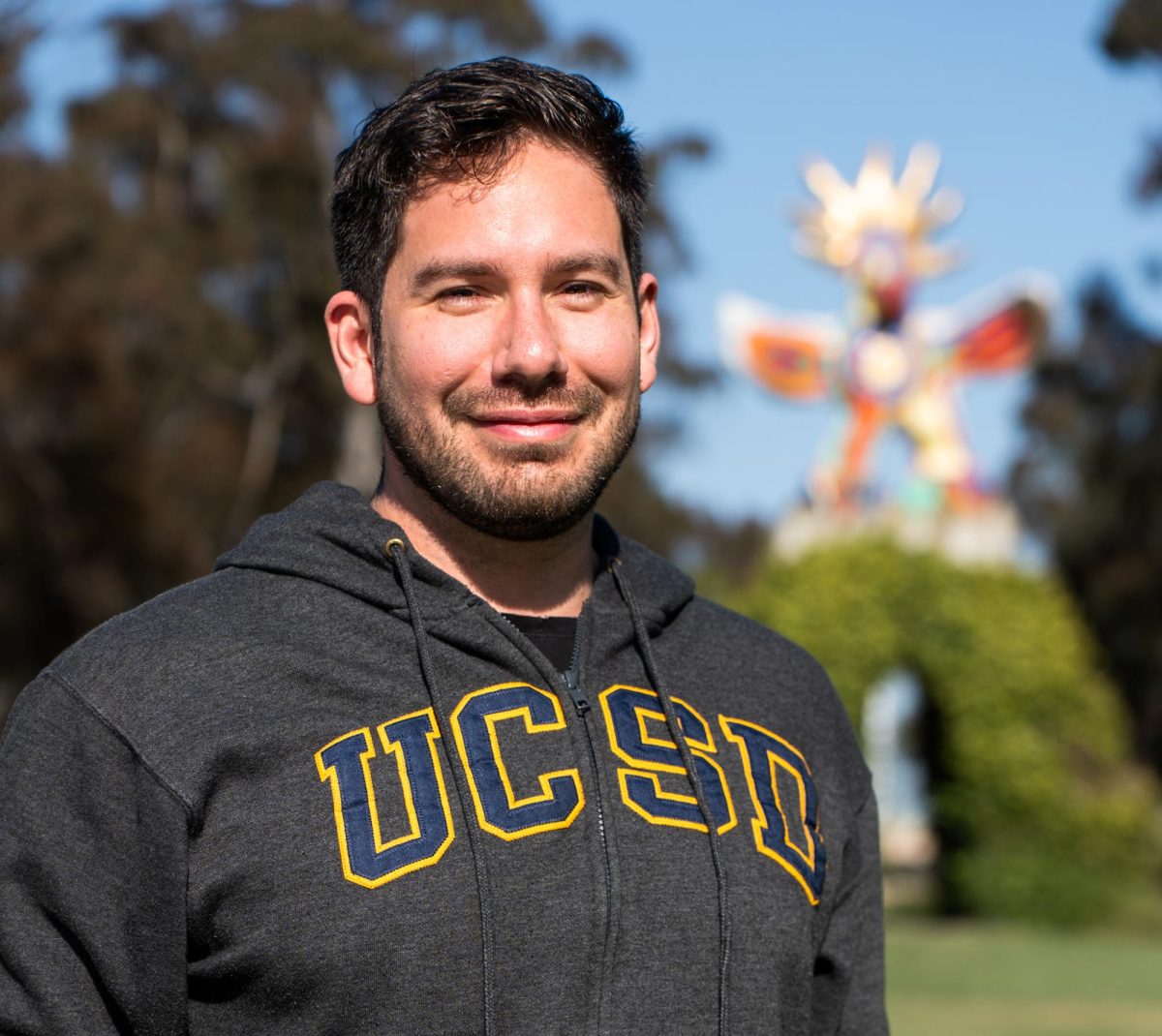
When Susy Bielak created the collection “Gestures with Flowers and Hands,” mixed media drawings of politicians shaking hands and offering flowers to allies, she focused on the symbolism of hands and the stories they tell through their actions. But this depiction of ceremonial handshakes and flower arrangements in dark charcoal grays and vibrant reds only foreshadowed the applause and congratulatory bouquets she was soon to receive.
In fact, on Sept. 2 —when the UCSD graduate was named New Artist of the Year by the San Diego Fine Art Society — the appreciation poured in. To commemorate the start of San Diego Art Month, the first annual Fine Arts Awards recognized notable local artists whose projects enrich the San Diego community. Winners were chosen via a public vote on the Society’s website. Bielak, one of four recipients, had her work showcased as part of a collection entitled “Here Not There,” at the La Jolla galleries of the San Diego Museum of Contemporary Art until Sept. 19.
Born in Mexico City and raised in Pennsylvania, Bielak relocated to San Diego four years ago to pursue a masters degree in fine arts, which she received in 2009. Due to her diverse upbringing, Bielak said that “questions of hybrid identity and issues of space have long propelled my work.”
Her artwork focuses on exposing the contrast between the personal and the social elements of society. For example, her series of monotypes entitled “Aerial Gaze” depicts people walking on a sidewalk as seen from a second story window.
“The project offers the proximity to witness people intimately and the distance to envision them as patterns,” she said.
Bielak frequently employs uncommon techniques to produce her artwork. One of her multimedia projects, entitled “Quake/Temblor,” uses old photos and seismographic records to portray the widespread effects of earthquakes on both the human and geographic levels. In the past she has applied sketchbook text and drawings onto bus doors, and drawn with water on opaque plastic to reference subtleties of memory.
“My projects often incorporate nontraditional materials and processes in order to best render an idea,” she said.
Bielak explained that her unconventional use of materials and her wide array of subjects make her work more relatable, and allow her to connect with her audience in myriad ways.
“I’m touched when the work strikes a chord with audience members—when my projects propel questions, inspire reflection, or invite people to see a social issue in a new way,” she said.
Bielak, now Associate Director of Art and Technology at Sixth College, credits UCSD’s research capability as one of the factors that aided her career.
“Having access to the resources and minds of this campus allowed me to take a huge leap forward in the scope of my work,” she said.
Bielak’s newest project is a work in progress that consists of drawings of materials taken from her kitchen cupboard and medicine cabinet, as well as engravings on kitchen tables.
“These experiments are exciting,” she says, as is “the process” of creating the art itself.
But in both art and life, finding the right “process” to achieve a goal can be half the battle.
“Figure out what you really want,” Bielak advised, “and keep pushing until you get it.”
A mere 25 minutes away from campus lies an NRA-lover’s wet dream, sitting inconspicuously off Highway 76 toward Oceanside. The Iron Sights Shooting Range offers a laid-back atmosphere and chance to spend an afternoon engaging in one of America’s favorite hardcore pastimes: shooting big-ass guns at things and feeling like a baller for as cheap as $12, if you have your own guns and ammunition.
As a newbie to the world of weaponry, I took a few friends for moral support when I visited the range, but the guys behind the counter quickly put us at ease by relentlessly cracking jokes. Still, they clearly knew their shit. After noticing that I was documenting the experience with iPhone pictures, an employee named Larry told me to put the phone away until we got into the shooting lanes and warned me that he wouldn’t hesitate to fight a woman who tried to “case his joint.”
Before I could summon up the cop-action movie references necessary to figure out what the hell he was talking about, I was asked to select my weapon of choice from the endless rows of seemingly identical guns. I arbitrarily picked the 9mm X-Five Competition, thinking that it looked basic yet BAMF enough, while my friend went with a menacing shotgun, the Remington 870.
As someone who’s never held a gun before in my life, the informality of the process was slightly unsettling. After filling out a short questionnaire in which I confirmed that I had never been convicted of a felony or misdemeanor, had never been diagnosed with a mental illness and wasn’t addicted to drugs or alcohol (because hey, it’s not alcoholism until you graduate), I suddenly found myself standing in a room full of people, a live and fully loaded weapon surreally resting in my sweaty palm.
We ditched the generic targets circle-shaped targets, opting instead for posters depicting a cartoonish zombie and a blown-up photograph of “Wifebeater Chuck” — a sneering, mullet-sporting thug pointing his glock straight for your face and wearing (you guessed it) a wifebeater.
“Hold the gun like this with your right hand,” Larry demonstrated, calmly. “Then wrap your left hand around it like this. Don’t do it like this, or else you’ll blow your thumb off.”
Next thing I knew, I had my protective head and eye gear on and was headed straight for the 24-lane indoor shooting range. We were assigned to lane six, hung up our target and loaded our guns. Larry handed over our ammunition — 125 bullets total between the three of us. Time to shoot some bitches.
Before coming to the range I had envisioned being barely able to restrain myself from running around in circles, recklessly shooting into the air and screaming “Yippiekayay, motherfuckers!” at the top of my lungs, but now that I actually had the cold steel in my hands, all I wanted to do was make it out of the building with both my thumbs intact. Yet, after unloading the first round of bullets on my 9mm — and having a fair amount actually impale Wifebeater Chuck — I relaxed a little and started enjoying myself.
Then came the fun part — time to shoot the rifle. Word to the wise: Shooting rifles is fun, but for the love of God, lean into the damn thing and place all your weight against it before you pull the trigger, or the gun will shoot back into your shoulder and leave you bruised for days. Despite the pain, I’d say spraying the targets with enough bullets to take down a whole army of zombies was the highlight of the experience.
As my adventure came to a close and I walked back out to the shop and removed my headphones, Larry glanced up at my poker-red ears.
“The police say that’s the sign of a true methhead. … So next time you score [some meth], come on over here and we’ll have some real fun.”
Though the whole experience turned out to be pricier than expected — $86 to rent guns, ammunition and shooting time for three people — it was a pretty badass and exciting way to spend a weekend afternoon, and something tells me that I’ll be back for more.
It’s a Saturday night and a week before the start of school — 11 weeks before the dreaded promise of finals — but Thurgood Marshall sophomore Jennifer Taylor* wants to secure her Adderall (also known as amphetamine-dextroamphetamine) supply before cartloads of anxiety-ridden college students flock to her already overdrawn supplier, jacking up prices. A smart and economical move — if you ignore the legality of the issue.
Adderall is classified as a stimulant or a drug that temporarily improves brain function in regards to memory and focus. When taken two to three times daily as prescribed, Adderall should allow patients to control previously erratic actions.
Normally, Adderall is used to treat those who suffer from Attention Deficient Disorder (ADD), Attention Deficit Hyperactivity Disorder (ADHD) and narcolepsy. A less lawful and more frowned-upon use is as a main ingredient in a Lohan-esque amphetamine binge and a mechanism for rapid weight loss. College students, however, seem to have adopted a different take.
“Your brain moves faster. I’m able to think faster — to read faster,” Taylor said. “What would take me an hour to read might take me half an hour to read. You’re really focused on what you’re doing.”
THE HYPE
Taylor isn’t alone — originally the collegiate dark horse in comparison to drugs like alcohol and marijuana, Adderall use among adults has been steadily increasing over the past decade, and usage has almost doubled since the year 2000, according to data recently released by Medco Health Solutions. This study drug has a wide basis of appeal. It’s relatively inexpensive: Pills range from $3 each to a high of $10 or $15, depending on how close midterms or finals are.
Bryan Marks*, a Muir College sophomore, obtains most of his Adderall from friends who have prescriptions, or friends of friends with prescriptions. In turn, Marks shares the powdered love by providing Adderall to friends without similar means — at an inflated price, of course. It trickles down the distribution chain: The prescription holder (usually oblivious of the value of the tiny blue pills) offloads his Adderall for a trivial amount (read: nickels and dimes); the purchaser then ups the price to a full bill as the next guy charges a $5. Marks even admits to upping Adderall prices to ridiculous amounts during finals season to score a larger profit. Everyone wins — except the consumer.
“I have more friends who abuse Adderall rather than take it,” Marks said. “Essentially, they aren’t taking it because they suffer from ADHD.”
So what’s with the excessive pill popping? “They take it because they’re studying. The people who take Adderall and party are ... I don’t know too many people who use amphetamines as a foundation for their drinking.”
READING BETWEEN THE LINES
Adderall (and its extended-release sibling, Adderall XR) comes saddled with a weighty list of side effects: Many self-described “honest” students are outraged at the advantage Adderall users are given in the classroom setting, assigning Adderall users an undesirable social stigma. Selling Adderall is considered a felony that can earn you a $10,000 fine and up to 45 years in prison.
Additionally, the U.S. National Library of Medicine warns consumers that Adderall is known to induce nervousness, headaches, stomach pain and nausea. In some cases, an overdose could prove fatal, which will definitely put a downer on your upper.
Not that such ominous warnings come as a surprise for Adderall consumers, or even act as a proper deterrent — an alarming number of more common prescription drugs like Xanax and Prozac have been known to cause fatalities when consumed by less-than-healthy or undiscerning patients. Addiction and dependency is the more pressing concern for the average user who — according to psychiatry professor Marc Schuckit — may find himself experiencing heightened paranoia and aggression as he ups dosage for increased effect.
“If I take a high dose of Adderall or a high dose of speed on the street, I can die exactly the same way, with convulsions and cardiac arrhythmias,” Schuckit said. “If I take regular doses for a high of Adderall or regular doses for a high of amphetamine I might buy on the street, I am likely to become very paranoid, believing people are trying to harm me and maybe hearing voices. It’s temporary — it will go away, but you can be pretty impaired while it’s there.”
Adderall, Schuckit explained, is a legalized version of speed, sort of. It’s not the drug itself that’s illegal, it’s the way people take it. Both are amphetamines — which can be disastrous in large quantities, regardless of whether you suffer from ADD or not. But what about when students take Adderall in measured, low doses? “I can’t help anymore, I’m sorry,” Schuckit replies.
Nancy Downs, an associate physician diplomat in UCSD’s psychiatry department, agreed that using Adderall at varying frequencies without being prescribed — in other words, the college user who wants it for an edge on finals — is harmful.
Downs explained that stimulants could cause cardiac Small Vessel Disease, when a user’s small vessels — the arterioles — get clogged through repeated stimulant use. Cardiac Small Vessel Disease can lead to a heart attack or result in acute chest pain. This condition is most common in cocaine users, Downs said, adding that she’s opting to discuss the effect of stimulants on users in very general terms rather than being Adderall-specific.
“Yes, stimulants do improve performance in healthy control subjects, unless they have one of underlying risk factors [such as anxiety], in which case it wouldn’t improve performance,” Downs said, “Absolutely. That’s why caffeine is so popular.”
Jaime Pineda, an associate professor of cognitive science, explained how Adderall functions: “Amphetamine causes neurotransmitter systems such as dopamine, norepinephrine and other biogenic amines to be released at the synapses.” In layman’s terms, Adderall — like cocaine and caffeine — targets the mesolimbic reward pathway and makes people feel good. And feeling good can be addicting.
There is some good news for Adderall users: According to the New York Times, Adderall is far less dangerous than cousin-drugs cocaine and methamphetamine. Additionally, the Times reports that Shire Pharmaceuticals Group, the makers of Adderall, have conducted medical research and deduced that the drug has no potential for addiction (though other studies have suggested otherwise). By no means is it risk free, but a relatively sunny 70 years of Adderall use by the general public indicates the drug’s unique dichotomous position as a study drug may be due, at least in part, to social stigma and moral disapproval rather than health implications.
THE COMEDOWN
Adderall hasn’t given Taylor any of Adderall’s notorious side effects of paranoia or isolation. When asked, during our now extensive walk, Taylor deadpanned. No. Of course she wasn’t hallucinating or feeling paranoid.
However, right before reaching her supplier’s door she reluctantly admitted, “I don’t feel comfortable going into a final without it. My grades are so much better now.” And with the drug’s identity in eternal limbo, who is to say cultural acceptance isn’t palpable? Everything in moderation.
With that, she turned the doorknob and walked through the doorway.
*Names have been changed to protect student’s identity.
Before I left to study abroad in Barcelona, everyone from my mom to my hairdresser Greg shared one common premonition: I was, without question, going to have the time of my life. The history, the tapas, the hombres — “oh,” Greg insisted, “the hombres!” — what a ball I’d have.
After promising to Skype often and smuggle soccer players in my suitcase come Christmas, I packed my room in milk crates and trash bags, and was gone.
Except the first few days didn’t quite turn out as planned. I wasn’t greeted at the terminal by a troop of World Cup champs. No charming caballero spared me the embarrassment of lugging a colossal orange suitcase down Barcelona’s ritziest street, hunched to the ground and sweating tears due to a broken handle. My first memories of tapas will forever reek of loneliness and jet-lag.
But best of all, I arrived homeless.
My first challenge in the city that sleeps in the middle of the afternoon was to find longer-term lodging other than the hostel bunk I had reserved prior to my departure. I’d tried in vain to track down an apartment on Craigslist in the weeks before I left, but the prospects of committing to live with strangers — and sending two months’ rent to an unknown across the Atlantic Ocean — were both pretty bleak.
And so I searched. And my bunkmate, Frank, a German exchange student who’d gotten in the day before with equally negligible planning and Spanish comprehension skills, searched with me. We scoured the local equivalent to Craigslist — a site called Loquo.com — employing such advanced search terms as “estudiante,” “chicos” (which, apparently, is seldom listed without being qualified by “gay”) and, in more desperate moments, “English,” to track somewhere to hang our respective hats.
Frank suggested early on that we visit some of the rooms together, which was fine by me. Our first stop: the apartment of a 29-year-old artist and teacher whose name eluded us. After being buzzed in and ascending the ill-lit staircase, though, we were taken by surprise: Anna (or Carla or Maria, but let’s stick with Anna), bless her soul, had long since waved her 20s a careless, cigarette-wielding goodbye.
Ignoring our feeble attempts at textbook-Spanish pleasantries, the woman stood at the entrance confused: There was only one room, but two of us. Thankfully, because “amigo” remains within the narrow bounds of my vocabulary, I was able to explain that I was only there as a friend. Not para mí.
Once the basics were settled, Anna told us to take a seat on the couch in her office. She rattled off the pertinent details in a weary, practiced monotone: no smoking, no fiestas, no loud music (especially not on Sunday), no guests unless they’re paying 15 Euros a night. Questions? No questions. Vamos.
The room itself was nothing remarkable. The flowery bedspread might not have suited Frank’s Teutonic sensibilities, and the lighting probably couldn’t have held a candle to Lindsay Lohan’s prison bungalow, but it certainly could have sufficed for a few months. Except, somehow, Anna’s insistence on padlocking the bedroom doors sort of eliminated any sense of rustic homeliness. And safety. We politely admired the washing machine and were on our way.
The next 72 hours of my life tell a story replete with confusion, heartbreak and occasionally indecent hallway ornamentation. Appraising a stranger’s home and sheepishly asking about their level of substance abuse is an awkward enough proposition at home, but with a second-grader’s vocabulary? It’s a lot worse. I promise.
Plus, the prospective housemates I’d met a couple nights before — ones who were the stuff of my study-abroad fantasy, as they were all from different countries and shared gourmet dinners in the living room — had just passed on me, doubtless due to my contemptible silence and awkwardness. Could asking a little about someone’s tesis really be that hard? It is called a tesis, isn’t it?
Except it didn’t have to be so terrible. Sometime in the middle of the third day, I was [Frank had already found a place by then. Bastard.] struck by inspiration in the form of a good friend of mine from school. With the dreadful days of recruitment fast-approaching for her, I’d gathered a rudimentary understanding of sorority attraction: Stop eating, start smiling and maybe pretend you love going to Big Bear, too. In other words, small talk.
Sure, it’s hard to keep the cheer alive when you’re craving a torta, but it’s worth it when the new girls are pretty. And my new apartment needed to be pretty.
After this, I schmoozed with the best of them, language barrier be damned. I attentively commented on Nuria’s charming balcony and San Francisco mug (“There it is, and here I am — Funny!”). I asked Kenneth, the architect, about his extensive CD collection (but he didn’t have WiFi; automatic no-go).
By the time I finally made it to the actually-charming duplex that I’ll be calling home for the rest of the year, making Spanish small-talk was a breeze. Maybe it’s an elementary-school lesson only necessary for an artless second grader, but it works for me: Showing a little genuine interest in someone is usually enough to land you right on your feet.
Gunning for re-election isn’t traditionally on the agenda of an A.S. president. And it’s an especially bold move for Sixth College senior and current president Utsav Gupta, considering his largely unpopular Winter Quarter decision to freeze funding for all student publications, in response to hurtful comments from controversial humor newspaper the Koala.
“I looked at the candidates running for president this year, and honestly, I was a little distressed,” Gupta said. “None of them had cabinet-level experience, most were only in [the A.S. Council] for one year, and most didn’t do much while they were there.”
Gupta swept the vote last spring, even after being rejected by the formerly popular slate Student Voice! as its official presidential candidate. Since then, he has spent his fourth year as a bioengineering major balancing a hefty course load with an almost impossible dedication to the A.S. Council. Gupta said the position can be time-devouring — consuming anywhere from “30 hours on a good week to 80 hours on a bad week.”
As a result, he’s had to cut down the usual five to six classes he takes a quarter, forcing him to stay another year and allowing for a possible second term as president. Like most A.S. presidents before him, Gupta hasn’t been able to finish much of what he’s started — a classic turnover problem that could potentially be remedied by his re-election.
“He stuck to his promises,” Associate Vice President of Student Organizations Andrew Ang said. “He has a large staff: He created a committee to look into all his campaign promises. But I believe that they were started, and not fully completed, in the term he said they would be completed in.”
But Gupta said lofty goals shouldn’t be something candidates avoid.
“I think an advantage I’ve had is I’ve been able to specifically state what I want to do — I think it was something that differentiated me last year,” Gupta said. “My platforms have always been very ambitious and I think it was my largest criticism levied against me, but I think a lot of it can be achieved.”
Given another year, Gupta said could continue fighting the Sun God Festival back into an “uncaged” all-campus format and investigating the possibility of a Division-I football team at UCSD. He also created a network of local student leaders this year who could take further steps in educating regional politicians about UCSD’s economic benefits, and California voters about the importance of supporting higher education — a concrete approach to curbing the rise in student fees.
Gupta has also promised to keep Transportation and Parking Services from coercing the A.S. Council into a student fee referendum, fight for later hours at Geisel and continue looking into Greek/student-leadership housing.
According to Gupta, uncaging Sun God has been a gradual process that has met a lot of opposition. Though he’s brought back the Junkyard Derby to Library Walk, as well as daytime events to individual colleges, he said he was prevented from planting student-organization booths on Library Walk by the three other councilmembers most involved in planning the festival — in addition to Associate Vice Chancellor of Student Life Gary Ratcliff, who “waited until it was too late to change the direction of the booths.”
Though Gupta has been criticized by most fellow candidates for proposing to start a football team funded by student fees, he has remained firm in his belief that the student body should be able to vote on the matter.
The most glaringly unpopular period in Gupta’s presidency came in the weeks that followed Koala Editor in Chief Kris Gregorian’s Feb. 18 racial slur on Student-Run Television. Though SRTV’s contract had only just been renewed earlier that quarter, Gupta pulled the station’s plug instantly. Less than 24 hours later, he enacted a freeze on all media-organization funding.
The maneuver, according to Gupta, was under his jurisdiction. He cited Section II of the A.S. Constitution, which stipulates that the role of the council is to “create and execute programs which serve the collective interests of the undergraduate population.” Gupta said the media-org funding system was not serving the “collective interests” of the students.
Still, if he could go back, Gupta said he’d have done things a little differently.
“If I were to go back with the knowledge I have now, I probably wouldn’t have had such an extensive freeze on media-org funding,” he said. “I wouldn’t have let it go on for so long.”
According to presidential candidate and Sixth College Senator John Condello, the council’s loudest supporter of free speech, the media freeze was a well-intentioned but detrimental reflex.
“He’s a smart guy,” Condello said. “He doesn’t do anything without knowing months in advance. The only reactionary move that I’ve seen him take is the media freeze.”
After the freeze added uproar from media-org leaders to a campus climate the Black Student Union had declared “toxic,” Gupta hosted a public forum to discuss alternative possibilities for funding student media. The forum drew over 100 attendees — including members of the A.S. Council, the BSU and student publications — and resulted in the creation of a committee to create a list of alternatives.
In the end, after the committee and the A.S. Council voted overwhelmingly against a non-content-neutral “government speech model” proposed by consistent Gupta ally and Vice President of Finance and Resources Peter Benesch, the media freeze was lifted by default — and all that was left was a campuswide bitterness against Gupta and Benesch.
“There should be some discretion involved in funding media organizations beyond a fixed set, if that makes sense,” Gupta said. “Which is why I was advocating for the hybrid [government speech model] approach.”
Still, Gupta’s decision damaged the confidence of many media-org members and their supporters, who criticized the president for not prioritizing First Amendment principles and failing to make decisions on behalf of the entire student body.
“I previously regarded him as someone who was good for the students essentially, willing to listen to everyone and sit down and be reasonable about the situation,” said Muir Quarterly Editor in Chief Nicole Teixeira. “But as the whole push for the change in the media guidelines continued and he led that charge, my opinion of him changed drastically.”
Gupta has maintained that his actions were largely misunderstood.
“I’m hoping I can work to rebuild some of that trust again,” Gupta said. “I didn’t do some sort of backhanded committee process to try and get specific legislation passed — everything was out in the open. I wanted media orgs to be part of the process. I’m hoping as the emotionality of the situation dies down, people will be able to see the specific realities of what happened versus what’s being presented or misrepresented."
According to Benesch, much of Gupta’s day-to-day success as A.S. president is due to his knowledge of the bureaucracy within the council and the administration.
“Even if you ignore the fact that he was A.S. president for the last year, he literally has knowledge that no other candidate does — absolutely no other candidate,” Benesch said. “If you ask any other candidate, ‘How do you do X?’, they might give you an answer — but it’ll probably be BS. In all honesty, knowing how to do things is the most crucial thing to being a president in student government.”
In two short years on the heated A.S. Council floor, Thurgood Marshall College sophomore Brian McEuen has almost never slipped out of line. His words are few and carefully chosen, avoiding the emotional charge that often divides his fellow councilmembers and drags meetings on.
In fact, McEuen’s place at the table might go unnoticed by a student unfamiliar with the council — if not for his stature. He’s a born politician, with kind eyes and a dashing jawline. (The spitting image of current Vice President of Finance and Resources Peter Benesch — also known for his serene, sometimes slippery presence on the council).
You’d think McEuen was born for this. But when he was first recruited to UCSD by the men’s volleyball coach, the high-school senior never expected to end up in student government. However, he was cut after three short weeks as a Triton, and McEuen was soon hot on the hunt for a new team.
That’s when he headed to the fourth floor of Price Center East. He served as an A.S. freshman senator his first year, and has since moved into the position of Marshall College senator and senate vice chair.
All this, while juggling a Lambda Chi Alpha membership, UCSD club volleyball and a brewing den of homemade beer back home. (He is currently in the process of brewing his second batch, a red oak amber.)
McEuen has also taken an extremely active role in presenting student concerns to administrators: He sits on the Campus Affairs Committee, the Advisory Committee on Sustainability and the Registration Fee Advisory Committee.
Still, the senator’s decision to run for the council’s most powerful position — especially on a brand-new slate — was somewhat unexpected, considering he’s only a college senator going into his junior year. (Sixth College junior and fellow presidential candidate John Condello, a close friend of McEuen, is taking a similarly premature leap toward the top spot.)
The Student Voice! slate, which carried McEuen into senatorship last year, was doomed to disintegrate after independent candidate and current A.S. President Utsav Gupta won by a landslide last spring, leaving SV! candidate Erin Brodwin with only a few hundred votes.
So, looking for a fresh (and hopefully more popular) pitch, McEuen talked with friend and Associate Vice President of Student Orgs Andrew Ang about creating the Tritons First slate. From there, they started recruiting running mates.
“We started picking people — what I think is the best of the best,” McEuen said. “Everyone on our slate has experience. They are not just random people who want to get involved.”
Even if he doesn’t win the presidential race this year, McEuen said he believes the Tritons First slate — his “biggest accomplishment” — will live on.
Indeed, McEuen runs the party like a machine: Every last campuswide senator recites the “Create! Empower! Restore!” catchphrase like it was mentally programmed, and it’s hard to traverse Library Walk without stumbling over a shiny Tritons First flier.
“I hope it’s not just a flash in the pan,” he said. “It’s supposed to be a lot more than that.”
Eleanor Roosevelt College Senior and fellow Lambda Chi Alpha member Dan Driver said McEuen is “a breath of fresh air.”
“Brian always has a smile on his face, and is a good person to look to when you need a calm and levelheaded point of view,” Driver said.
McEuen said this affinity toward creating togetherness is what sets him apart from current A.S. President Gupta, who is running for a second term.
“Utsav is a very smart person,” McEuen said. “I would bet my bottom dollar that he knows more about the rest of this campus than the rest of the student body. But he hasn’t really brought the council together at all, and that’s one of the main things I want to work on.”
McEuen said his ability to facilitate constructive conversation — something the current president has not proven to be his strong point — is one of the most important attributes of an executive in chief.
“The president might not have the best ideas, but he needs to be the best at getting people to come forward with those ideas,” he said.
Even independent candidate Condello recognized McEuen as one of the council’s most reliable mediators. Condello, who has a reputation for being confrontational during meetings, has expressed interest in appointing McEuen as his chief of staff, if elected, as a voice in his ear to keep him “in check.”
In response to McEuen’s candidacy, Gupta said he’s worried that McEuen has almost no track record of personal accomplishments on council.
“The main thing that worries me about [Brian] is that he hasn’t actually accomplished any projects over the two years that he’s been on A.S. — aside from the collaborative things like the A.S. referendum,” Gupta said. “But I can’t really tell you what he’s done throughout the year or what he stands for.”
Another one of McEuen’s main priorities, if elected, is to rein in A.S. spending.
“My biggest problem with the way A.S. is run, for the two years I’ve been on council, is that they waste money,” McEuen said. He said he will urge councilmembers to pay more attention to where their money’s going, and recruit more moneymaking events like concerts on campus and ultimately lower council dependence on student activity fees.
McEuen said he is also dissatisfied with the red tape involved in the process by which A.S. senators request A.S. funding for their individual projects.
“We have to beg council on our hands and knees,” McEuen said. “The way that the budget’s drafted — the way our system works right now — there are so many loops you have to jump through to get money. That shouldn’t be the case. It’s the students’ money, not A.S.’s money.”
Although he is a self-proclaimed Arizona Cardinals fan, McEuen’s stance on a potential UCSD football team aligns with his conservative views on spending (It’s a talking point that aligns almost identically with that of presidential candidate Wafa Ben Hassine, leader of Students First, the election’s only other large slate. )
“It’s a little bit of an insult to injury if we are asking our students to pay for a football team when students already have to leave the school because they can’t pay for an education,” McEuen said.
McEuen has called his exit from the UCSD volleyball team a “blessing in disguise.” Still, his intense involvement with the A.S. Council can sometimes become a strain alongside academics, he said.
“I wasn’t super involved in high school, so it’s hard for me to balance everything,” McEuen said. “It’s a challenge I still face.”
Last February, after A.S. president Utsav Gupta made a split-second decision to freeze funds for all student newspapers, one senator in particular took the spotlight. Sixth College sophomore John Condello became the posterboy for Gupta’s opposing army, aggressively vocal about the absolute preservation of free speech on campus — in this case, free speech in the form of access to content-neutral press funding.
Condello’s impassioned participation in the debate — which at times became very personal at public forums and meetings, as well as over the A.S. e-mail listserv — was a testament to his commitment against a shady, over-bureaucratic council.
“My whole rule is just to take the bullshit out of A.S. and reconnect with the students, rather than this extension of high-school ASB and being the patsy for the administration,” Condello said.
The Sixth College senator argued that Gupta’s move to re-evaluate media funding guidelines was a thinly veiled attempt to defund controversial humor newspaper the Koala, which was contributing to racial tensions on campus.
“[It was] about shutting down the Koala,” Condello said. “Just be honest about it — if you’re going to fuck someone over, just tell them you’re going to fuck them over.”
Though Condello — who became close friends with Koala members during the controversy — acknowledged that the publication’s content is often extremely offensive, he maintained that its purpose on campus is to ensure the right to express ideas freely.
“I agree with none of the content of the Koala,” Condello said. “What I do agree with [is] some of the ideas behind it, which is the idea behind any media organization, and that’s to broaden people’s horizon.”
Gupta appointed Condello to a committee composed mainly of student-media representatives, tasked with examining alternatives to open funding of all publications. At the pinnacle of the controversy — a March 10 A.S. Council meeting at which councilmembers were to vote on the committee’s findings — Vice President of Finance and Resources Peter Benesch showed up with a PowerPoint unfamiliar to the rest of the committee. It detailed a “government speech model,” which would allow the council to fund only the student press that reflected its own values. Condello had fire in his eyes.
“We should talk about why this is bad legislation,” Condello said at the meeting. “It is sketchy as hell — we agreed that there was going to be no PowerPoints.” [There is] a lot of backstabbing through the whole thing.”
Stacy Sluys, editor in chief of Sixth College newspaper the Sixth Sense — formerly staffed by Gupta and Condello — said she sees Condello’s passion as an attribute. However, Sixth College President Brian Ng said the senator’s emotional investment in issues can sometimes alienate other councilmembers.
“I think his passion — as much as it is his strength — can often sometimes be his weakness,” Ng said. “He can sometimes be too impassioned in debates.”
Condello agreed that his debating style can be overly aggressive, but said that when it comes to collaboration, he remains level-headed.
“I’m OK with that as long you can work with people after,” Condello said. “Everybody makes mistakes.”
If elected, Condello said he hopes to make the A.S. Council more transparent by talking to students individually.
“Drink a coke with me, let’s get some pizza together and let’s talk about what you need to see changed,” Condello said. “Let’s work together and get it done. I don’t want to continue the self-imposed isolation that A.S. garnered over quite some time.”
According to Ng, Condello has proven his ability to make student government more accessible while working on the college level this year.
“He can definitely, and will, listen to a lot of students,” Ng said. “And that’s probably one of his greatest strengths: He has a charisma about him that a lot of people find very approachable. He understands students’ needs without the baggage that comes with being a part of student government for several years. I feel like sometimes folks can be very involved in student government but then often lose sight of what students’ values are.”
Condello said he is equally invested in standing up to UCSD administrators, who are often antagonistic toward student interests.
“I don’t think that they’re some kind of ultimate evil,” Condello said. “I just think that what they see as the right thing to do is often very disparate from what the student sees as the right thing to do.”
Last quarter, Condello was one of several councilmembers who faced probable impeachment due to 5.5 absences from council meetings, which are held every Wednesday night at 6 p.m. According to Gupta, that fact, along with his lack of experience, indicate that Condello isn’t prepared for the job.
“I think he made a lot of things personal against me, but I still really like him,” said Gupta. “Again, though, I’m worried about the experience issue: One year as senator, and he honestly hasn’t shown up to college meetings. He’s only started speaking up in the last bit of the year where elections are starting up.”
According to Condello, he collected a large amount of absences because of a class conflict. He added that he missed several more meetings because he was hospitalized due to a knee injury and respiratory distress from mono.
Last Friday, Condello did not attend the noontime A.S. presidential debate in Price Center Plaza. According to Condello, he didn’t attend the debate due to a migraine, a problem he’s had since he was a child.
As students vote on TritonLink this week, Condello said he plans to dive headfirst into his campaign, which was delayed by his recent recovery period from mono.
“It’s going to be a Blitzkrieg kind of campaign for [this] week,” Condello said. “[It’s] going to be a firestorm of me advertising.”
If elected, Condello said that, though his brutal honesty may make some uncomfortable, protecting his ideals and the interests of students will come first.
“Ultimately, I care more about the right thing than about making people like me happy,” Condello said. “That’s why I can never be a professional politician — because I’d piss [off] too many people.”
— Regina Ip
Senior Staff Writer
[caption id="attachment_17360" align="alignleft" width="150" caption="Wafa Ben Hassine"][/caption]
Wafa Ben Hassine
Revelle College junior and A.S. Campuswide Senator Wafa Ben Hassine is always flying into A.S. Council meetings from somewhere else — from the Revelle College Council, the Student Affirmative Action Committee, the Muslim Student Association, KSDT Radio, the Sustainability Resource Center or UCSD Commute Solutions.
Ben Hassine said she considers this hyper-involvement in student life to have lent her an edge over the other presidential candidates: a “wholesome appreciation of what UCSD has to offer.”
But in the eyes of some fellow councilmembers, Ben Hassine’s heap of interests — and the packed schedule they create — compromises her ability to fufill the responsibilities of a seat on the A.S. Council.
According to Associate Vice President of Student Organizations Andrew Ang, Ben Hassine was part of the Student Organization Funding Advisory Board, which Ang chairs, from the end of last spring to early Fall Quarter — but eventually stepped down after she continually missed meetings.
“As a campuswide senator, she represents a huge community on this campus — and by being part of those committees, maybe she thinks she’s representing them in those committees,” Ang said. “I think that’s very noble and that’s very honest of her to do, but if she can’t follow through with them, then how is she going to represent the entire student body?”
However, A.S. Transfer Senator Adam Powers disagrees with Ang’s argument.
“I think if it’s a valid criticism, it’s a valid criticism of all of us,” Powers said. “I don’t think there’s a single student leader running who is not completely overburdened with commitments. I think that the mark of a good candidate: how well you function under that pressure that all of us have. And from what I’ve seen, she’s been able to pay attention to all of her commitments and do well by them.”
Powers worked with Ben Hassine on the California Democracy Act Coalition, which petitioned to allow state legislators to pass the budget with a simple majority. Although the statewide ballot initiative failed, the UCSD chapter — founded by Ben Hassine — recruited over 30 volunteers and gathering hundreds of signatures.
Ben Hassine said she will drop all other commitments if she is voted into the presidency.
“I made a decision that if I get elected as president, I’m not doing anything else. And if I don’t [get elected], I’m going to focus on just one org.”
According to Ben Hassine, her biggest priority as president would be to institutionalize student activism.
“I feel like activism, the word, [is taken] to mean somebody holding a pole or flier or something — but that’s not what it means to me,” she said. “It just means doing something with a purpose.”
For the candidates on Students First — the slate Ben Hassine created this year — this “purpose” is achieving access and affordability at UCSD.
“Usually, it’s always this fringe group of people that are protesting, that are talking to legislators,” Ben Hassine said. “Every person has a different role, and I feel like students need to utilize that unique role to collectively work for a more affordable education.”
Ben Hassine also considers campus sustainability a number one priority, evidenced by her work with One Earth One Justice — which brought Fair Trade on campus and made steps toward taking the UCSD Bookstore sweatshop-free by convincing administrators to discontinue the sale of Russell sportswear.
Along with the habit of spreading herself too thin, councilmembers have said Ben Hassine has a tendency to represent and advocate for specific groups and issues — a potential detriment to representing the student body as a whole.
“Being opinionated is her hardest shortfall,” Vice President of Student Life Ricsie Hernandez said. “She doesn’t take time to talk to other people about their views. Being opinionated about one thing is completely detrimental to the whole student population.”
Hernandez appointed Ben Hassine to the Housing and Dining Committee, and said she performed well there (Ben Hassine was the only committee member to vote against the recent hike in housing and dining fees). However, Hernandez said she doubts the senator’s ability to adapt to the much broader role and reach of A.S. president.
“I think there are better choices for president who have good attendance records and are open to all ideas, and could represent the entire student population instead of focusing on specific groups,” Hernandez said.
UCSD College Democrats President Victor Lin — who worked with Ben Hassine on the CDAC — disagreed.
“She’s an all-campus senator,” Lin said. “And take a look at her work on the [CDAC] — that affects all students. … It’s good to see someone so passionate about non-trivial things. It’s refreshing.”
Ben Hassine stressed that her broad focus on access, affordability and sustainability does not mean she will ignore the more lighthearted aspects of student life.
“I want to personally assure everyone that I love to party and that I really, really do support student life on this campus, and I do think it is the one answer to healing UCSD after all that happened with the protests and whatnot — bringing everyone together regardless of race or ethnicity,” Ben Hassine said. “Even if maybe I focus on the budget cuts too much or whatever, I feel that it’s well-placed because it’s about time students are aware of these issues, and it’s about time they also spend their money sustainably.”
Ben Hassine has been especially vocal about her opposition to pursuing a football team — one of current A.S. President Utsav Gupta’s key campaign promises.
“I understand football is cool, but it costs $1.5 million just to get it started,” Ben Hassine said. “Do you know what we could do with $1.5 million for our students other than just a football team? It’s not responsible to propose that right now.”
Ben Hassine defended her view of UCSD students as “global citizens.”
“I always hear things like, ‘Oh, you have an external edge,’ or, ‘You focus so much on the VP of External Affairs,’ or, ‘You care too much about people outside of UCSD, so you can’t work for UCSD students,’” Ben Hassine said. “But I feel like, as A.S. president, I would need to work for students at UCSD but not negatively affect the world around us. We can’t be completely ignorant of the outside world. We can’t. It’s completely irresponsible. We have such privilege to be here.”
Last year, Muir College senior August Ryan Brenner held a Seder for his friends — complete with matza and karpas — to “raise cultural awareness” as his friend Doug Rosen put it. Brenner isn’t Jewish. The point of the party was just to bring people together.
Brenner, a San Mateo native who goes by Ryan, started his college career at UC Santa Cruz but transferred to UCSD because it was better for his chemical engineering major. Now in his second year at UCSD, this Village resident has taken a new interest in campus politics — albeit in the most lighthearted sense possible.
According to Brenner, most of the other candidates for A.S. president are far more qualified, and he doesn’t have much chance of winning.
“I talked to my friend in class and he said, ‘You should run for president,’” Brenner said. “I woke up the next day, had a research meeting, got out at 9 a.m., picked up a candidate packet, got 150 signatures and turned in the packet by 11 a.m.”
Brenner’s only political experience to date is an office aide position he held during his senior year of high school. But he abused those privileges, and — as punishment for getting students out of class with office passes — Brenner was forced to read the school announcements. He was then kicked out of that position a week before graduation, after he badmouthed a certain teacher over the loudspeaker.
If elected, Brenner said his top priorities will be allowing students to start organizations at any time of the year and improving UCSD’s parking nightmare.
According to Brenner, faculty ‘A’ spots should be moved across campus and more ‘B’ spots should be changed to ‘S’ spots to benefit students. He’s also angered by the fact that campus employees have to buy their own parking permits.
“They’re employed by the campus and spend 500 of their hard-earned dollars every year to work here,” Brenner said. “If I could do something about changing that, I would. I’d find out about it from a qualified person — if I’m somehow able to win.”
A firm advocate of free speech, Brenner said he doesn’t agree with current A.S. President Utsav Gupta’s Winter Quarter decision to freeze the funds of student media organizations in response to the actions of humor newspaper the Koala. Though he said he finds much of the content published in the Koala to be vulgar, Brenner made it clear that the students involved have the right to say whatever they want.
“What’s the harm? If you don’t want to read it, don’t read it,” Brenner said. “If you don’t like what it says, start a newspaper and write anti-Koala stuff.”
According to Brenner, both his biggest challenge and accomplishment at UCSD is waking up in the morning. A typical week for Brenner includes going to “80 percent” of his classes, hanging out with friends and doing his homework.
“He’s really everywhere on campus, having a good time, and bringing people together,” said Eleanor Roosevelt College senior Douglas Rosen, who is Brenner’s friend of four years.
Brenner’s strategy for victory is simple: make people smile. And as a ballsy conversationalist who likes outdoor adventures and collecting interesting facts (about everything from cider to Passover), every once in a while he succeeds.
“Ryan is a positive experience every time,” Rosen said. “He always makes everyone his friend. No one is upset meeting Ryan Brenner; he transcends his college. He makes six colleges one university.”
At UCSD, Brenner participates in the Tae Kwon Do Club and is a member of the Slavic Student Union.
After graduation, though, Brenner said he doesn’t want a lab job. Instead, he’s aiming to be James Bond or conduct research on aliens.
“I’m pretty 100-percent confident that aliens exist somewhere in the universe,” Brenner said. “Whether they’re here on this planet is a very small possibility.”
Brenner says he’s “pretty 100 percent confident” that aliens exits and that through more advanced, futuristic technology, it might be possible to find other life forms similar to humans, or that aliens may be so super advanced that they’ve already tracked down humans.
“Did you know that all the previous presidents when asked about when will you release your UFO files, their response is that UFO files don’t exist,” said Brenner. “When they asked Barack Obama’s press secretary, the response was there are certain circumstances preventing the release.”
But if he becomes A.S. President, he just might have to put that off until later.
Marshall College junior Tan Dhillon is quick to describe himself as “the Indian guy who isn’t Utsav.” And with a collection of campaign promises aimed at rewiring how student government works at UCSD, he apparently aims to make this distinction very clear.
Both Dhillon and Utsav Gupta — the current A.S. president now making a bid for a second term — have a year of experience as executives. As chair of the Thurgood Marshall College Student Council, however, Dhillon finds himself at the head of a considerably smaller governing body. While TMCSC’s budget is $90,000 a year, the A.S. President oversees roughly $3 million in student fees.
But the frightening prospect of campuswide governance hasn’t slowed Dhillon down at all. In his independent run for the council’s top position, he has worked to define himself from his pack of opponents — several of them seasoned A.S. insiders — by preaching empowerment, administrative accountability and unity. He’s even taking a few well-aimed shots at Gupta — an easy target, but an effective one nonetheless.
“Utsav hasn’t been working on unifying the council,” Dhillon said. “There’s a lot of division that hasn’t been addressed.”
Dhillon’s vision takes him far beyond the confines of the council’s internal harmony as ell. As president, he pledges to combat the unfortunate nature of “campus monopolies” such as dining-dollar requirements, which Dhillon said lock students into paying dramatically inflated prices for food on campus. He said wants to end the abuse and play the empowerment card by overhauling dining package options and changing all dining dollars to Triton Cash — a move that would allow students greater spending flexibility and more eateries to choose from.
Though the promise is enticing, Dhillon has yet to work out the details with Housing, Dining and Hospitality Services. Given that the department could lose a substantial chunk of income by adopting the plan, Dhillon would face a rough battle if elected.
“I do understand there is a strong opposition,” he said. “But what is the university here for? The university is here for the students. HDH is not functioning in the students’ best interest, and that needs to be changed.”
Dhillon’s quest to stand up for the little guy — or, the student body — will take him to even greater heights. After spending a significant amount of time working with residential security officers during his time as a resident advisor, Dhillon is markedly disillusioned with how officers treat students.
“RSOs prey on the fact that students don’t know their rights, and just barge in,” he said. “They’re overly aggressive, and it’s unacceptable.”
To combat the perceived abuse, Dhillon said he aims to create a campuswide awareness campaign to educate students about their on-campus rights from day one, and one to provide feedback on RSOs. If they can write us up, we should be able to write them up, according to Dhillon. If he’s elected, RSOs may soon find themselves subject to review by the students they are paid to keep an eye on.
This push for student rights is hardly a campaign tactic. Throughout his term as TMCSC Chair, Dhillon has actively pursued new avenues for students to voice their opinions on campus matters. When he learned that Marshall’s main administrative committees — the executive committee, the curriculum committee and the DOC committee — held no student positions, Dhillon wrote letters to the Marshall administration demanding that students be represented on the committees. He also insisted that representatives not be selected by administrators.
Like many candidates, Dhillon has also jumped in line with supporters of a plan to extend Geisel Library’s operating hours. But if that doesn’t work, he has a backup plan: convert Price Center East into a versatile, always-open study space by adding more power outlets to accommodate laptops.
But not everyone agrees that Dhillon’s experience and approach to leadership are what the university needs.
“I think Tan’s a nice guy,” said presidential candidate and Sixth College Senator John Condello. “But I think he demonstrated last night [at the ERC debates] in one of his quotes that he’s not able to lead when he said, ‘Sometimes I think a leader needs to take a backseat role and know when to follow.’ I think that’d be great if he was running for a senator position.”
Gupta echoed Condello’s concerns.
“He has experience being a college council chair, but there’s no relation between being a college council chair and A.S. President.”
However, Dhillon said students can rely on his drive and selflessness. His passion for student life at UCSD, according to Dhillon, is directly influenced by the lessons he took away from his upbringing. After two of Dhillon’s family members passed away from heart failure, he said he realized how much he wanted to help people.
“It’s not about the prestige — it’s about helping people, having a direct interaction and seeing a change,” he said. “People always say you have to aim high to reach high, and I want to do both.”
Almost every year, the A.S. presidential election has its maverick. Either he’s a Koala affiliate advocating more beer and partying, or a highly uninformed sacrificial lamb looking to bitch about the system.
But Joe Virgilio falls somewhere in between. The Muir College senior believes the answer to accomplishing anything and everything is to get rid of all these goddamn committees and “just do it” — though he’s often clueless to what that something is. (He’s also been cited lurking around the Koala office once or twice.)
Accordingly, it’s often hard to tell if Virgilio’s joking. At the A.S. presidential debate in Price Center Plaza on Friday, he addressed the audience awkwardly, with squinty eyes and trailing anti-slogans. When asked about how he might go about improving student life, he struggled with a couple incomplete thoughts and eventually concluded: “The students tell you what they want, and then you just do it.” When the conversation entered the land of acronyms, he grabbed the microphone to say he was “sort of at a loss of what everybody’s talking about.”
Though Virgilio has never been to an A.S. Council meeting, he maintains that he hates it regardless. Too many committees. Too much talking. Too many people. Not enough action.
He’s especially not a fan of A.S. President Utsav Gupta, who is currently running for re-election. Virgilio claimed Gupta has not done anything during his presidency this year.
“I voted for him last year, you know, and it [seemed] like this guy would actually do things, and he didn’t — I mean, not that I [noticed],” Virgilio said in an interview. “Utsav just seems like a rich kid. He’s kind of smug. I don’t like him.”
Gupta, who was stifling laughter throughout the debate on Friday, did say later that Virgilio provides a valuable dialogue about the perspective of the average student.
Among Virgilio’s goals are keeping the library open, giving shuttles more funding, giving the co-ops more money, building a giant radio tower atop of KSDT radio and installing more benches around campus.
“I want to see more benches. There’s a lot of walking and there’s no benches anywhere,” Virgilio said. “This really upsets me, actually. It might be my priority number one.”
The benches, Virgilio said, would allow him to avoid more public seating areas. Needless to say, he isn’t much of a people person. Ever since he transferred to UCSD in Winter 2009, Virgilio said he’s had trouble adjusting. He’s uncomfortable around large crowds, and on-campus organizations aren’t really his thing.
“I had really bad anxiety, and I know a lot of other students that have anxiety when they come here as transfer students,” he said. “It’s like, crippling, almost; there are so many people and it’s just like, you don’t want to go to class, you don’t want to go to school even. I’ve overcome that.”
After an unexpected surge in requests from student-media organizations for more money, the A.S. Council is searching for a way to fund UCSD’s 13 active student-run publications for Spring Quarter. Media orgs requested $62,511.31 in funding this quarter, nearly double that of the 29,897.48 requested last quarter.
According to Vice President of Finance and Resources Peter Benesch, the A.S. Council allotted $45,000 to media organizations this year, estimating that $15,000 would be used each quarter. Instead, $23,114 was allocated in Fall Quarter and $25,912 was allocated in Winter Quarter.
This quarter, $39,393 is being allocated to media organizations — leaving the council with a large deficit.
At an A.S. meeting on March 31, councilmembers debated whether to pull the money from mandate reserves — the council’s surplus from previous years — or from money intended to fund non-media student orgs.
Benesch said the council has not made an official decision on where the media funds will be pulled from.
“I was the only one who suggested that we actually need to reallocate money so we can have some sort of sense of how much money we have left in other accounts,” Benesch said.
According to Benesch, 12 councilmembers abstained from the vote last Wednesday on where the funding should be drawn from, claiming they didn’t want to be responsible for making the decision. The council will vote again at this week’s meeting.
Additionally, Transfer Senator Adam Powers has reopened the media-org committee created by A.S. President Utsav Gupta during Winter Quarter to reexamine the funding guidelines. According to Powers, the committee aims to ease current guidelines with changes such as creating an emergency reserve for last-minute issues.
Associate Vice President of Student Organizations Andrew Ang said he supports the committee’s goals.
“I think that we should allocate more money, and I don’t think $45,000 is enough,” Ang said.
Benesch said he is concerned that such lax standards will open the floodgates for requests in the future, forcing the council to spend its funds unwisely.
“It’s the most ludicrous thing I’ve ever heard,” he said, “You need some sort of fiscal discipline. If you believe that this is a one-time occurrence, then maybe that would be appropriate. But it’s my opinion that it’s only going to get larger.”
Out of the 13 media organizations that requested money, three were brought in for a council interview because they either submitted a request for an overly large sum of money, or because they represented a new publication.
One major funding request came from No. 15, a newly established fashion and arts magazine that requested $8,693 — the entirety of which was approved. In addition, the A.S. Council fully approved humor newspaper the Koala’s $3,471 request to print its issue in full color.
According to Benesch, the allocation caused a divide amongst the councilmembers.
“[No. 15] was allocated more than I’ve heard of any media organization ever being allocated — ever,” Benesch said. “$9,000 approximately for one media organization to publish for one quarter — that’s one-fifth of what we’re supposed allocate out per year to one media organization.”
Ang believes the sum is a non-issue.
“They requested a lot because of the nature of their magazine,” he said. “It’s a fashion magazine, and they wanted to develop a publication that was also a work of art. We have a memorandum of understanding where they will never request that much again.”
The council will revote on the issue at the April 7 meeting this week.
[caption id="attachment_17317" align="alignleft" width="105" caption="Wafa Ben Hassine"][/caption]
Five candidates attended the A.S. presidential debates last Friday, including two on brand-new slates that grew out of Student Voice! — which swept most election seats in recent years — and a three-person slate called NOW!
Candidates present were current A.S. President Utsav Gupta, on NOW!, Campuswide Senator Wafa Ben Hassine on Students First, Marshall College Senator Brian McEuen on Tritons First and independent candidates Thurgood Marshall College Chair Tan Dhillon and Muir College junior Joe Virgilio.
Independent candidates Sixth College senator John Condello and Muir College senior August Ryan Brenner did not attend.
The debates focused on the failed transportation referendum — which proposed raising student fees $40 per quarter, in order to maintain all campus shuttle lines — and the Winter Quarter student-media
funding freeze enacted by Gupta in response to Koala Editor in Chief Kris Gregorian’s use of a racial slur on SRTV.
Gupta defended the A.S. Transportation Committee’s recommendation to abandon the contentious referendum, and said he formed a Defense of Public Transportation Committee to
save the Blueand White shuttles without raising student fees.
“We’ve recommended proposals and other sorts of cuts,” Gupta said. “We wanted to explore other referendums so that any referendums that do come before you are as small as possible.”
In contrast, McEuen, Dhillon and Ben Hassine agreed that the decision to fail the referendum will result in cuts to shuttle services and therefore negatively affect students.
Dhillon said the funding issues now facing Transportation and Parking and Services could be remedied by creating more “S” spots that students could buy to fund the shuttles.
In regard to the media freeze, Gupta claimed he never actively tried to defund controversial newspaper the Koala, or stop their distribution.
“My concern has always been regarding our sponsorship of their publication, and I would defend their right to distribute their publication across the campus, as I have done,” Gupta said.
He added that he had been willing to explore the “government speech model” suggested by Vice President of Finance and Resources Peter Benesch, which would give the council discretionary power to fund certain media organizations through advertisements.
McEuen, who also ran with the Student Voice! slate last year, said he would have educated groups such as the Koala about diversity instead of targeting the publication because of its beliefs.
McEuen said his slate aims to fund more student orgs and lobby externally.
“We want to lobby not just the regents, but we want to go to the state level and the local legislatures, and lobby them to make sure that they understand that students are not going to stand for these drastic fee increases,” he saBen Hassine said all students should be given the right to issue their publications if they are constitutionally protected.
“If media orgs don’t fall under such protection, we should take publications off campus through legal channels,” she said.
Ben Hassine said that, as a member of the media funding committee, she boycotted meetings that she believed falsely pitted the Black Student Union and the media organizations against each other.
“If we wanted to make our guidelines better, let’s make a committee to find what’s illegal not go out there specifically for one org,” Ben Hassine said.
Ben Hassine added that, although her slate is geared strongly toward Students for Affirmative Action Committee organizations, it will reach out to other constituents because of the social and ethnic diversity of her running mates
Virgilio, who is running on a platform centered on improving student life, said he wants to bring more fun to UCSD, but is unsure about how to do so
“[Creating fun] step by step, that’s not something that we can do,” Virgilio said.
The vice-presidential debates will take place on Monday, April 5, in Price Center Plaza at noon. Voting will begin the same day and continue until 4 p.m. on Friday. At 5:30 p.m., election results will be announced at Round Table Pizza in Price Center. Students can vote both on TritonLink and Library Walk.
THE LINEUP
MAIN STAGE
Diversion Sound
Crash Kings
B.o.B
Michelle Branch
The Parson Redheads
Thrice
Relient K
Drake
DANCE TENT
DVC
Shark Attack
Robbed by Robots
DJ Battle winner
Skeet Skeet
Designer Drugs
Z-Trip
After teasing students a week ago with bookmarks listing a partial lineup of this year’s Sun God Festival, Associate Vice President of Concerts & Events Alex Bramwell has named B.o.B., Crash Kings and The Parson Redheads as the remaining Sun God acts.
They will join Drake, Relient K, Thrice and Michelle Branch on the main stage. Deejay acts Designer Drugs, Skeet Skeet, Robbed By Robots and Shark Attack will perform in the festival’s dance tent, leading up to a set by headlininger DJ Z-Trip.
The idway stage will host performance by student organizations Donald Glover, Joe Mande and Dan Mintz. Cirque Berzerk, a troupe of gothic trapeze artists from Los Angeles, will take to the stage periodically throughout the day.
Bramwell said students’ reactions to the lineup released a week ago have been mixed.
“The general reaction has been very positive,” Bramwell said. “Of course, there are going to be complaints and some people are upset. ... We definitely don’t just choose whoever we feel like booking. Any name you could throw out as a suggestion for a headliner, we’ve likely checked [to see] if they are available or not, and if they’re an option.”
The festival’s total budget, which is drawn from student fees guest ticket sales, is roughly $690,000. Bramwell said security for the festival — including UC police officers and Staff Pro personnel — is approximately $50,000.
“We spend less than half of our budget on booking acts, because of production and security costs that limit the money that we can spend on artists,” Bramwell said.
Last year, according to 2008-09 AVP Concerts & Events Garret Berg, ASCE spent about $550,000 on Sun God Festival, $40,000 of which went to security and about $120,000 of which went toward the talent budget.
Twenty thousand wristbands will be created for the event. Of these, 3,500 will be set aside for guests and sold for $40 each. This year, wristbands will be available on the Thursday before the festival, in addition to the day of the event. They can be retrieved from Marshall Field on Thursday, May 13 from noon to 6 p.m., and on Friday, May 14 starting at 9 a.m.
“If students have class on Thursday and Friday, they can decide which classes are more important and pick up their wristbands on the best day,” Bramwell said.
Last year, student wristbands could only be picked up on the day of the festival. Many concertgoers — worried by the fact that Sun God 2008 had run out of student tickets — crowded the lines Friday morning and spent up to four hours waiting to pick up their wristbands. According to Bramwell, there were roughly 1,000 wristbands left over after the 2009 festival.
“Last year, we didn’t sell out,” he said. “I’m not concerned [about running out of tickets], and I would advise students that they don’t necessarily need to be concerned and they can come on Friday to pick it up. Of course, no promises can be made.”
Bramwell said he hoped that moving the distribution to Marshall Field will help keep the line more contained and easier to regulate by campus police.
Following the annual Battle of the Bands and the first-ever DJ Battle Dance Party — which took place over the weekend at the Loft — student act Diversion Sound and deejays J-Sharp and Barons of Bass will also perform at the festival.
? A veteran in his 30s with post-traumatic stress disorder reported “feeling down” and reacting unpredictably to “loud noises.”
Saturday, March 27
8:05 a.m.: Welfare check
? A 15-year-old male wearing a blue T-shirt and a black jacket was reported as missing at Lot 103.
Sunday, March 28
8:41 p.m.: Incomplete phone call
? A female was heard saying “What the heck” before getting disconnected while making a 911 emergency call. Unable to locate.
Monday, March 29
9:12 a.m.: Vandalism
? A hole was punched in the wall where a sign was once posted at the Cognitive Sciences Building.
12:44 p.m.: Reckless driving
? A female driver with “possible medical problems” was seen driving erratically in the “wrong lane” at Campus Point Drive. Unable to locate.
1:38 p.m.: Incomplete phone call
? “Laughing” was heard through a Thurgood Marshall College call box.
1:44 p.m.: Fire
? A trashcan was set on fire at Gilman Drive.
7:22 p.m.: Suspicious person
? A 20-year-old male wearing a white sweater with yellow stains was seen “holding a syringe” and walking toward the Student Center. Gone on arrival.
Tuesday, March 30
9:12 a.m.: Suspicious person
? A bald white male wearing beige clothing was reported as “yelling at people” and “shouting something about being a prophet” at the Center for Molecular Medicine Building.
10:43 a.m.: General disturbance
? A homeless black male wearing a red sweater and blue beanie was reported as cursing, “yelling at staff” and saying “You might not live that long” to customers at the Mobile gas station.
3:32 p.m.: Burglary
? A laptop was stolen through a broken window at the Sixth College apartments.
Wednesday, March 31
3:35 a.m.: Report of rape
? A Thornton Hospital nurse reported that a rape had occurred at the UCSD campus.
3:10 p.m.: Animal call
? A student reported being “bit” by a 64-pound black dog in front of the Student Health Building.
3:29 p.m.: Suspicious person
? A female magazine solicitor in her 20s was reported as “aggressive[ly] cursing” at someone on Library Walk. Unable to locate.
3:32 p.m.: Animal call
? A white dog without a leash was reported as “growling” at Foodworx.
Thursday, April 1
3:13 p.m.: Noise disturbance
? “Bands” were reported as causing noise disturbance at the Revelle Plaza.
10:08 p.m.: Alcohol contact
? An intoxicated 20-year-old female was seen “passed out” at Lot 705.
11:08 p.m.: Suicide attempt
? A female student texted that she had “taken 15 pills and [was] overdosing.”
11:39 p.m.: Drunk in public
? A female reported that her intoxicated friend was “trying to strike” her at the Matthews apartments.
RESPONSIBILITIES
• Acts as the student body’s official
representative, and chief executive officer of the A.S. Council
SALARY & BENEFITS
• $10,000 per year
• A-spot parking upgrade
WHY WE ENDORSE HIM
He’s got the right ideas — and the popular support to make them happen.
The Guardian editorial board has been skeptical of a Condello candidacy ever since he tried to melt the student-media freeze with his bare hands last quarter.
After a series of tipsy committee meetings with campus-newspaper leaders that ballooned his head to epic proportions, that cocky son of a gun sauntered into the A.S. Council meeting with nothing to show for hours of “deliberation” (read: chair swivelation, ball bustation). It was an overconfidence that allowed Vice President of Finance and Resources Peter Benesch to come dangerously close to pushing a well-prepared, content-biased funding model through council.
Then there’s the fact that Condello has an absence record like a battlefield, two untouched senator projects and one of the hottest tempers in the room. Last Friday, he missed the presidential debates in Price Center Plaza, and has proven five times less likely to answer our phone calls than current A.S. President Utsav Gupta.
But do we really want Gupta answering our calls when all we can get out of him is the same old dodgy press release? What sets Condello apart from Gupta is that he wears his heart on his sleeve. He’s completely unscripted — often to a fault — but we’d rather know what our president is thinking than watch him whisper it among his office entourage.
Unlike the current president, Condello has his priorities straight. Sloppy and angry as his performance may have been, the Sixth College senator was one of the only councilmembers during the funding freeze to sacrifice his poker face for the absolute protection of student rights. Gupta and Benesch’s proposal would have given self-important A.S. kids the right to choose which newspapers could thrive on campus. Not only would that be a fucking snore, it would be downright unconstitutional.
In a way, it will break our hearts to see the current president go. Gupta is one of the hardest-working student politicians we’ve ever encountered on the council — even if he has estranged half his governing body and entered annoying legal battles like making the council into a 501(c)(3) organization and trying to shut down the Koala. Yeah, he would probably get a lot more paperwork done than Condello. But at this point, no affinity for gruntwork can make up for the skewed, isolated ideologies Gupta has revealed himself to hold over the last couple months.
Of the other candidates, no one beats Condello in consistency and likability. Tritons First frontman Brian McEuen says all the right things, but his goals are lackluster, his contributions are impossible to track and he makes us feel like we’re talking to a teleprompter. Students First figurehead Wafa Ben Hassine is a doer and a dreamer, but her devastating political correctness is off-putting to the average student, and her record of emotional investment in certain issues could make for toxic council relations.
Independent candidate Tan Dhillon also shows promise, but he could use a year on council to understand the hot mess he’d be dealing with, and his presidential swagger is in dire thirst of some Obamafication. As for independents August Brenner and Joseph Virgilio — hope you guys at least got laid on the “I’m a presidential candidate” pitch.
If this was high school, Condello would be the candidate with “cool kid” syndrome, but we think there’s just enough UCSD nerd in him to fuel the late-night Excel binges and student-org visits. He did completely change the direction of the shady nonaffiliate speech policy committee last year, and has proven he can wake up at 4 a.m. for crew practice. Plus, in the end, Condello knows the ultimate peacekeeper is a nice, cold beer. It’d be refreshing if the A.S. Council could finally earn a little cred with its constituency by doing what college students are supposed to do.
Most importantly, whether or not Condello hits the grindstone as hard as he says he will, at least he won’t do more harm. He’s far more cautious about the idea of a D-I football team, and won’t waste any more time trying to defund the Koala. Sorry, Gupta — it was good while it lasted.
Desiree Prevo
Vice President of Student Life
RESPONSIBILITIES
• Serves as interim A.S. president in event of office vacancy
• Appoints and dismisses councilmembers on A.S. committees
SALARY & BENEFITS
• $5,250 per year
• A-spot parking upgrade
WHY WE ENDORSE HER
She knows Student Life is about
more than event planning.
In the past, the vice president of student life might as well have been called the VP Sun God. Year after year, diversity and athletics have been thrown to the wayside by a bubble event planner who loves fliers, music and parties. If elected, Desiree Prevo, who’s running on the Students First slate, will change all that.
As a board member on the Black Student Union and a current A.S. campuswide senator, she played an instrumental role in drafting the BSU’s list of demands and sustaining resistance in the aftermath of Winter Quarter’s racist events. Her close ties with the Students for Affirmative Action Committee will ensure outreach and retention won’t be ignored in favor of a few annual concerts.
Prevo — a calm, rational thinker — also believes that defunding the Koala isn’t the answer to improving UCSD’s campus climate.
Incumbent VP Student Life Ricsie Hernandez has, to put it lightly, taken a hands-off leadership role this year — especially in ensuring AVP Concerts & Events Alex Bramwell didn’t completely ruin Sun God with another underwhelming lineup.
Prevo’s plan to have weekly check-ins and improve communication within her office may seem an easier-said-than-done response to the current lack of supervision, and it’s a bit concerning that she lacks a specific vision for what she’d like to see each of her three associates accomplish. But her greatest strength as a candidate lies not so much in her specific plans for the three sectors of Student Life — Diversity, Concerts & Events and Athletics — as in her demonstrated passion for reform. Her commitment to diversity is an especially strong indicator that she’d expand the office to become more than a sideline Sun God cheerleader.
It’s worth noting that Prevo’s opponent, Kristina Pham of the NOW! slate, has a host of awesome ideas — such as restoring afternoon concerts at Price Center in the week leading up to Sun God. But unlike Pham and Tritons First candidate Nicole Metildi, Prevo has already proven herself both a competent leader and an honest, sensible strategist — two qualities to value in a VP who promises to pump new life into those two neglected parts of Student Life.
Josh Grossman
Vice President of Finance and Resources
RESPONSIBILITIES
• Advises president and council on all fiscal issues
• Oversees activity-fee distribution
SALARY & BENEFITS
• $5,250 per year
• A-spot parking upgrade
WHY WE ENDORSE HIM
He has concrete plans to reduce superfluous spending.
Our long-deliberated choice to endorse Josh Grossman for Vice President of Finance and Resources comes with quite a few reservations. His intention to use thinly veiled media-org funding rules to pursue the shutdown of the Koala, for example, demonstrates that he is just another sketchy Peter Benesch character.
Not only would such an endeavor be a waste of the VP Finance’s time and potentially cost the university a lot of money in legal battles, it’s also extremely divisive and harmful toward other media that might get caught in the crossfire. The convictions expressed in his interviews, furthermore, show that he is dangerously out of touch with student opinion.
It’s not unreasonable to assume that, if both Gupta and Grossman are elected, they will make the most toxic combination since vodka met Red Bull. Except instead of a lethal hangover, they would cause a divided council and a whole lot of wasted time and money.
But Grossman’s edge over competitor Andrew Ang is his fiscal responsibility. With student fees at an all-time high, reducing unnecessary spending within the council’s budget should be a top priority. Grossman has said he’ll scrutinize every item in the budget before it’s approved ,and is ready and willing to place limits and on A.S. spending — something Ang, having been burned for his non-content-neutral attempt earlier this year, is now too cautious to feel comfortable doing.
Given the likelihood that administrators try to dip into the A.S. funding pool next year, we need a VP who will hold his ground against outside interests. Ang seems to crumble to anybody’s will if it’s strong enough, while Grossman’s position in the A.S. committee to review the Transportation Referendum shows an ability to put in the research and resist administrative blackmailing.
As proposals like the Transportation Referendum have shown, we are going to need someone with concrete plans for the budget, and the backbone to stay the course — we just wish Grossman’s commendable financial policy didn’t come in such a potentially disastrous package. It’s going to be Grossman’s job to be a “watchdog of student fees” — not shut down the Koala. Hopefully he’ll learn early on to stick to his job description.
Facundo Ramos
Vice President of External Affairs
RESPONSIBILITIES
• Educates student body on issues affecting UCSD at city, state and national levels
• Lobbies officials and legislators on behalf of student body
• Serves as UC Student Association rep for UCSD
SALARY & BENEFITS
• $5,250 per year
• A-spot parking upgrade
WHY WE ENDORSE HIM
His experience in the External
Affairs office ensures he’ll get things done in Sacramento.
It’s been a busy year for student activists. A massive tuition increase, a contentious debate over racial sensitivity and minority retention on campus, student-loan reform and an ongoing statewide dialogue about the controversial D.R.E.A.M. Act have meant a packed schedule for the A.S. Office of External Affairs.
Next year will no doubt prove just as critical for student mobilization as the last seven months. With that in mind, it’s clear the candidate most qualified to take the reigns of such efforts is Facundo Ramos.
Nearly three years of experience in the external office have given Ramos the knowledge, the background and the ideas necessary to head up a new year of student-led political activism.
He intends to reinvigorate efforts to directly engage with lawmakers, and has plans to join up with the United States Student Association and take his activism to the national stage — a much-needed step toward letting those who can make a difference hear what we have to say.
Under the mentorship of current Vice President of External Affairs Gracelynn West, Ramos has been schooled in the ways of effective organizing and dedication to the student cause.
Despite his qualifications, however, there are certain points of concern about Ramos. As the brother of immigrant rights activist Matias Ramos, he seems likely to focus the bulk of his efforts on mobilizing students in favor of the D.R.E.A.M. Act.
He should keep in mind that as an elected official, he will be responsible for representing all students — which means making tuition costs and increased state funding for the university a primary goal.
It wouldn’t hurt if also practiced his public-speaking skills. While his experience is invaluable, it could all be wasted if no one is listening.
Campuswide Senators
RESPONSIBILITIES
• Complete at least two
projects each year, one of which must benefit the entire campus
• Serve on at least two
campuswide committees
• Vote on the council floor
Jason Caffrey
UCSD’s tornado of student leaders — A.S. hotheads, SAAC activists, student-media diehards — often become so wrapped up in themselves that they forget to take into account the sentiments of the remaining 80 percent: the students who would rather their fees go toward stocking essential lab equipment than the Sun God lineup. Jason Caffrey will always err on the side of conserving the council’s $3 million, and funneling it back, wherever possible, into the academic experience.
More than your average Geisel geek, Caffrey also has a grasp on which documents he would need to present to which departments to make headway in cutting costs. Sure, he might stick out like a Ticonderoga in a room of bleeding ballpoints. But his cynicism — and indifference to luxuries like a D-I football team — is refreshing, and, unlike most average-Joe candidates before him, Caffrey has stumbled through enough droning A.S. minutes to know a referendum from a resolution from a First Amendment lawsuit.
Ruby Chua
Vague buzzwords like “outreach” and “diversity” have been choice vocabulary on the campaign trail this year. One of the few senatorial candidates to present a clear idea of how she’d actually pursue those grand ideals, though, Chua plans to encourage activism both on campus and in Sacramento. She’s passionate about fighting fee increases and pushing for the D.R.E.A.M. Act, which would make undocumented immigrant students eligible for financial aid.
They’re goals that are, granted, pretty lofty for a lowly senator with three short quarters to push an agenda. But unlike most of her opponents, Chua has experience lobbying the capital and has spent two years as an intern in the A.S. External Affairs office — which, along with a fleshed-out agenda, sets her apart from this year’s crop of inexperienced slate puppets.
Elizabeth Elman
Don’t let her cute little freckles fool you: As the most qualified campuswide senator candidate this spring, Elman means business. A superstar member of the Student Sustainability Collective, Elman is experienced in navigating administrative bureaucracy.
In other words, when she says she wants to make Sun God Festival more sustainable and encourage the use of public transportation next year, we believe she’s got the know-how and drive to make it happen.
She’s also well-informed about a slew of other issues sure to plague the council next year. She’s a tree-hugger who understands the importance of the California Democracy Act and doesn’t think students should foot the bill for the Loft or a football team when tuition is shooting through the roof. And, in regard to the media freeze, she said she wants to increase access to funds rather than add regulations. Right answer.
Now, if only she’d try and run this entire mess of a council.
Elizabeth Garcia
After the eye-opening racially charged events last quarter, it’s difficult to deny the importance of enacting some well-orchestrated efforts to educate our campus about cultural diversity.
Like many others in the Students First slate, Elizabeth Garcia has staked her candidacy on this hot issue. Though only a Muir College freshman — and a generally uninformed one at that — Garcia shows potential of becoming an effective leader for her cause.
Most of all, Garcia demonstrates the kind of eloquence necessary to ensure both cooperation between colleagues and a rational mindset in answering the controversial questions now facing the A.S. Council.
Seeing as she hasn’t even been here a year, it’s hard to predict whether Garcia will follow through. If she catches on quick, though, she has the potential to become one of the council’s most effective senators.
Michael Raimondi
A bubbly Eleanor Roosevelt College sophomore with a Justin Bieber haircut, Michael Raimondi has chosen his senatorial goals wisely: He wants to help students understand how to navigate administrative roadblocks and partake in campus sustainability.
As an Econaut working with Housing, Dining and Hospitality Services, Raimondi’s administrative know-how has generated some refreshing proposals. He plans to educate students about RAs and petitioning classes, reduce superfluous A.S. printing and recruit more trash cans and student art. He may not have the strongest grasp on how to help failing enterprises like the Grove Cafe, but he knows that something needs to change — even if it’s something as simple as adding a more visible sign.
Denya Roberson
OK, we’ll admit Roberson isn’t very experienced when it comes to A.S. Council politics. But anyone who drops by a four-hour council meeting because she thinks it’s “interesting” would be an asset to our council. Plus, there’s something to be said for a senator as engaging and amiable as Roberson. She’s a BSU member with a talent for informing those who don’t understand; her welcoming personality and reasonable demeanor will help her reach out to a large variety of students and help them see why diversity should be a campus priority.
Being a longtime runner on the track team, she’s also valuable as a representative of the athlete’s perspective on council matters — which will hopefully result in more coordination with the Athletics Department.
Our only worry is that Roberson will be so busy studying for chemistry and jumping hurdles next year that she’ll let her senatorial obligations fall to the wayside. But considering her success in time management thus far, we’re betting she won’t let us down.
Zoe Seher
Every platform supports increasing the number of on-campus events, but Eleanor Roosevelt College sophomore Zoe Seher’s intense involvement with the student-org system proves she has the skills and connections — not just the ideas — to get the job done.
Seher has structured plans for putting on cultural events and art fairs, thanks to her time at the Center for Student Involvement. Hopefully, she can even impart this know-how onto her more clueless peers. She wants to teach students about event finance and how to fill out paperwork; about how to rent space in Price Center for free, so there is more speech about controversial issues; about org delegation and retention. She wants to host more events on campus, and she actually knows how to do it. Imagine that.
Cody Marshall
Though generally inexperienced in the way of administrative bureaucracy, Marshall’s main appeal lies in his levelheaded approach to issues he’s passionate about: athletics and student outreach.
Unlike most pro-football councilmembers, Marshall has personally gauged student opinion on the subject, and constructed a solution that considers alternative funding. His opinion that the A.S. Council must find a way to defund the Koala may compromise free-speech ideals, but a dissenting opinion would still benefit discussions on the topic next year.
Though Marshall is most passionate about football, his well-played actions during the “Compton Cookout” fiasco impressed us most. While many sacrificed diplomacy for easy-to-shout slogans, Marshall kept communicating his viewpoints rationally in public forums and rallies, encouraging dialogue between upset and frustrated groups of students. His mature level of involvement will be an invaluable asset for the A.S. Council next year.