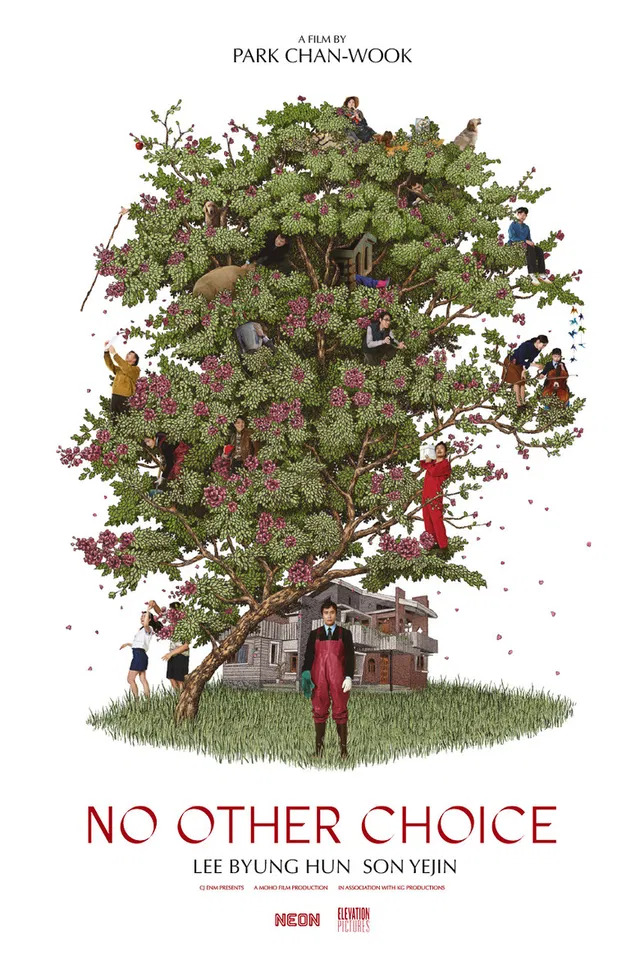
Rating: ★★★★★
Directed by Park Chan-wook
Starring Lee Byung-hun, Son Ye-jin, Woo Seung Kim
Rated R
Release Date: Sept. 24, 2025
As the annual Academy Awards draws ever closer, I’ve grown increasingly fervent about one of the biggest snubs this awards season. Despite being short-listed for the best international feature film earlier this winter, Park Chan-wook’s latest feature film “No Other Choice” was, to my surprise, left off of the official academy nominee list.
Though I’d previously only known Park by name, I excitedly kept up with news about the wide theatrical release of “No Other Choice,” avoiding spoilers on “film Twitter” for months before finally catching a showing in late January.
“No Other Choice” surpassed my every expectation, thrilling me with its whirlpool of a protagonist and story. As hyped as I was, I still wasn’t prepared for the scale of what I saw. I was genuinely blown away by Park’s direction and went home wishing I could permanently sear the images into my eyelids.
After faithfully serving as the manager of a paper mill for 25 years, Yoo Man-su (Lee Byung-hun) is sent a killing severance from his higher-ups: a box of premium eel to share with his family, signifying the end of his time with his company. The paper mill, newly acquired by American buyers, lays off Yoo and his entire team. Unemployed and unable to fulfill his patriarchal breadwinner duty, Yoo seeks to reclaim his sense of self by crafting a desperate plan to eliminate his job competition one by one, through any means necessary.
Chanting “no other choice” throughout, Yoo endeavors to kill the man whose job he wants, as well as the two candidates he believes are more qualified than him. As Yoo’s far-fetched ploy actually begins to fall into place, the audience is entranced with horror, wondering whether he will be able to see it through to the end — and how much he must sacrifice if he does.
Rich color grading, dramatic lighting, and seamless stitching of scenery blended into a cinematic vision that speaks to the director’s careful eye and consideration for his craft. I was particularly impressed by Park’s masterful scene transitions that proved cross-fades can still be novel. While most filmmakers would utilize mirrors to capture multiple angles of characters, Park’s use of digital screens to achieve the same effect completely blew me away. The film relies sparingly on computer VFX, but these moments blend into the narrative effortlessly. Most memorably, the use of computer graphics enhances an anecdote in a character’s memory, superimposing fireworks over a lighter catching flame to create a dazzling transition between past and present. In Park’s careful hands, these choices were unlike anything I’ve seen recently, and I was awe-struck.
Park’s cinematography is just the tip of the iceberg: The intriguing plot gave me insight into the crushing expectations of the patriarchal society Yoo lives in.
I found these themes best exemplified by the tooth infection plaguing Yoo. At first, the pain is only a dull ache, reflecting his cautiously confident attitude that losing his job is a temporary setback. But the longer he is unemployed, the toothache, like him, festers and rots away. As Yoo insists on executing his plan alone, he treats his tooth pain similarly. My only gripe with this metaphor was that I found it to be a little too on the nose, detracting from the rest of the film’s precise and subtle messaging.
It’s hard not to wonder why Yoo has such a particular compulsion — even obsession — to continue work in the paper industry. We see him working other positions as he comes to the realization that the digital age is shrinking his beloved industry. Yoo’s unwavering loyalty to his former place of employment is wholly unrequited, his years of service hardly considered when American management swiftly discards him.
Yet, Yoo remains completely bound to the notion that he will claw his way back to his previous standing, dropping his current job in an instant to interview for a position under his former subordinate. Yoo’s encounters with each victim aid the audience’s understanding of the different ways each character’s expectations for themselves as breadwinners have warped their sense of self, completely devastating their self-confidence and driving their obsession.
All awarded “Pulp Man of the Year,” they share this compulsion of pride from their specific paper-related careers. The men at the bottom, like Yoo, drink themselves nearly to death because they refuse to pivot careers, and their counterparts at the top live alone — despite being married — because of their unyielding desire to maintain their dream lifestyles.
After breaking into the home of his first victim, Gu Beom-mo (Lee Sung-min), Yoo clumsily stumbles upon a sorry sight: the listless Gu lying half asleep in a drunken stupor, listening to “Red Dragonfly” by South Korea’s “King of Pop” Cho Yong-pil on his bespoke audio system. Yoo cranks up the volume on the soundsystem, leading to a fantastically hilarious screaming match as the soundtrack blends the song with Yoo and Gu’s screeches. “There is no need to stick to paper,” Yoo roars while frantically waving a loaded pistol, to which Gu weeps that paper is what kept him fed for decades. Exasperated with his victim, Yoo is ironically unable to apply this advice to himself.
The moment is as ridiculous as it is pitiful. Make no mistake: “No Other Choice” is not just a commentary on this particular brand of machismo that permeates patriarchal societies; it is also a critique of the fruitless endeavor of dedicating yourself to an uncaring machine.
I found the messaging of “No Other Choice” poignant and, at times, heartbreaking, complemented by its deliciously absurd delivery. To me, this ability to juggle relevant and nuanced social commentary with levity and irony is the hallmark of a master storyteller. Regardless of the fact that this year’s Oscars refuse to recognize it as such, “No Other Choice” is an achievement in the medium of film that I recommend wholeheartedly.