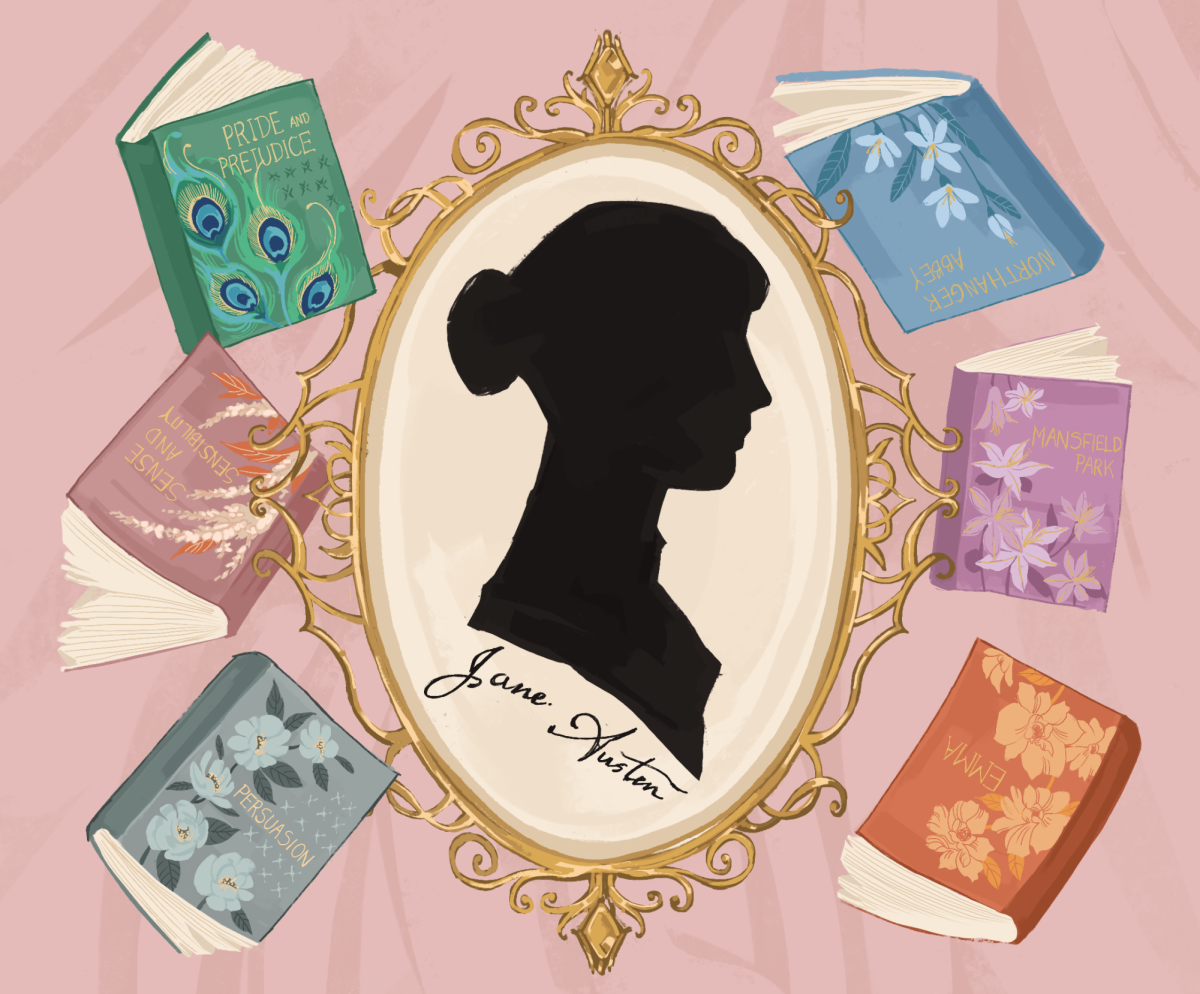
It is a truth universally acknowledged within the literary community that Jane Austen is one of the most impactful and renowned writers of all time. Her novels explore women’s lives in 19th-century England through a blend of ironic witticisms and economic criticisms. The themes studied in Austen’s work ring true to this day, and, of course, her classic love stories continue to resonate with couples across the ages.
I have prepared a personal ranking of her six major novels. My qualifications for making this list are as follows: (a) I have read every single book on this list over the course of the last four years; (b) I own the Barnes & Noble Collectible Editions of Jane Austen’s novels; (c) I am a literature major; (d) I wrote an analytical paper about “Pride and Prejudice” in high school; and (e) I volunteered for my local middle school’s production of “Emma: A Pop Musical.” Yes, this was a real show.
Now that I have established my credentials, without further ado, let’s jump into the best and worst of Ms. Austen’s oeuvre!
6. ‘Mansfield Park’ (1814)
I hate to start this list on a downer, but “Mansfield Park” is … not great. The plot of a poor girl who moves to live with her rich relatives and grapples with economic inequity is quite trite compared to Austen’s other, more nuanced work on class divides. This made it fairly difficult for me to get through this novel the first time, let alone for a reread.
Plot aside, I also don’t find any of the characters of “Mansfield Park” particularly interesting. The main character, Fanny Price, sticks out like a sore thumb among the strong-willed heroines of the Austenian canon. She spends more time passively observing her surroundings than taking agency over her own destiny. Her two suitors oscillate between dull and egotistical, neither of which seems very romantic to me.
And, of course, the story’s ending — a marriage between the protagonist and her cousin — doesn’t help. Sorry, Ms. Austen, I promise I love your other books a lot more.
5. ‘Sense and Sensibility’ (1811)
I first became acquainted with Austen’s debut novel in elementary school after watching the holiday-themed episode of “Girl Meets World” that tried — and failed — to adapt the classic tale into a teenage love triangle. It wasn’t until about six years later that I read the original story and understood the true nuances of the plot.
We meet two Dashwood sisters — steadfast, practical Elinor, and hopeless romantic Marianne — who learn whether the quality of sense or sensibility prevails more in true love. Spoiler alert: It’s both. By the end of the novel, Elinor and Marianne break out of the specific archetypes Austen critiques, and the sisters embrace the importance of the other perspective.
However, for how well-rounded the two main characters are by themselves, their love interests are comparably one-dimensional and bland. Writing a compelling romance was definitely a skill that Austen sharpened in her later works, and for that reason, “Sense and Sensibility” remains in the lower half of this list.
4. ‘Northanger Abbey’ (1818)
In the face of Austen’s sweeping romance stories, “Northanger Abbey” tends to fly under the radar. When I first picked it up, I wasn’t expecting anything special. Boy, was I wrong.
“Northanger Abbey” is easily the most unique — and underrated — novel Austen wrote. A satire of 18th-century Gothic novels, Austen regularly breaks the fourth wall in this text, addressing the reader and playing with fantastical elements in a way she doesn’t do in any of her other books.
The plot is driven by Catherine Morland, a 17-year-old ingenue who is convinced her suitor’s home — the titular Northanger Abbey — is haunted. Catherine’s fervent belief in the supernatural works as a gambit of dramatic irony, with Austen subverting the reader’s expectations in revealing that the house is grossly normal, much like Catherine herself.
In deviating from the rest of Austen’s works, “Northanger Abbey” is a great bit of fun from start to finish. And, of course, Austen never stops reminding us about the importance of reading: “The person, be it gentleman or lady, who has not pleasure in a good novel, must be intolerably stupid.”
3. ‘Emma’ (1816)
Quite possibly Austen’s most amusing heroine, Emma Woodhouse is staunch and resolute in her conviction to never marry, preferring instead to play matchmaker with the people around her. As a fellow meddler myself, I loved Emma from the moment I picked up this book; I could easily relate to her imaginative nature. And that’s precisely what makes “Emma” succeed.
To me, “Emma” feels the most timeless out of all of Austen’s works. You could pluck its characters and setting off the page and insert them into the modern day without any sort of anachronism. Much like how “Clueless” incorporates the plot of “Emma” into a ’90s high school scene, Emma, Jane, and Harriet all feel like real people I could go to school with, and maybe even befriend.
The characters are flawed, yes, but that’s what makes them human. They gossip, they’re convinced they’re always right, they flirt and love — just like all of us today.
2. ‘Persuasion’ (1818)
As the last of Austen’s six major novels, “Persuasion” is also her most mature. It manages to merge the strongest elements of Austen’s past works, featuring some of her funniest lines alongside one of her most compelling romances.
Years before the start of the novel, Anne Elliot broke off her engagement to the man she loved due to her friend’s disapproval of his less-than-ideal financial situation. The story follows what happens when she — now on the verge of becoming an old maid — runs into him years later.
“Persuasion” is a tale about pressure and whether true love is worth the unfavorable opinions of society. It’s a philosophical rumination on reputation and regret and an exploration of what to do if you ever get a second chance with the love of your life. Much like her other novels, “Persuasion” is more than just a love story: It’s a powerful social commentary that reminds me why Austen is one of the greats.
1. ‘Pride and Prejudice’ (1813)
I know, I know, everyone’s favorite Jane Austen story is “Pride and Prejudice.” But sometimes, you’ve got to give it to the masses.
Elizabeth Bennett is one of my favorite fictional characters of all time. She has inspired me since I first read this book at 13 years old. She never breaks from her morals, no matter what anyone says about marrying for money. She knows what she wants out of a marriage, and she prioritizes her autonomy at every turn. By the end of the novel, she marries for love, finally having fallen for a man who learns to better himself to be worthy of her.
“Pride and Prejudice” is a truly beautiful novel, featuring some of the most romantic prose ever written: “I cannot fix on the hour, or the spot, or the look, or the words, which laid the foundation. It is too long ago. I was in the middle before I knew that I had begun.” It’s simultaneously humorous and moral, full of wit and whimsy — a seminal work of literature that captures the beauty of femininity and family all in one.