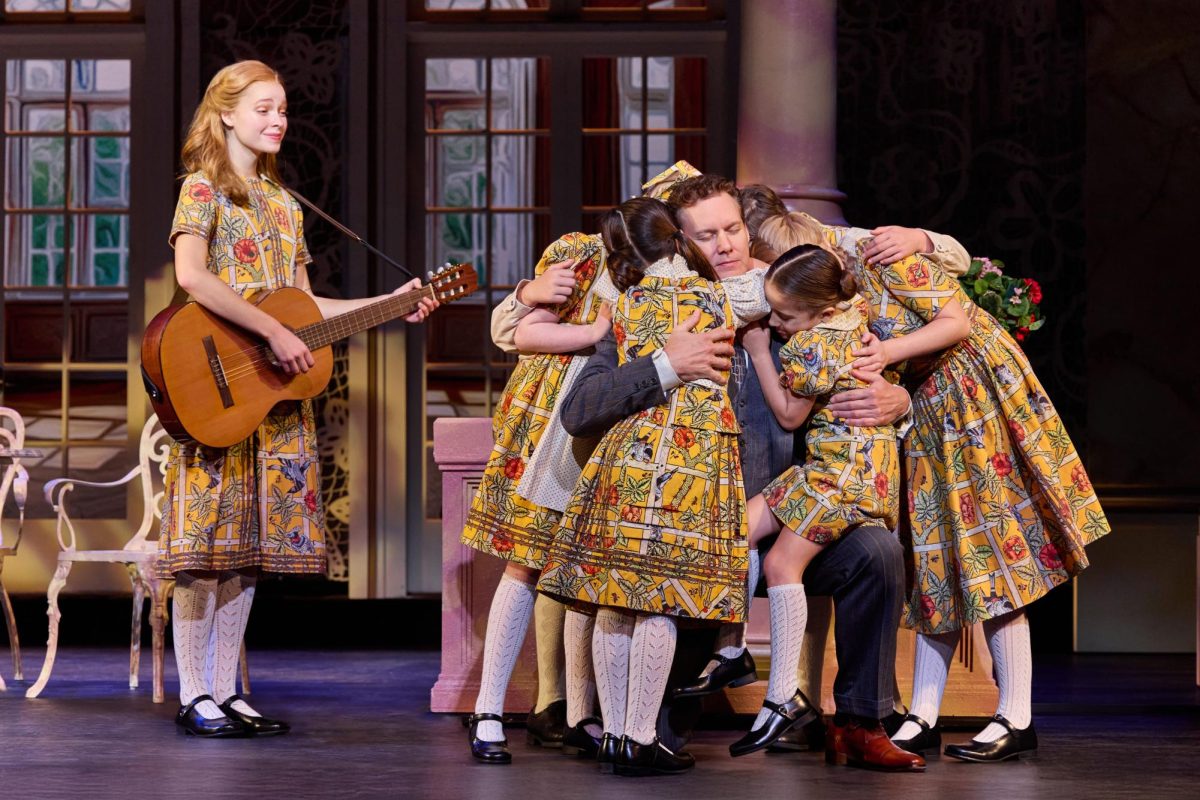
As a lifelong fan of “The Sound of Music,” I entered the San Diego Civic Theatre with high expectations, and I did not leave disappointed. The critically acclaimed North American tour, directed by three-time Tony Award-winner Jack O’Brien, brought this classic to San Diego. With incredible vocals and performances, this particular production allowed audience members to immerse themselves in the magically musical world of the von Trapp family.
The story follows a free-spirited and impulsive nun, Maria Rainer (Cayleigh Capaldi), who finds herself feeling restricted within the walls of Nonnberg Abbey. She is sent by Mother Abbess (Christiane Noll) to the fractured home of widowed Navy Captain Georg von Trapp (Kevin Earley) as governess to his seven mischievous and neglected children. While developing a unique bond with each member of the family, she brings love and music back into their lives.
The show opened with a strikingly cinematic set design: a backdrop of the enchanting hills of Salzburg, Austria, paired with alluring lighting and fog that accented the whimsical feel of the stage. Taking us through the landscapes of Austria, the Abbey, and the von Trapp estate, the set moved seamlessly from one location to the next. In addition to accurately representing the performance’s various settings, the atmosphere and ambience of each location seemed real and lived in, making me feel like I was really there. The Abbey was particularly stunning, featuring a colorful stained glass window reflecting on the characters to give the building a divine feel. The walls of the set also shifted back and forth gracefully to follow the movement of Maria, Mother Abbess, and the sisters as they walked around the stage.
Maria is the heart of the story — her enthusiasm and passion for music makes “The Sound of Music” what it is — and Capaldi captured her essence with stunning accuracy, embodying the charm of this universally beloved character. Her vocals throughout the show truly brought the Civic Theatre alive — only heightened by Earley when their voices merged impeccably to depict Maria and the captain’s love in the song “Something Good.” It was truly a breathtaking performance, punctuating why this classic tale remains timelessly captivating for all audiences.
The young actors portraying the von Trapp children put on equally incredible performances despite their ages. Each one of them breathed their individual characters to life in how their relationships with not only each other but also Maria felt natural and genuine as the show progressed. This is especially portrayed during their thunderstorm-prompted rendition of “The Lonely Goatherd.” The scene perfectly illustrated the breaking of the ice between the kids and Maria, as the comfort she provided solidified her unwavering presence in the family.
The family’s newfound joy does not go uninterrupted, however, as “The Sound of Music” is set on the precipice of World War II. After receiving a mandatory commission in Reich’s navy, the captain — a patriotic Austrian — refuses to comply with the force of encroaching Nazi ideology. His character’s stance on this topic is drastically different from his friend Max Detweiler (Nicholas Rodriguez) and eventual ex-fiancee Baroness Elsa von Schraeder (Kate Loprest). While the captain and Detweiler share humorous quips and interactions throughout the show, they act as foils to one another, with the captain standing tall behind his morals and Detweiler urging him to comply for the sake of survival. Earley’s portrayal of this character is a refreshing portrait of hope and endurance during a tumultuous political climate.
These tensions are most explicitly portrayed in the song “No Way to Stop It” — a number notably cut from the 1965 film adaptation — performed when the captain breaks off his engagement with Schraeder. Loprest’s strong vocals stole the show here, perfectly capturing Schraeder’s character and her rigid indifference to the situation, adding an extra layer to the musical’s turning point.
This leads into the Salzburg music festival, which cements the direness of the family’s situation with a glaring backdrop of Nazi flags. The family sings my personal favorite song from the musical, “Edelweiss,” here. The calming and lullaby-like anthem praises the country of Austria, directly contrasting the hateful flags behind the characters. In this moment, the melody transforms into a symbol of the von Trapp family members’ subtle rebellion against the Nazi annexation of their home country. Although I used to cherish this song as a lullaby, the quiet strength in it captures their love for their homeland despite being drastically torn apart from it, foreshadowing the family’s impending escape.
Seeing this story brought to life beyond the screen with all of the clear love and thought that was put into it, I was able to appreciate the musical on a new level. Ending with a standing ovation from the audience, this performance was truly a testament to the skill and heart keeping this piece of art alive 60 years after its creation.