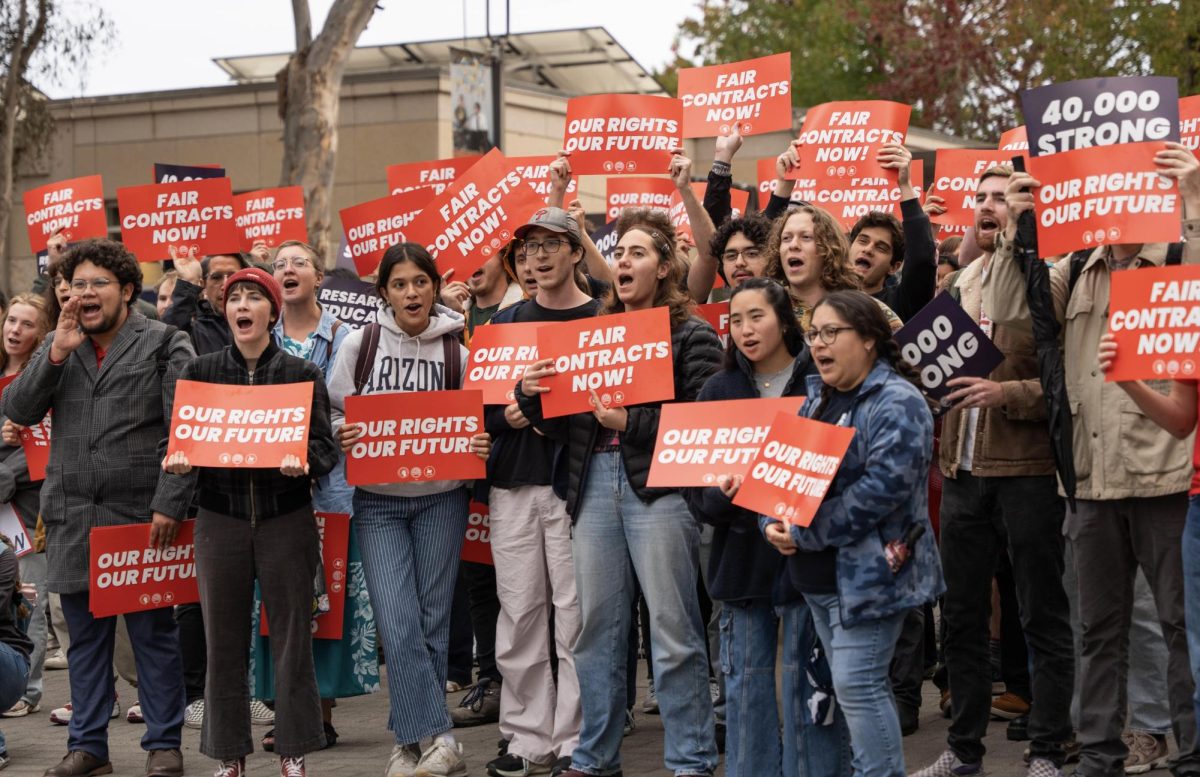
On Thursday, Nov. 20, at 4 p.m., around 200 members of United Auto Workers Local 4811 gathered in front of Geisel Library to rally for fair contracts, expanded childcare access, improved healthcare coverage, increased wages, and stronger protections for international workers. Speakers also criticized the University of California for what they described as insufficient negotiations with the union over unfair labor practices.
UAW 4811 represents 48,000 academic employees across the UC system, including 36,000 academic student employees, 7,000 postdoctoral fellows, and 5,000 academic researchers.
UAW 4811 met with UC negotiators the day before the rally on Wednesday, Nov. 19, at UC Berkeley for its most recent round of contract negotiations. The UC representatives arrived late, prompting the union to state that negotiations were not presented in good faith. UAW 4811 noted the UC negotiators presented an internet link to the UC policy as a counter to an article in the contract regarding childcare subsidies.
Union members said the rally, which occurred at several campuses systemwide, aimed to highlight ongoing wage concerns, working conditions, and the future of academic workers across the UC system.
Demonstrators marched onto Gilman Drive, blocking traffic as they walked toward Gilman Parking Structure. Participants chanted for fair contracts and emphasized that if the UC continued to stall bargaining negotiations, the union would escalate by bringing forward a strike authorization vote.
Greg Hester, a senior contract and grant officer for the UC San Diego Sponsored Projects Office, emphasized that the members of the union sustain the University’s research.
“We are the ones that make the University of California run. We help get funding for science that is critical for not just California, but for the entire country and the world,” he said.
Several speakers condemned recent salary reductions for some academic employees. The UCSD biology department recently lowered the wages of certain Ph.D. student researchers in a process known as “step-lowering.” Academic workers are paid by experience and time served, classified in different steps; step-lowering describes the effect of the University’s constant reclassifications of workers at different steps to lower pay. Certain researchers faced pay cuts of around $900 per month.
One speaker described how they have become more reliant on food pantries to feed their family and hand-me-downs to clothe their kids.
In bargaining negotiations, the UC offered a 3% pay increase as part of a new contract, with a further 2% increase every year thereafter. UAW 4811 responded that these pay increases are not nearly enough.
Udayan Tandon, an Ph.D. candidate in computer science, recounted their experiences as an international student. They are financially strained to the point of having to choose between either paying rent this month or buying a ticket to fly home.
The march ended back in front of Geisel Library, where organizers concluded by encouraging attendees to speak with fellow colleagues and remain involved as bargaining efforts continue.