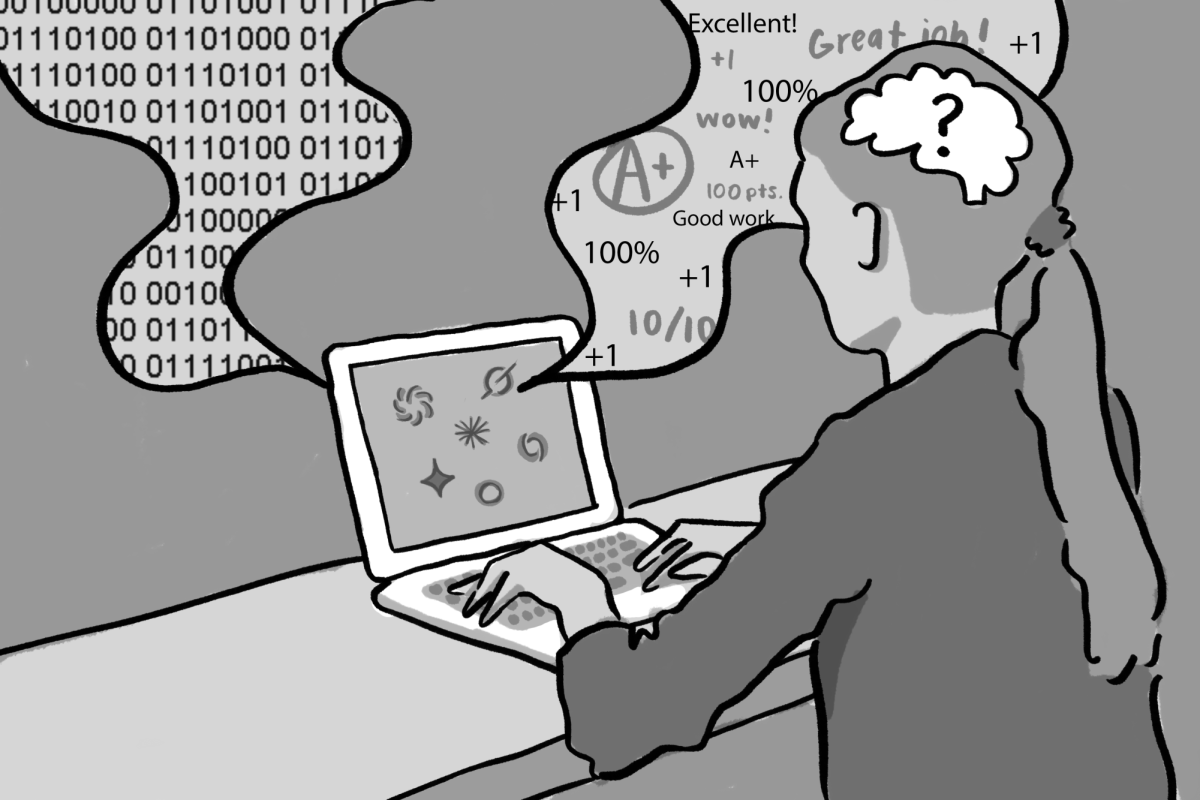
This past week, UC San Diego made headlines for the subpar math skills of its 2025 incoming class. A study that found nearly one in eight incoming freshmen — many of whom earned a 4.0 GPA in high school — were placed in middle-school level math remedial courses. This collapse in preparedness, described as a “thirtyfold” increase in failing scores since 2020, shows that students hold indicators of knowledge like perfect grades and diplomas, without actually possessing the cognitive skills those metrics are supposed to represent.
Students have not recovered from the pandemic learning loss, when remote learning worsened educational inequalities. Reimplementing standardized tests or creating more structured math courses is only ignoring a core issue: the current technological landscape provides too many routes to circumvent the learning process.
As AI tools like ChatGPT become our default engines for writing and reasoning, we risk creating a generation that produces polished outputs without any of the underlying cognitive ability to create and integrate them. Thus, we need to draw a sharp distinction between using AI as a search engine and using it as a replacement for human brainpower.
“Cognitive offloading,” which is the over-reliance on external sources to take on the cognitive load, is becoming increasingly pervasive as AI responses are available on any platform that requires us to digest information ourselves (i.e. Gmail, JSTOR, and Google). When we hand off the cognitive “drudgery” of structuring an essay, solving a complex problem, or even just brainstorming, we tell ourselves we are being efficient. But you and I both know: we are not doing any of the work at all — we are blindly accepting an AI model’s imitation of humanity.
By offloading critical thought, we rob our brains of overcoming the learning curve necessary for deep understanding. If we want to maintain our intellectual autonomy, creativity, and critical thinking skills — the very qualities that make us human — we must not outsource this struggle to a standardized mechanical machine.
A recently published MIT study highlights the physical changes our brains experience when we bypass the learning curve. Researchers monitored the brain activity of 54 participants, aged 18-39, who were each asked to write several SAT essays using their own knowledge, a Google search, or ChatGPT.
The group that wrote using only their brains showed the highest levels of neural connectivity across 32 monitored regions, specifically in areas associated with “creativity ideation, memory load, and semantic processing.” They also reported the highest levels of satisfaction with their final paper and could recall most of what they had written. In contrast, the group who used ChatGPT could only remember very little — if anything — of what they had written and “consistently underperformed at neural, linguistic, and behavioral levels.”
The action of copy and pasting predetermined responses promotes a standardized approach to thinking and communication. AI models aim to please, as they prioritize responses that receive positive human feedback and are “likely to engage the chatbot more” over those that are novel or difficult. When we stop deviating or taking the intellectual risks that lead to genuine insight, we begin to standardize our own reasoning pathways.
Instead, we should learn to capitalize on AI to enhance our own cognitive potential. The same MIT study asked two of the groups to revisit one of their essays; the ChatGPT-only group were only allowed to use their memory, while the brain-only group now had access to ChatGPT. The brain-only group, interestingly, showed enhanced brain connectivity across all EEG frequency bands compared to their first write. This suggests that AI has the potential to enrich learning — as long as it is used to supplement original work, not replace it. We can maintain our authenticity and individual voice when we are not simply passive receivers of knowledge, but instead actively engaging with the content we are creating or digesting.
In a world defined by distractions, constant overstimulation, and a terrifying homogeneity of ideas, the most rebellious thing a human can do is learn to articulate their own messy, complex thoughts. We must resist the urge to let AI do the heavy lifting, not because the AI is bad at it, but because we need to be good at it. If we want to own up to our academic accomplishments — grades, degrees, and careers — we need to start using AI for its original purpose: an extension of our cognition, not a substitute for it.