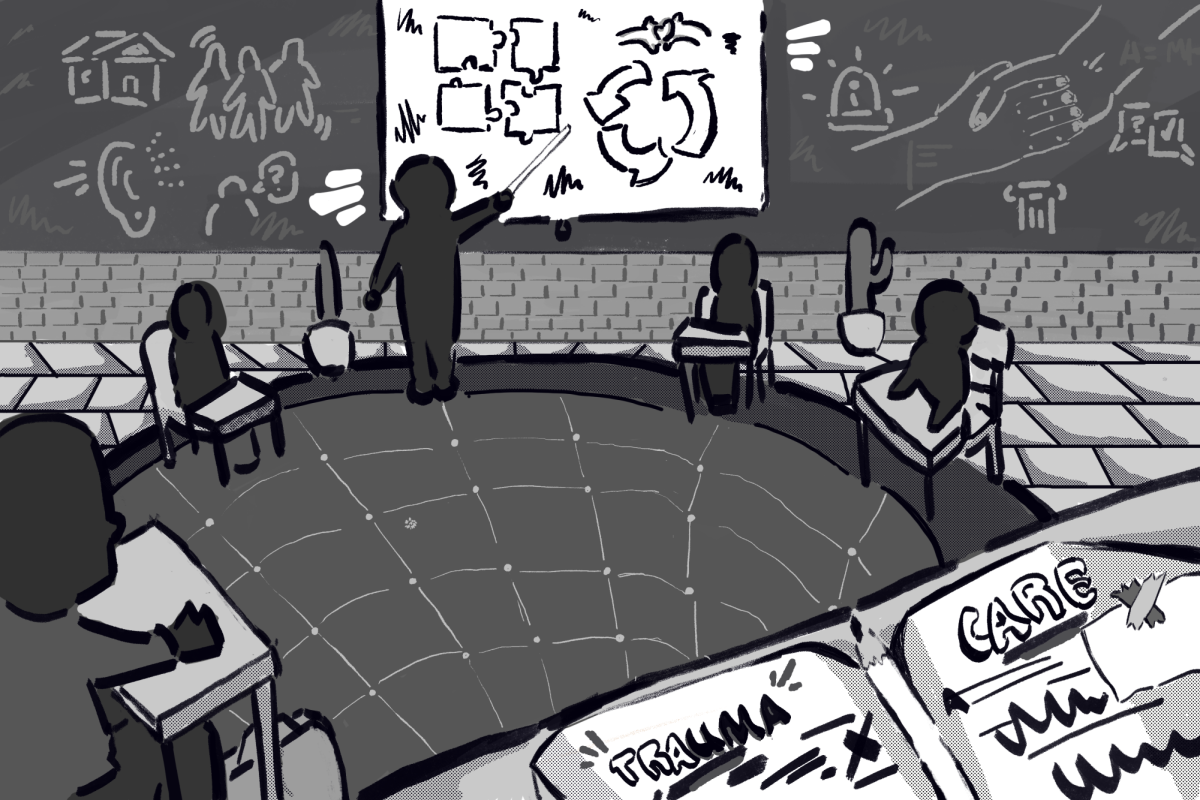
Trauma comes in many forms and can be triggered by everyday tasks that many people wouldn’t think twice about. For some, even using pipettes in a laboratory can prompt traumatic memories and remind them of previous drug use. For others, discussing women’s health could be triggering, particularly for those who have experienced pregnancy loss, medical trauma, or had negative experiences with the healthcare system.
On May 8, the UC San Diego Jail Outreach Program hosted a workshop in partnership with UCSD’s CARE at the Sexual Assault Resource Center that aimed to provide students and instructors with skills to navigate trauma-impacted environments from jails to classroom settings.
Founded in 2017, the Jail Outreach Program strives to provide a STEM education for the incarcerated, equipping them with the basic tools to further their education once out of these facilities. The program’s instructors teach courses ranging from biology to women’s health at the Las Colinas Detention and Reentry Facility and East Mesa Reentry Facility, which house nonviolent offenders and work toward preparing residents for reentry into society.
According to Kiana Miyamoto, the writing support lead at the Jail Outreach Program, the organization was created after founding Ph.D. students noticed that educational outreach programs largely focused on students in grades K-12, leaving marginalized populations — such as the incarcerated — with fewer opportunities.
“These are all nonviolent criminals, so they might have a little bit of a checkered past, but they don’t necessarily need to be condemned to a life where they’re kind of trapped in this cycle of recidivism,” Miyamoto said. “Our goal is to kind of break that cycle and create a platform in which people can initially gain an interest in science and engineering.”
For Renee El-Krab, a UCSD postdoctoral student in the department of medicine, the workshop aligned closely with her interests in both education and equity. El-Krab first learned about the event through an announcement from the Jail Outreach Program; she considered becoming an instructor herself and participated in the workshop to gain initial experience.
“A lot of my professors taught in the local jails near [my undergraduate] university,” El-Krab said. “So it was something that’s always been in the back of my head. It’s really inspiring and really exciting and I really believe in expanding education and equity.”
During the workshop, CARE team members guided participants through different trauma-informed teaching strategies, translating the Jail Outreach Program’s practices — such as transparency, empowerment, and collaboration — into tools applicable beyond correctional facilities.
Participants were encouraged to consider how they would react to certain scenarios using these trauma-informed practices, including responding to insensitive comments or unexpected disclosures from students. The workshop also explored how instructors can create environments where students feel respected, supported, and emotionally safe.
Those discussions were particularly relevant for Jail Outreach instructors, who navigate classroom dynamics unfamiliar to many university educators. Miyamoto explained that instructors and students are often unaware of the privilege they hold. Their experiences and opportunities often differ greatly from incarcerated students, who face limited access to academic resources and social stigma. As a result, training for instructors emphasizes being aware of and sensitive to students’ unique — and potentially traumatic — backgrounds.
Rachel Weinstein, a Ph.D. student at UCSD’s School of Biological Sciences, attended the workshop as a principal member and instructor for the Jail Outreach Program. Weinstein, who has been teaching since 2023, described that while prepared course material is often straightforward, navigating unexpected or emotionally sensitive situations can catch instructors off guard.
“When students, for example, maybe mention a history of drug use and you’re like, ‘How do I respond to that? That was not really on my agenda,’’’ Weinstein said. “So I think it was really helpful to think about these things. What are effective ways to respond or handle a situation that aren’t very punitive, but are nonjudgmental and can kind of turn it into a situation where everyone can feel more comfortable instead of less comfortable?”
Miyamoto emphasized that the workshop’s broader goal was to encourage students and educators to approach teaching with greater compassion and awareness while also applying trauma-informed practices beyond the classroom.
“I think that … leading with compassion with people is just something everyone should always do,” Miyamoto said. “But I think it’s just something that we can really emphasize, especially for this particular audience, knowing that we come from very potentially different worlds.”