

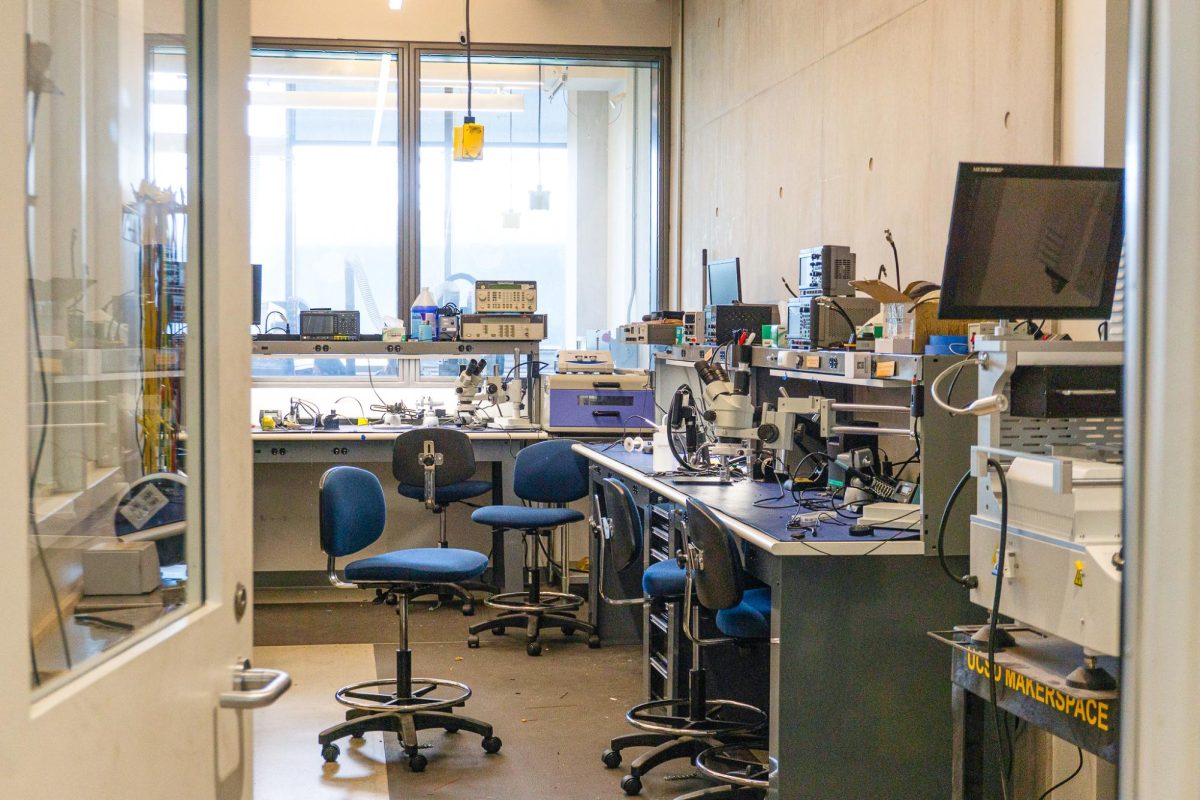
On April 20, The UCSD Guardian reported that UC San Diego cut all future funding for the Makerspace, the school’s only free public innovation workshop. Since then, Associated Students President and third-year William Simpson has informed The Guardian that the Makerspace is not currently at risk of being defunded, confirmed after a series of meetings between representatives from the student body and UCSD administrators.
Concerns about the Makerspace first arose in Fall 2025.
“A lot of our operations take place in the Makerspace, so when we obviously noticed cuts to time, cuts to staff, and broken machines that weren’t being fixed, we were a little worried,” said second-year Julien Yamamoto Chen, president of the Startup Incubator Club.
Since February 2026, Chen has been working with Campus-Wide Sen. and second-year Kaleb Truchan as part of a concerted effort to bring administrative attention to the Makerspace out of fear that the school had decided to defund the project.
Members of the SIC, A.S., and thousands of UCSD students have expressed discontent with the decline in Makerspace functionality over the past year.
The Makerspace is overseen by the Qualcomm Institute: an interdisciplinary research center under UCSD Academic Affairs which is given a yearly core budget dedicated to sponsoring student innovation and research on campus. The QI has no working relationship with Qualcomm Incorporated, the technology and communications company.
QI Director Ramesh Rao has overseen the institute since its founding in 2000 and is responsible for budgeting a variety of research projects and services.
“There was no immediate threat to the [Makerspace’s] funding … the story took on a life of its own,” Rao said in an interview with The Guardian, but the budgets disagree.
Documents from UCSD’s Policy and Records Administration detailing the QI’s core funds for the 2024-25 fiscal year, this year’s approved budget for the Makerspace, and figures from the Academic Senate’s January 2026 budget town hall speak to the school’s ongoing struggle to overcome major federal grant cuts and a subsequently restructured state budget.
The combined core funds of the QI and UCSD’s Design Lab took a cumulative 8.3% cut, seen through quarterly reductions with a campuswide mandate to “[preserve] student-facing capacity, and [encourage] innovation” in spite of these newfound limitations.
This year, Rao approved a reduced $678,993 budget for the Makerspace, a significant 32% decline from its previous million-dollar allocation.
Rao has acknowledged that the school’s wider budgetary crisis greatly affected all projects under the QI but declined to comment further when asked about these specific internal documents in a follow-up interview.
“If you have any questions [about these figures], you should ask whoever sent this to you,” Rao said. “There is an office of public records [for this].”
The Makerspace also lost one of its three full-time employees after staff member David Contreras moved away in August 2025. With Contreras — who supervised students on weekends — leaving the team, schoolwide restrictions have in turn created a gap in the space’s weekly availability.
“We’re all employees of UCSD,” Rao said. “Every penny comes through UCSD. If the campus has a hiring freeze, we have a hiring freeze.”
The Makerspace previously operated from 11:00 a.m. to 7:00 p.m. six days a week, but staff shortened its operating hours to 1:00 p.m. to 6:00 p.m. for the time being based on prior usage statistics. However, Rao promises that it remains open on Saturdays to support the student organizations that rely on the space.
This year, Makerspace Director David Lesser has begun consistently working overtime without additional pay, managing operations on Saturdays despite staffing shortages.
“He’s basically a one-man show; it’s quite insane,” Truchan said, noting Lesser’s exclusion from meetings with school officials throughout the quarter. “David actually isn’t really looped in; we’re gonna try to get David in more meetings seeing as he runs the damn show.”
When asked for insight into the financial difficulties previously faced by the Makerspace, Lesser told The Guardian that he could not provide public comment.
“Those numbers are what they are, okay?” Rao said. “Look at what’s happening now instead of looking at numbers and coming up with some sort of scenario.”
Rao feels confident that the Makerspace will be able to recover because of an optimistic state budget for the coming fiscal year. The projected budget also justified the recent hiring of a temporary worker in late April to address the workshop’s staffing shortfall.
On April 1, the SIC hosted Launchpoint 2026, the club’s first annual business and technology expo, to rally support for continued funding of the Makerspace from the 40 student organizations present.
“We knew we couldn’t do the jobs of the [school’s administration] — to change legislation and things like that ourselves,” Chen said regarding Launchpoint. “So we did the next best thing and tried to bring people together and pass a resolution.”
With a signed petition from the roughly 300 students in attendance, an A.S. resolution written by Truchan passed soon after, officially calling on the University to recognize the demand to adequately staff the space, restore its original operating hours, and maintain free services for all students.
On April 3, Chen and Simpson sat down with Vice Chancellor for Student Affairs Alysson Satterlund, Dean of Jacobs School of Engineering Albert Pisano, and Rao himself to express their concerns, reevaluate the program’s wider impact, and eventually secure further funding for the space.
“As students, you probably feel like you don’t have any control or power over the institutions of the school, but your voice matters,” Chen said. “The school is here to serve us, not the other way around. Question what’s going on around you and take initiative. If you can organize any kind of voice to represent a need in the school, definitely do it. Don’t waste any time.”
Truchan and Chen have been tasked with presenting current usage statistics to the school’s administration to justify reextending the Makerspace’s operating hours and inviting further potential investment from the school, state, and philanthropists.
“The Makerspace was made for everyone — vis-art students, engineering students; even if you’re part of the D&D club, you can print little D&D figurines,” Truchan said. “I’ve done it myself. This is a place that anyone can use and everyone should. Student services are really hard to come by, especially at large public schools like ours. This is something students need to capitalize on.”


