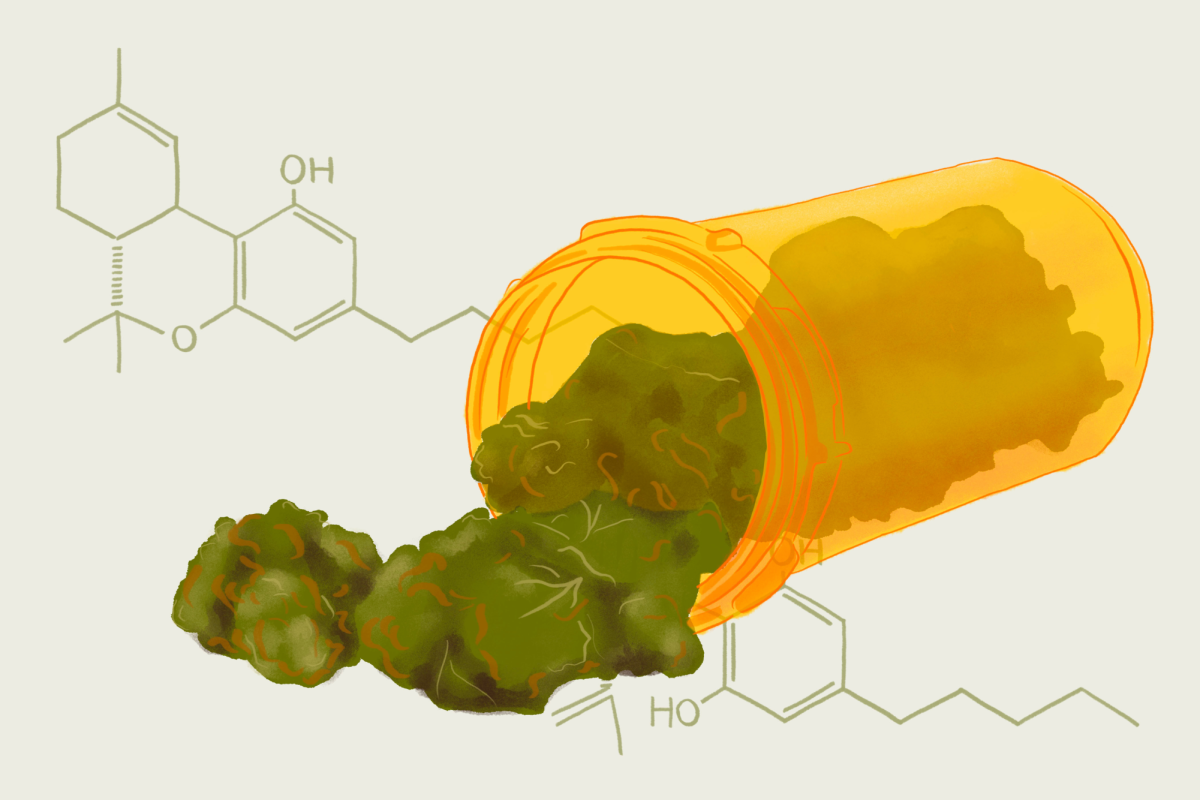
Picture this: You walk into your local Vons or CVS Pharmacy looking for an over-the-counter medication to cure your headaches from midterm stress, and you see shelves stocked with Tylenol, Advil, and marijuana.
This hypothetical scenario could become reality in just a few decades. President Donald Trump’s recent executive order, which intends to increase medical testing of cannabis, may extend to other psychedelics to discover new treatment options for mental health disorders and pain management.
The executive order reclassifies marijuana from a Schedule I to Schedule III drug, shifting it from the same category as drugs like heroin and MDMA to that of over-the-counter Tylenol. This decision does not federally legalize marijuana, but it recognizes that there are legitimate medical uses for it. As a Schedule III drug, researchers are now less restricted in studying its effects — especially the dosage effects on younger recreational users and its potential for treating various mental health disorders.
When marijuana was a Schedule I controlled substance, researchers had difficulty accessing a research-approved supply. Dr. Igor Grant, the director for the Center for Medicinal Cannabis Research at UC San Diego, explained to The UCSD Guardian that researchers previously needed to obtain a special Drug Enforcement Administration license for each study.
“There is a chain of custody,” Grant said. “That is, you have to document very carefully where the drug is going, how it’s stored … so it can get quite complicated. It’s not that research wasn’t possible, but really, I think you need a center kind of like ours that has the resources to go through all that stuff to really do this.”
Even for centers like the CMCR, there was only one legal supplier of marijuana — the National Institute on Drug Abuse.
“[NIDA] has a farm at the University of Mississippi where they grow marijuana, package it, and give it certain strengths of THC,” Grant said. THC is the component that gives users a “high.”
These restrictions continued until about four years ago, when the DEA licensed additional suppliers to provide a wider variety of cannabis products. Grant explained that these new locations did not have their own placebo strain, leaving NIDA as the only source of specialized placebo strains required for double-blind clinical trials.
Trump’s recent rescheduling could bring state dispensaries into a federal-controlled system, opening up more avenues for research into other psychedelics, which may offer alternative treatment options when traditional ones fail.
For example, ketamine is a hallucinogenic that is recognized as a legitimate treatment for depression complicated by strong suicidal ideation.
“In just a few treatments of ketamine, it’s kind of almost like [it] reboots the brain or something resets,” Grant explained. Its mechanisms are still not well understood, but dissolving research barriers will help us understand why it can be more effective than traditional treatments.
Grant also described how the Schedule I category may have interfered with research into LSD in the 1960s when psychedelics first gained popularity.
“There were some suggestions that LSD, for example, might be helpful in treating conditions like alcoholism, and there was a bit of work in that area, but then it all got stopped because all these drugs were classified in Schedule I,” Grant said.
Besides the drug itself, researchers are still seeking to understand how various doses of psychedelics affect both patients and recreational users. A joint used to contain 5 or 7 per cent THC. But now, products can contain closer to 100% THC. The benefits of these drugs plateau in higher concentrations, according to Grant.
“There are people who are very heavy users of cannabis who then develop this hyperemesis syndrome,” Grant said. “They come into the hospital, and they can’t stop throwing up. Cannabis should prevent nausea. What happens is that, in an overdose situation, the mechanism in your brain that controls nausea becomes overwhelmed, and they no longer respond in the ordinary way, and the treatment is, you have to stop [cannabis use].”
Understanding these nuances in dosing is critical to creating personalized treatments for adolescents, who are sometimes prescribed psychoactives for pain management and are likely to abuse these treatments. In a study analyzing prescription misuse among U.S. youth between 12 and 17 years old, 20.9% — or 1.3 million — reported misuse and 3.4% were classified as having a substance use disorder. Taking into account younger patients’ vulnerability for dependence and the inconsistent findings on cognitive effects only proves the necessity of increasing access to research on psychedelics.
There is still much we do not know about how psychedelic use manifests in patients and recreational users. The lack of consistent results, however, suggests that this reclassification was a step in the right direction toward finding new treatments and medicines. The examples of cannabis use for chronic pain and ketamine for depression are just the tip of the iceberg.