


Artemis is the latest Western imperial project
Written by Gitanjali Boyd, Contributing Writer
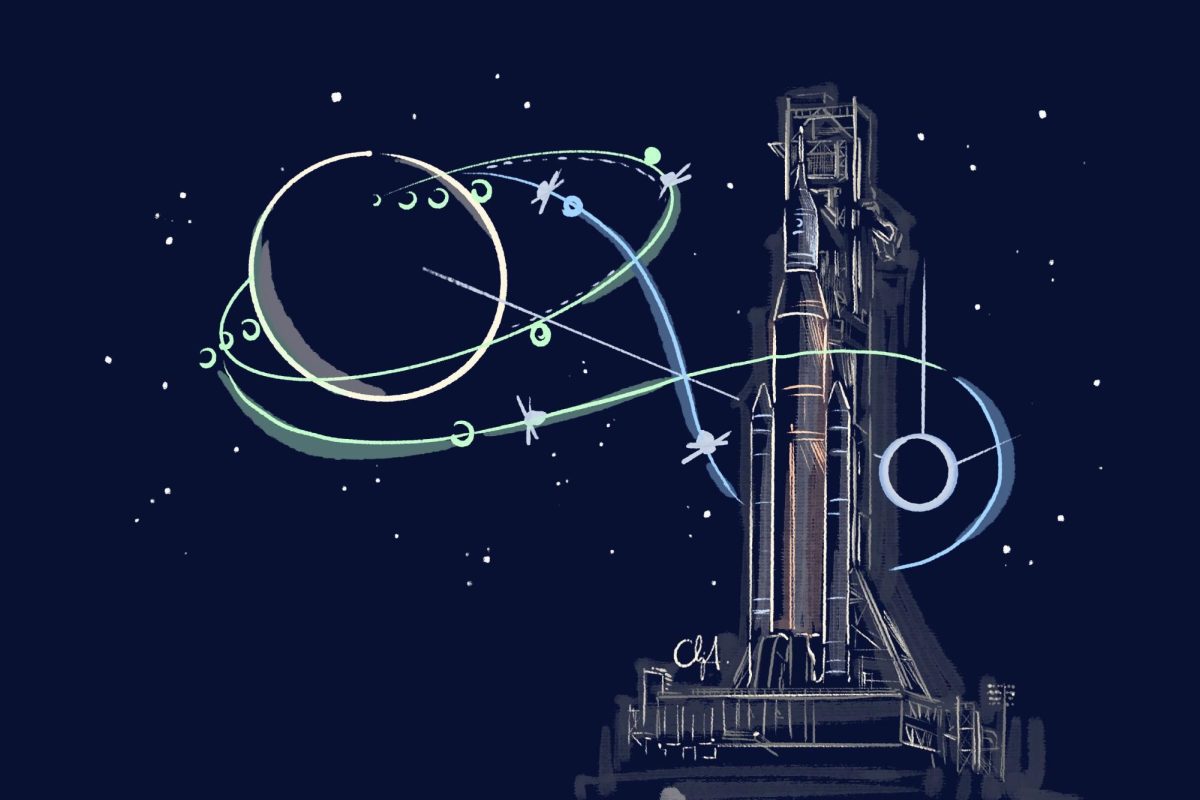
“We are going to steal … ze moon!” With the recent success of the Artemis II launch — the first crewed lunar journey in over half a century — it is difficult to discern whether this quote comes from infamous Disney villain Gru or Jared Isaacman, the current NASA administrator. The highly anticipated mission was touted as an inspiring model of diversity and an exciting precursor to future deep space escapades. However, it is a worrisome step toward the expansion of Western imperialism and the destruction of a celestial body in the name of American ego and greed, shrouded by the smoke of rocket contrails.
The recent mission, which traveled past the uncharted territory of the dark side of the moon, marked the beginning of a new campaign with the aim of setting foot on the moon once again. But this objective of standing on the moon has already been achieved, raising questions about the program’s motives. Why utilize such copious amounts of resources — $4.1 billion per launch — to perform a feat we have already accomplished, when there are more pertinent issues and scientific endeavors on Earth?
For NASA, the answer lies partly in what the moon itself has to offer. Unlike the Apollo 11, resource extraction — rather than scientific curiosity — is the primary motive behind Artemis. If done in unregulated excess, this extraction poses long-term threats to the natural environment of the moon in a manner similar to the progressive destruction of Earth. For example, oxygen in the water located in the moon’s poles could be used by future NASA moon bases as breathable air, rocket propellants, and drinkable water. Additionally, there are vast stores of invaluable Helium-3 in lunar soil and the rock formations on the near side of the moon — an isotope that the Department of Homeland Security utilizes in nuclear warhead technology. While presented by NASA as monumental scientific developments, the reality is that science is no longer the driving force behind these objectives. In January 2026, the Trump administration proposed cutting NASA’s Science Mission Directorate by nearly 47% while leaving human exploration spending intact. NASA’s function is increasingly opposed to scientific research and oriented instead toward capitalistic gain at the expense of our beloved moon’s health.
As stated by Pamela Conrad of Carnegie Science, “If something that’s not here [on Earth] is seen as a resource, just ripe to be exploited, then that [perpetuates] colonialism.” Beyond the allure of abundant profitable resources, American ego and the insidious expansion of Western imperialism drives the Artemis mission. NASA recently promised to establish “a continuing U.S. presence on the moon solidly on its road map for the coming decade,” reflecting the imperial desire to “establish colonies” in foreign territories. Furthermore, the U.S. is competing with China in the “new space race” to obtain ownership over the moon’s resources. While control over lunar resources is imperative to dictating the future of deep space travel, ownership is a problematic concept rooted in colonial ideology. It inherently limits the accessibility of space exploration through “space colonization,” facilitating the pursuit of a new frontier for Western empires to continue their exploitation of natural resources.
The successful launch of Artemis II undeniably paves the way for fascinating developments in space exploration. Yet, it is imperative that as we embark on this new chapter of discovery, we recognize that scientific exploration should not be synonymous with exploitation. Currently, NASA’s motives foreshadow a worrisome repetition of our destruction of Earth on yet another celestial body.
Isaacman said last month, “This time, the goal is not flags and footprints. This time, the goal is to stay.” Rather than perpetuate this colonial mindset, we should approach space exploration with the saying my dad often repeated to me during our outdoor escapades here on Earth: “Take only memories, and leave only footprints.”
Space is progress, not escapism
Written by Cindy Y. Chen, Staff Writer
Last week, I watched “Project Hail Mary,” a story about a lone astronaut who is shipped off into space to save the universe. This got me thinking about where our fascination with space comes from. Since the 1950’s space race, space has captured the public imagination, from films like “Hidden Figures” to “Interstellar.” Yet, with more pressing worries on Earth, missions like Artemis II are often dismissed as escapism or frivolous spending.
While understandable — after all, resources are finite and the needs on Earth are immediate — space exploration is a necessary investment.
Though scientific advances are often judged by their immediate usefulness, history suggests that the most consequential inventions rarely begin that way. Quantum mechanics began as an attempt to understand why heated metal glowed odd colors; today, it has informed lifesaving technologies like the MRI. The laser, once famously dismissed by its creator as “a solution in search of a problem,” now appears in barcode scanners and eye surgery.
Space exploration is no different. Since the late 1950s, NASA’s missions — once considered impractical — have given rise to technologies like GPS and modern weather forecasting and fundamentally redefined the way we respond to natural disasters. They have also deepened our understanding of Earth itself: Satellite data exposed the ozone hole, prompting the Montreal Protocol to help prevent further atmospheric harm.
While Artemis II’s mission to send four astronauts around the moon may not seem immediately practical, its value, like many others before it, will only become clear in hindsight.
Beyond usefulness, one of the most salient criticisms of space travel centers on its association with wealth and spectacle. Jeff Bezos’ Blue Origin, which flew Katy Perry and other celebrities on suborbital flights, offered tickets costing upward of $28 million for a brief journey to the edge of space. Public reaction was swift and critical. In a world rife with inequality, such flagrant displays of wealth feel detached, excessive, and difficult to justify.
Yet, early exclusivity is often where innovation begins, rather than where it settles. Planes, for example, were once reserved for society’s elite during the interwar period; over time, falling costs turned what was once luxury into a standard mode of travel. Similarly, missions like Artemis II are noncommercial now but may one day become commonplace. The Blue Origin expedition is not a flaw unique to space exploration but a reflection of Earth’s inequalities.
Beyond the practical, there is another reason to look outward.
In a world dominated by immediate crises, missions like Artemis II offer a rare chance to think beyond the here and now. There is something intrinsically human about pushing past the boundaries of what is known and asking questions we cannot yet answer: how the universe began, whether life exists beyond Earth, and what our place is within it. It is that same impulse that led us to discover that Earth is not the center of the universe and the origins of galaxies billions of light-years away.
Our search into space keeps those questions alive — not because they are easy or immediately useful, but because they remind us that there is still more to discover.





Charles D Phillips • Apr 14, 2026 at 8:23 am
This is interesting but the authors need perspective. First there is NO “dark” side of the Moon, that comes from a Pink Floyd album. All of the Moon is illuminated at one time or another. There IS a side that always points toward Earth of course.
Anyway, right now we have an Administration that loves to talk in imperial, in militaristic, phrases. But that has not always been the case and hopefully soon we will be back to normal. People have always explored and this is exploration.
Why spend these resources to go to the Moon? A partial answer is spinoffs – but doing this we improve rockets and capsule technology. These things do contribute to other improvements. When we first started flying rockets we did not know about the potential for geosynchronous communications, weather, etc satellites. We did not know about navigation satellites. Should we have stopped building rockets until we knew about weather satellites, and just built rockets that contributed to them?