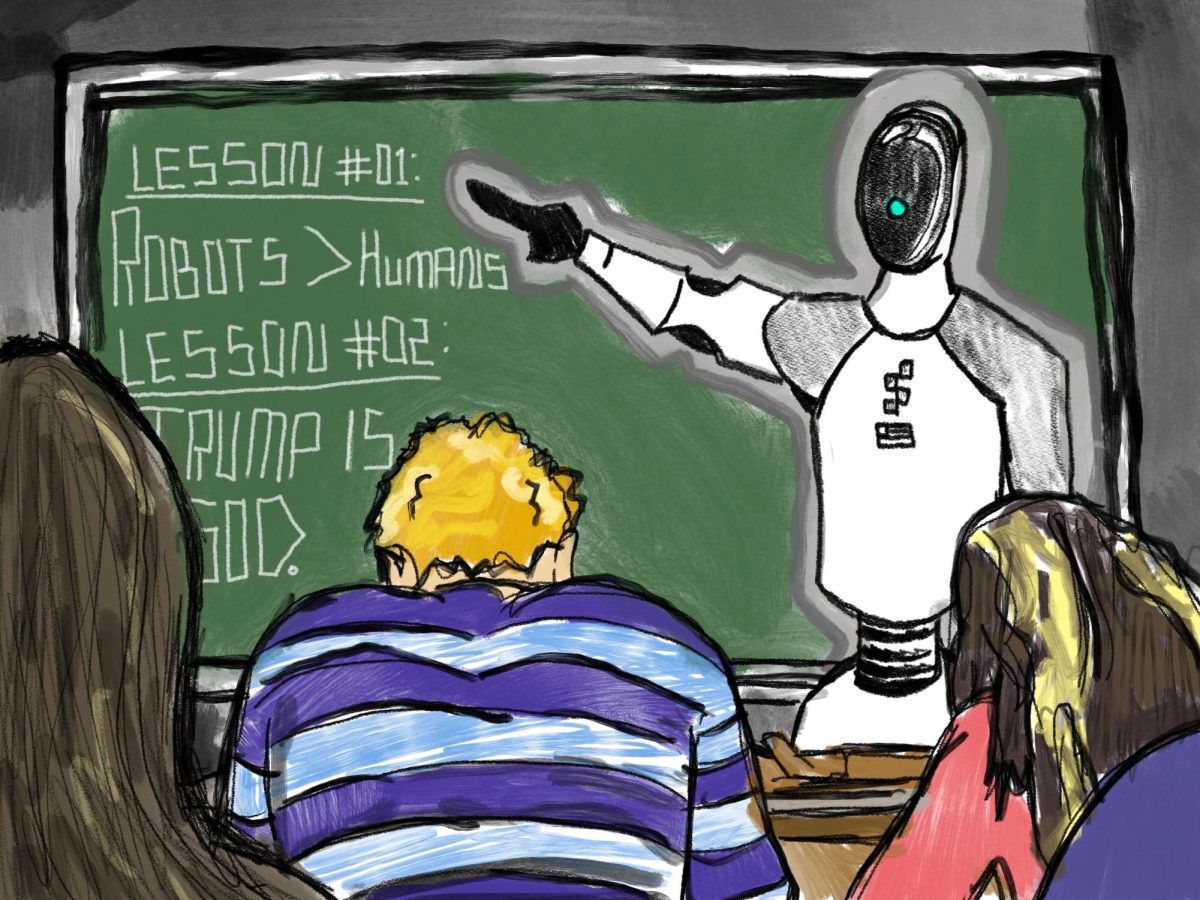
When Melania Trump introduced the humanoid robot Figure 03 at an AI education summit, its appeal was hard to dismiss. The robot was introduced as a future teacher that could personalize every lesson and give immediate explanations on subjects from literature to math and science. Learning would become faster, more efficient, and completely tailored to the student — at least, in theory.
While a robot teacher may be able to adapt to students’ learning styles, those features don’t necessarily lead to better understanding. This doesn’t mean AI can’t teach: The issue is how it will change education. Education isn’t about getting answers the fastest — it’s about learning how to think, challenge, and make sense of problems without being given an immediate solution.
One of the main appeals of AI education is that it will supposedly better equip students for the future. In actuality, it may be preparing them for the wrong one. AI can already retrieve information, summarize concepts, and analyze basic information — the same skills that these students will be trained to do. Students may end up finishing school without learning the critical thinking, judgement, and decision-making skills that are actually valued in today’s workforce.
If students rely on AI as their sole teacher, they will struggle to develop these skills. They become dependent on tools instead of being able to think through problems on their own. This leaves them underprepared, not only for the job market, but also for dealing with ambiguous situations and forming opinions without guidance. Students who are used to being guided toward solutions may struggle more in situations where they need to think independently and make decisions with no clear correct answer.
Learning has also always been a social process. In a classroom setting, students can ask questions, learn from mistakes, and work through problems with their teacher’s help. These interactions help them not only understand the material better, but give them opportunities to challenge ideas.
A robot cannot replicate these settings. It can’t participate in genuine discussions, respond to misunderstandings, or create a community where students can learn from each other. Without these crucial interactions, learning becomes more isolated, rather than something that develops the way students think and engage with others.
It also defeats one of education’s main purposes: exposing students to a common set of ideas. In classroom settings, students are not just learning on their own; they’re learning together by engaging with the same concepts and responding to each other’s opinions.
When learning is highly personalized, that shared experience no longer exists. Students may ultimately learn very different things and have unequal exposure to ideas. Without the shared ground that traditional education provides, there are fewer opportunities for discussions and disagreements, which are crucial to students’ learning.
The question isn’t whether or not AI can teach — it’s what will change if we allow AI to define schooling. Education was built to push students, expose them to new ideas, and change how they view the world. Under AI’s instruction, students are less likely to build their own beliefs and ideas. When that happens, education stops being educational.