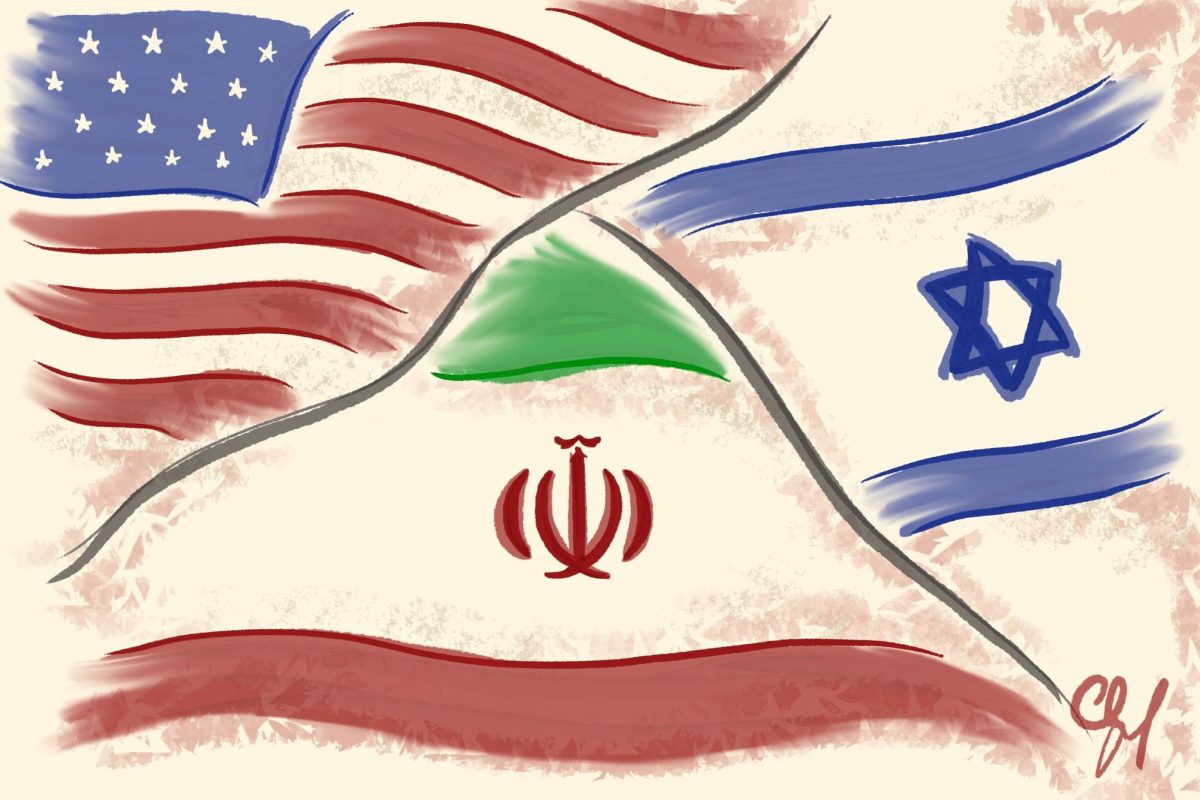
On Feb. 28, the United States joined Israel in launching a military assault on Iran. While it was sold to the public as a necessary act of strength, in reality, this was a war of choice. It offers no clear path to long-term security, many possibilities of regional escalation, economic blowback, and moral ruin. Far from advancing American interests, the Trump administration’s decision to enter a needless war risks destabilizing energy markets and further binding American credibility to an Israeli military project, particularly one where the parties have contradicting goals.
The clearest sign that this war is unnecessary is that the administration’s central justification falls apart under basic scrutiny. In announcing the war, President Donald Trump framed the conflict around preventing Iran from obtaining nuclear weapons. That argument becomes far less convincing when measured against his own record. After U.S. strikes in Iran in June 2025, Trump claimed that Iran’s nuclear sites had been “obliterated.” If that were true, then the urgency for launching another war just months later over nuclear capacity is unexplainable. Americans are now being asked to support a dangerous and open-ended conflict on the basis of a threat Trump himself had already claimed to neutralize.
That contradiction is even harder to defend because the U.S. already had a functioning framework for containing Iran’s nuclear ambitions without launching attacks. Under former President Barack Obama’s Joint Comprehensive Plan of Action, Iran agreed to reduce its stockpile of enriched uranium, cut back its centrifuges, cap enrichment levels well below weapons-grade, and submit to international monitoring in exchange for billions of dollars in sanctions relief. The deal was not perfect, nor did it solve every problem Washington had with Tehran, but it did accomplish the central objective that now supposedly justifies war: preventing Iran from developing a nuclear weapon. Instead of building a framework that had already proven diplomacy could restrain Iran’s nuclear program, Trump abandoned it in his first term and replaced it with military escalation in his second.
Trump’s poor use of diplomacy and power is rooted in a deeper misunderstanding of the kind of state with which the U.S. is now at war. The Trump administration appeared to believe that Iran could be pressured, fractured, or politically reshaped in the same way other authoritarian regimes like Venezuela have been. But Iran is not Venezuela. Before the U.S. launched an operation to kidnap then-President Nicolás Maduro, he was willing to offer sweeping economic concessions, including access to Venezuela’s oil wealth to preserve his hold on power. That is the logic of a ruler who is more concerned with maintaining his own power than protecting the sovereignty of his country.
Iran’s leadership operates differently. The Islamic Republic is not built around one man bargaining for his position. Rather, it is a multilayered theocracy designed to endure internal and external shocks with power distributed across the supreme leader, the Islamic Revolutionary Guard Corps, Assembly of Experts, Guardian Council, and president. Each of the entities in Iran tie its well-being to the stability of the state; removing or weakening one figure does not unravel the system. That is precisely why Iran’s leadership did not capitulate after the assassination of Supreme Leader Ali Khamenei at the start of the war. Prior to the war, Iran established an extensive depth chart of replacements for each key position. Instead of collapsing, the theocracy continues to shift authority through formal succession mechanisms that were built to preserve the state. In contrast, Venezuela’s post-Maduro leadership under Delcy Rodríguez quickly moved toward capitulation to Washington, showing how a more personalized and pliable regime can bend under pressure in ways Iran’s multilayered theocracy was built to resist.
This reality becomes even more dangerous because in this war against Iran, the U.S. and Israel are not fighting for the same geopolitical outcome. In Washington, the loudest Iran hawks have flirted with the fantasy of regime change, often imagining that a post-clerical Iran could simply be remade under a figure like Reza Pahlavi, the exiled son of Iran’s last shah, or some other Western-aligned alternative. Israel’s objectives appear far more destructive. It is not pursuing regime change — it is pursuing state collapse. Israel’s bombing campaign has expanded beyond military and nuclear sites to include prisons and detention centers filled with Iranian political prisoners and dissidents. Trump himself admitted that all of the alternatives his administration had in mind to replace Iran’s supreme leader were killed during the war.
This distinction of goals in this war matters. Regime change, however reckless and arrogant, at least assumes that some political order will survive and be replaced. State collapse means something far darker. It is the destruction of the institutions and social stability that hold a country together in the first place. What would remain post-state collapse would be a catastrophic vacuum, filled with sectarian fragmentation, criminal networks, refugee crises, and spiraling regional instability. Americans should know this by now. Iraq, Libya, and Syria already revealed what happens when outside powers shatter a state without any serious plan for what comes next. That is what makes this war so dangerous. One country wants a new Iranian government that is subservient to the West. The other is willing to destroy its very existence.
The consequences of this war are not confined to the battlefield. Iran sits beside one of the most strategically vital energy corridors in the world, and any prolonged conflict raises the risk of disruption. The Strait of Hormuz is a chokepoint through which roughly 20% of global oil and gas flows through. That means this war does not just risk lives abroad — it threatens to drive up energy prices, worsen inflation, and deepen the financial strain already felt by Americans at home and virtually everyone else around the world. The neoconservative elite in Washington are asking the public to absorb the economic consequences of a war they openly frame as a conflict that will extend over a prolonged period of time.
Even more troubling, Iran did not pose the kind of direct military threat to the American homeland that could plausibly justify this war as an act of self-urgent defense. Iran is a regional power with proxies, short- and medium-range ballistic missiles, and the capacity to threaten U.S. bases and partners in the Middle East. But that is not the same thing as an imminent threat to the U.S. itself. Analysts have long assessed Iran’s capabilities as primarily regional rather than intercontinental. Treating that as grounds for another open-ended war is not strategically justifiable for protecting the U.S. mainland. Instead, it is an egregious military overreach.
The war has also exposed a deeper strategic weakness that Washington and its Gulf allies will have to admit: America’s regional security architecture is far less stable and formidable than advertised. Following the initial strikes in Iran, Iran sent retaliatory strikes toward Israel and the Gulf states. The strikes showcased how vulnerable the U.S. and its allies remain to asymmetric warfare, even after years of arms sales and military coordination, including the permission to place U.S. bases in other Gulf states.
Tehran does not need to match the U.S. weapon for weapon to create serious disruption. It can inflict damage with comparably cheap drones and missiles that force Washington to spend far more trying to intercept them. That imbalance matters. It means this war is not simply testing military strength. It is exposing the fragility, costliness, and unsustainability of the regional order the U.S. claims to dominate.
The U.S.’s strategic carelessness has already produced devastating human consequences. In Minab, an Iranian elementary school was struck during the opening phase of the war, killing over 100 children. Additionally, at least 13 U.S. servicemen have died in the war. Together, these losses reveal the true cost of an unnecessary war launched without any defensible strategic purpose.
At every stage, this war has reflected poor judgment rather than strategic necessity. It began with a contradiction, escalated without a coherent political endgame, and has already imposed costs that extend far beyond the battlefield. What has emerged is a familiar pattern of overreach: the abandonment of diplomacy, the illusion that military force alone can cleanly remake a region, and the willingness to accept civilian suffering and economic instability as the price of a geopolitical fantasy. The U.S. did not have to fight this war. It was a war the neoconservative wing of the Trump administration chose. That is exactly why this war against Iran is unjustifiable.