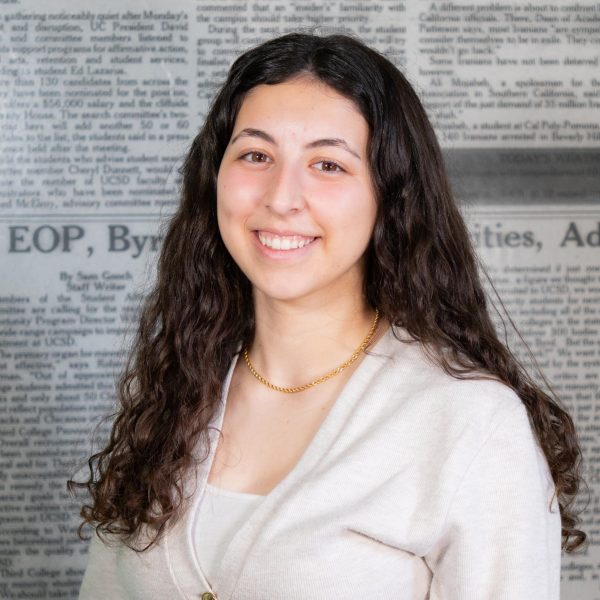
When UC San Diego swimmer Eva Boehlke touched the wall in the Big West Championship’s 200-yard individual medley, she was satisfied — winning a hard-fought gold in a Big West record time of 1:57.43.
It wasn’t until she got out of the pool that Boehlke realized the moment meant something more. She was greeted by her teammate senior Chloe Braun holding Boehlke’s ticket to the 2026 NCAA Championships with tears in her eyes. On a foggy evening in Houston, she had become the first swimmer in the country to qualify for the national collegiate meet.
The moment was a shock, but not because Boehlke lacked confidence. She didn’t know the specific time she needed to auto-qualify for the NCAAs — nor did she care. She just always wants to swim a little faster than last time, hoping simply to better herself.
Throughout her swimming career, Boehlke has avoided the ultracompetitive impulse to strive for win after win. Instead, she strides for personal records and does so for herself, becoming an athlete whose visible confidence and optimism have pushed her to greatness. Joy — not pressure — has always been the force that carries her forward, from childhood practices to the NCAA championship stage.
When she was 6 years old, Boehlke began swimming for one simple reason: She wanted to spend time with the neighborhood kids in Durham, North Carolina.
“I was really bad,” Boehlke said in an interview with The UCSD Guardian. “I was really slow for a long time, and then, all my friends moved up to the next group. And I was like, ‘Wait, what do you mean? … Okay, I need to lock in, so I can follow them.’”
Boehlke didn’t give up on swimming when she wasn’t promoted alongside her friend group. Instead, she begged for another chance. The young swimmer’s pleading, along with her promised effort, was enough. Her coach, who saw a girl who just wanted to spend time with her friends, bridged the path that launched Boehlke to being one of the fastest college swimmers in the nation.
“If she hadn’t been willing to let me in, I probably wouldn’t have been here today,” Boehlke said.
Her success was made possible by a coach who took a chance on her, parents who loved her for being their daughter — not for being an athlete — and a team who made the pool her second home. They protected her love for swimming through their belief in her, rather than setting high expectations.
For Boehlke, swimming wasn’t worth it if she wasn’t able to do it with her friends. She wasn’t in pursuit of competitive greatness, but of childhood friendship. Motivated by her teammates, she kept swimming and getting faster over the next eight years. As she improved, she began to consider swimming at the collegiate level.
“I think it was probably freshman, sophomore year [when I realized], because I started to get faster, and COVID hit,” Boehlke said. “All my friends were from swim, and it was just like my outlet, like my social outlet, and I was like, ‘Wow, this is really fun.’ … I work hard, and it’s challenging and whatever, but just being with people is my favorite part.”
Boehlke had planned to commit to George Washington, but she took advantage of a free trip to UCSD during recruitment season. She stepped foot in La Jolla, a coastal city defined by its beaches, cliffs, and ocean-carved landscape, and found that it was nothing like her home in North Carolina. She was ultimately convinced to become a Triton when she met head coach Marko Djordjevic, who Boehlke described as “father-like” and “very easy to talk to.”
Despite her awed first impression of UCSD, her first collegiate season as a Triton was rough. Boehlke suffered from a back injury that changed the trajectory of her college career — and may be the very reason she’s swimming at the national level.
Boehlke still doesn’t know exactly what happened, but the strain on her back brought another level of pain to swimming — especially in her main stroke, breaststroke. It became a little discouraging; every time she returned to the water, she reminisced about the speed she used to command.
“My kick was so powerful,” she said. “I remember like, gliding, and I just don’t do that anymore. And like, my knees pop … so I’m just like a little grandma, but like, super fast. I remember how it used to be — no longer.”
The injury began a new era for the soon-to-be Big West Swimmer of the Year. Boehlke’s optimism reframed the hardship, shifting her focus from breaststroke to backstroke and butterfly, where her underwater strength mattered most.
She discovered a new forte: the 200-yard IM. Finding the IM wasn’t just a strategic shift — it was how she kept swimming fun. In doing so, she found the event in which neither her Triton teammates nor her Big West rivals could keep up.
“I like the pain,” Boehlke said. “I do really like the two IM. It’s kind of, it’s fun, because you get to mix up, you know, it’s all four strokes. And so I feel like, at every 50, when you change strokes, it’s like, ‘Oh, like it’s a new race. … I’m doing something different, instead of, you know, staring at the same line at the bottom while doing the same stroke.’”
Boehlke brought her swiftness to the Big West swimming championships, ready to take home gold. Unfortunately, the meet opened with a relay disqualification when the timing system failed to pick up Boehlke’s wall touch. Why? Perhaps because her butterfly turn was so sharp and fast that the system simply didn’t read it as humanly possible.
“At other pools and other timing systems, they praise people for, like, the exchange time that I had,” Boehlke said, “But for some reason, they say it’s illegal at that specific pool. So, like, I was a little fast, but in some places that would be accepted.”
Following her roommate, junior Asia Kozan, who had just won the 500-yard freestyle, Boehlke stepped on the block to compete in the 200-yard IM. As she was swimming, she held a calm confidence — one that resisted the overbearing pressure to win as she glided through the water. She won the race with a time of 1:57.43, beating Hawai’i junior Zofia Tyminska by 0.66 seconds. Braun, in third, joined Boehlke on the podium, proud to celebrate her teammate.
“I don’t like chasing times because I’m like, it doesn’t matter, like, I’m gonna give the same amount of effort regardless of if I like, know the time or not,” Boehlke said. “So I’m like, I’m gonna have fun, and I’m gonna put everything out there. And so, I didn’t actually know what the qualifying time was. I looked up, and I’m like, ‘Oh yeah, that’s fast. Like, that’s a drop.’ And I get out, and everybody’s like, ‘That was it! Like, you did it!’ And I was like, ‘Oh, even better.’”
Part of the reason Boehlke emerged from the race with a ticket to the national championship may have been her mindset — still as eager to swim for fun, not results, as her 6-year-old self was. It also contributed to the pure joy her teammates felt for her. Braun, her teammate, friend, and competitor in the 200 IM, was the most excited to greet the gold medalist with her clinched ticket.
“My friend Chloe gave me the ticket, and she was like, ‘You, you got it, like you did it,”’ she said. “And I was like, ‘Yeah.’ And she started crying. … And then I was crying too, and … my coach, he has the video of her finding out. He was watching it, and then, he was like, ‘I started crying.’ So, it was just a very exciting and emotional day.”
With her speed, Boehlke could consider swimming professionally in the future. But the harsh routine required for succeeding as a collegiate swimmer has left her hesitant in beginning that path. There are 6 a.m. lifts, followed by hours of practice. In between all of the physical work, there’s constant homework and exams to catch up on during the short gaps in the day.
“Each swim takes so much out of you, literally, like, time, energy — all of it — that you can’t really do that many other things,” Boehlke said. “Like, especially as pre‑med, I want to shadow or I want to become like a phlebotomist, but I don’t have time. So, there’s just so many things I want to do that I can’t, and swim is also year‑round. And so, it’s like, ‘Oh, you can do it during the summer and the off‑season,’ but there really is no off‑season. I get a month in August, and that’s my off‑season.”
On the other hand, Boehlke’s dual citizenship in Peru offers an appealing path to a professional swimming career outside of the U.S. With slower cuts for who qualifies to swim for the Peruvian national team, Boehlke has a better shot than most at representing the country. More importantly, she wants to see the world and experience cultures outside of North America, while still doing what she loves.
“I want to travel,” she explained. “I think that’s why swimming for Peru would be so much fun. I love going there. I’m like, losing my Spanish, and I think going there, I’d be able to practice and meet new people. [I love] the culture aspect and traveling, seeing new things.”
Until then, Boehlke’s going to keep working to make the program faster — and more fun. Her optimism, effort, and kindness have taken her this far.
“[I want] people to just remember me as somebody who has like, a positive outlook and enjoyed coming to practice every day and really enjoyed swimming,” she said. “I think they’re like, ‘Eva just kind of shows up and has fun,’ and like, you know, I work hard and all this, but it helps so much that you don’t hate your life because you’re swimming. Yeah, I just see the positive in things.”
Boehlke has come a long way from the 13‑year‑old who was thrown into the 200‑yard butterfly and had to pause at the wall to gag before gutting it out. She’ll end her third swimming season as a Triton at the NCAAs in Athens, Georgia, from March 18 to March 21, swimming her best in the 200-yard IM and supporting her close friends and fellow qualifiers, Braun and Kozan. It’s the perfect ending to a season built on grit, growth, and the people who helped her get here.
As Boehlke looks to her future, many things are still up in the air. But there’s one thing that she’ll never sacrifice: her joy.
“There’s never been a moment where I felt pressure to be good,” Boehlke said. “I do it because I enjoy it.”