

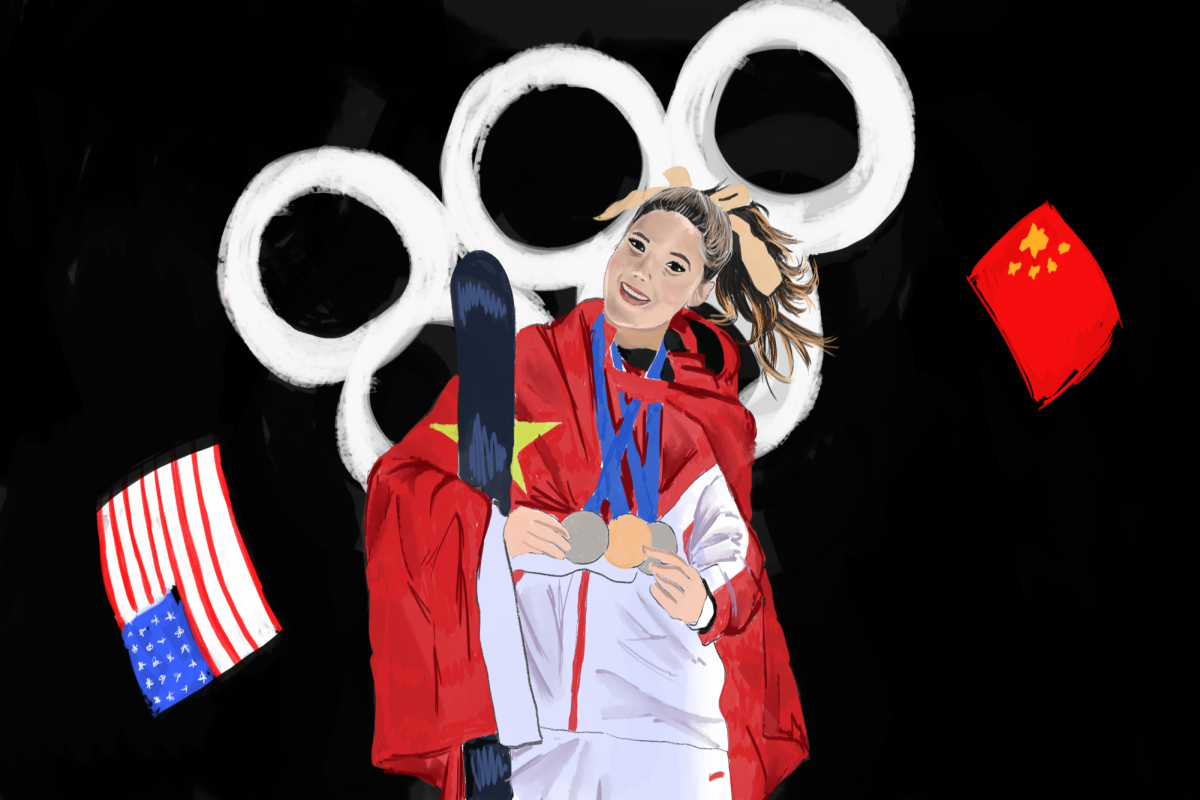
Last month, freestyle skier Eileen Gu soared through the halfpipe, landing the kind of runs that win Olympic medals — in her case, one gold and two silvers at the Milano Cortina Games. But her performance quickly gave way to a very different conversation.
A San Francisco-born freestyle skiing prodigy who has competed for China since 2016, Gu became the center of a political firestorm during the 2026 Winter Olympics. Public figures across the ideological spectrum, including Vice President JD Vance, argued that someone who “grew up in the United States” and “benefited from our education system” should compete for the U.S.
But this expectation is strangely selective. Cases like Gu’s are hardly rare.
Take tennis star Naomi Osaka, for example, who has lived and trained in the U.S. since she was 3 years old and competes for Japan, the country of her mother’s birth. There’s also NBA guard Jordan Clarkson, born and raised in Florida, who represents the Philippines to honor his Filipino heritage. Neither athlete caused nearly the same level of national debate on whether they had somehow “benefited from American freedoms” and therefore owed the U.S. their allegiance.
Perhaps the closest parallel is freestyle alpine skier Zoe Atkin, who competed alongside Gu in the 2026 Winter Olympics. Atkin grew up between the East Coast and Utah and now attends Stanford University — the same university as Gu. Despite being born and raised in the U.S., she chooses to represent the United Kingdom through her father’s nationality. Like Gu, Atkin developed her athletic career in American training systems while competing internationally for another country.
All of these athletes share similar biographies: American training, American education, and dual-nationality backgrounds that allow them to compete elsewhere. Yet, only one has been so widely criticized for it. If the concern were truly about athletes exploiting American resources to compete abroad, Gu — who spent summers in Beijing throughout her childhood — would arguably face less criticism than athletes who have spent little or no time in the countries they represent.
The difference is not the act itself, but the country involved.
Critics point to China’s human rights record as the central indictment of Gu’s choice, the tone of which can border on absolutism. On “The Ingraham Angle,” for instance, Fox News host Laura Ingraham criticized Gu for being “paid off by a communist country that tortures political prisoners” and “oppresses Christians.”
This discourse treats Gu as if her Olympic affiliation perfectly reflects her take on global politics. Yes, China’s human rights record is undeniably serious and complicated. But since when were athletes meant to function as geopolitical moral agents? Athletes are competitors, not diplomats. They do not negotiate treaties, alter foreign policy, or determine a nation’s human rights record.
Not only are these criticisms of Gu flawed, but they are also deeply hypocritical. Many of the same voices claiming Gu should appreciate American freedoms are also defending President Donald Trump’s policies that erode those very freedoms at home. Over the past year, Trump has been accused of targeting protestors and violating their First Amendment rights while backing deportations that bypass basic due process. To apply the defense of “American freedom” selectively is an inherent contradiction.
Beyond all of these inconsistencies lies a more personal reality. Gu is arguably as Chinese as she is American: She was raised by a single Chinese mother, speaks fluent Mandarin, and spent much of her childhood traveling to Beijing each summer to attend cram school. Yet, even this biography is beside the point. Identity, especially for children of immigrants, is rarely confined to a single national label.
The real question is this: Are dual-heritage Americans only allowed to “choose” one side of their identity when that choice aligns with U.S. interests?
The cases brought against Gu — that she was “sold out” to compete for another country, that China is communist, that she somehow owes the U.S. — begin to collapse the moment they are placed alongside the many similar cases that seemingly provoked no outrage at all. What is left behind is less about anything Gu herself did and more about the discomfort of seeing a star athlete win medals for another country.
Strip away the moral posturing and call it like it is: The U.S. is angry that it didn’t make the podium.



Mr G • Mar 9, 2026 at 12:17 pm
Great article listing many other athletes that fall into a similar camp as Eileen. Especially the similiarity with Zoe.
The near daily rhetoric and beat ups from social platforms, mainstream media and keyboard warriors is so old and tired now, it’s just noise and garbage. I nearly find it entertaining now, to see and read the right wing dribble and click bait headlines from the media outlets, and I lean right wing politically! – I hope Eileen and her mother feel the same.
It was so warming and pleasing to see the overwhelming support and appreciation for Eileen at the Chinese New Year celebrations this week in San Francisco.
Yes, there is some greyness, citizenship questions, a tiger mum striving for the best opportunities, smart brand alignment, structured media responses, financial success, proactive personal exposure, but above all else, as many read it, first and formost, Eileen is a highly aspirational, dedicated and motivational athelete, student and model. That can’t be questioned.
And only 22.
For a decade she has promoted for young female empowerment in her sport, for multi-cultural indentities, she’s exhibited consistency, passion, dedication, commitment, self assurance & confidence and self-ownership of her space, place and time, she’s done it.
Choose to beleive her reasons why she represents China and young females, or don’t, each to their own, but a decade of doing what you said you would do (integrity), to me that is good territory to be in.
That’s why Alysa Liu has called BS on the treatment of her.
I would ascertain that many of those throwing stones, have got broken glasshouses.
China and USA each have some pretty shocking geo-political records, both recently and historically, neither to which Eileen has any involvment in or is answerable for.
Yet in this modern day broken and disruptive society, the atheltes pay the price if they represent any nation with questions. Look at all the Russian athletes.
Recognising Eileen as the bi-culture indiviudal she is, I really appreciate that in her sport especially, she promotes both domestically and abroad.
Yes she can occasionally tow a line finely between the arrogance/over-confidence state and the realism, genuineness/self-confidence state, (mostly erring on the right side of that line – just) but hey, she appears to have thrown the kitchen sink at trying to be the best and has acheived it. And she also has her moments of vunerability and humility.
From my persepctive, as a westerner with a multi-cultural 1/2 asian teenage daughter, the Chloe Kim’s, Eileen Gu’s, Alysa Liu’s, Zoe Atkins of the Skiing and Snowboarding world, are all inspirational, motivational and leading example figures to my daughter and her Gen Y western father.