This was a difficult review for me to write. SML’s performance at The Loft last Wednesday doesn’t lend itself to a conventional concert review. Some concerts are easy to document: a setlist to follow, standout songs to dissect, a clear arc from opener to encore. SML’s performance offered none of that — and that was precisely the point.
Wednesday’s show was different right from the outset. The stage held only four musicians: synthesist Jeremiah Chiu, saxophonist Josh Johnson, percussionist Booker Stardrum, and guitarist Gregory Uhlmann. SML is usually a quintet of artists from Los Angeles, known for blending traditional jazz structures with electronic textures to create something distinctly modern. As I took my seat, I overheard the group at my table lamenting the absence of bassist Anna Butterss, naming her as the reason they had come in the first place. It was a reminder that, for many in the room, this wasn’t casual attendance — it was devotion.
The crowd itself felt unlike the usual Loft demographic. Instead of the steady wave of UC San Diego students typical of campus shows, the space rapidly filled with an older generation of jazz enthusiasts. Surrounded by paperboy hats and infinity scarves, I felt distinctly out of my element, but absolutely not unwelcome. If anything, the audience composition signaled that this would not be a conventional campus concert.
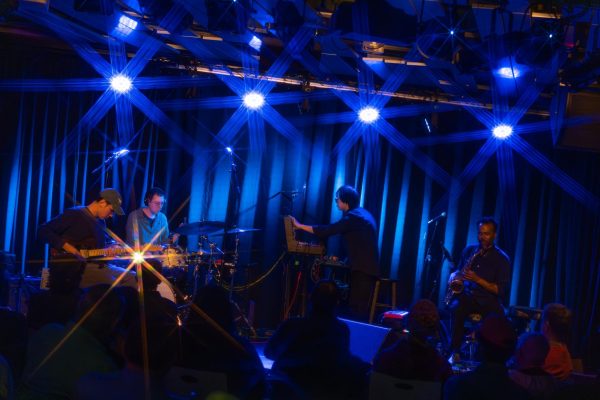
And it wasn’t. SML’s set unfolded as a continuous hour of improvisation. There were no clear song breaks or visible signaling between members. The performance opened with Chiu coaxing scattered, almost alien tones from his synthesizer — beeps, hums, and frequencies that felt more environmental than melodic. For a moment, it was disorienting. Gradually, those disparate sounds began to cohere as the other musicians entered one by one. Johnson’s saxophone threaded through the electronic haze, both restrained and searching. Stardrum laid percussive textures that built atmosphere even more than they established rhythm. And Uhlmann’s guitar lines, while more muted, anchored the abstraction.
Harmony, when it finally arrived, sounded earned rather than predetermined. It surfaced almost accidentally in a few measures where everything aligned before dissolving back into dissonant tension. The quartet seemed uninterested in settling anywhere for too long. Whenever its sound built and found cohesion, Chiu would immediately shift into something new, disrupting its established coordination. Throughout the night, the quartet cycled fleetingly through fragmentation, slow-burning crescendos, and moments of unity.
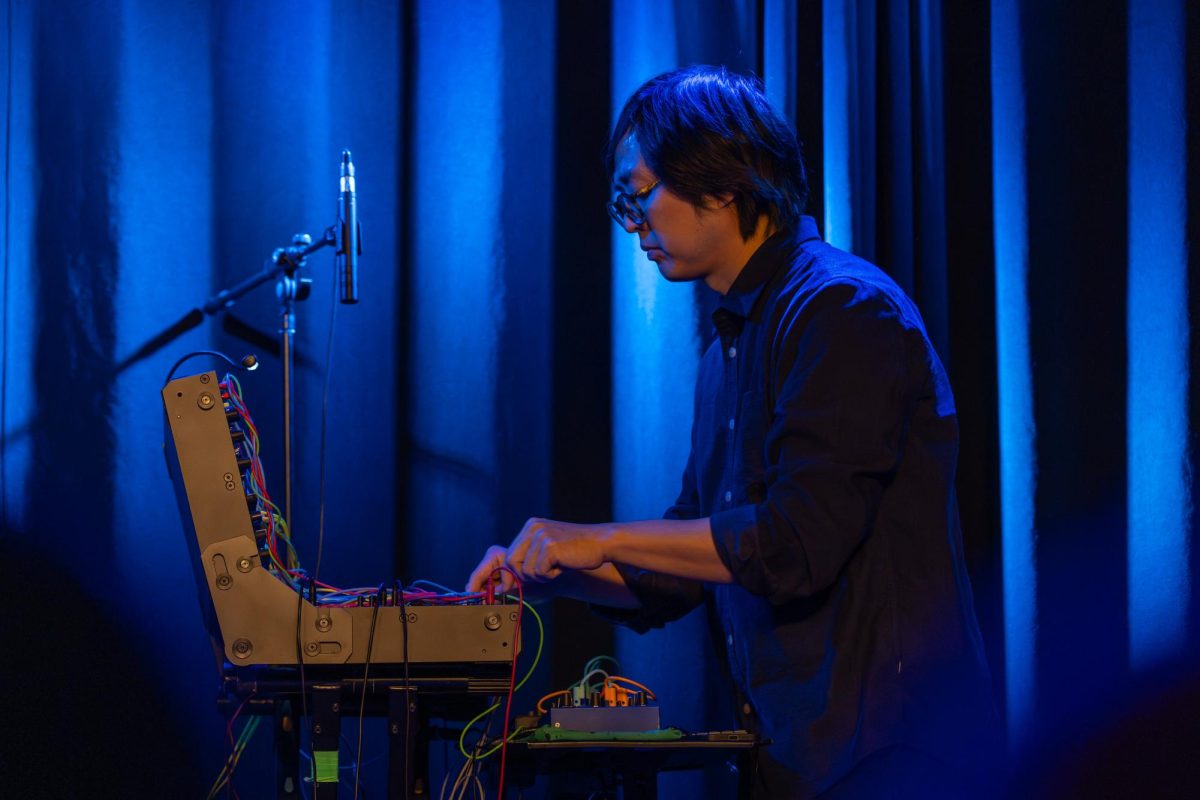
What struck me the most about the performance was the absence of spectacle. There were no dramatic lighting shifts or smoke machines, and no charismatic frontperson commanding the stage. The musicians rarely looked at the audience and barely looked at each other. Yet, their responsiveness was undeniable. I felt like I was sitting in on a practice session rather than a polished performance, and strangely, it was that intimacy that made my experience feel privileged. There is something inherently vulnerable about improvisation — about letting an idea unravel in front of an audience without knowing where it will land. We were not just spectators; we were witnesses to experimentation.
I was also impressed by how completely ArtPower staff transformed The Loft’s space. The typical standing-room-only rows of students were replaced by neatly arranged tables and assigned seating. Instead of plastic cups and shouted conversations, Zanzibar Café staff moved softly between tables, delivering wine glasses and small plates to audience members who barely broke their focus from the stage. The clinking of silverware and low murmurs blended smoothly into the ambient hum of the saxophone became a part of the evening’s texture rather than a distraction.
A steady blue light washed over the stage for the duration of the set, casting the musicians in cool tones and illuminating rows of gently nodding heads. The lighting never shifted dramatically — no spotlight solos or theatrical flourishes — just a constant, subdued glow that mirrored the music’s patient unfolding. I watched as my fellow listeners tried to anticipate where the quartet might steer the sound next, their faces suspended somewhere between enjoyment and concentration. The usual cheering between songs and phones raised to film were both almost entirely absent. Loud applause came only once, at the very end, as if interrupting the flow earlier would have broken something fragile.
For a moment, I forgot I was in the middle of UCSD’s campus. The Loft was no longer a student venue; it was more like a tucked-away jazz club in a larger city — the kind of space where people arrive ready to listen rather than to be entertained. The transformation of the room mirrored this transformation of expectation. This wasn’t a night built on recognizable hooks or crowd-pleasing crescendos. It was built on attentiveness.
That attentiveness is what ultimately made the performance so hard to pin down in writing. SML’s performance resists a neat summary because it resisted a neat structure. There were no noteworthy singles to break down, no clear setlist to analyze. Instead, there was process — sound forming, dissolving, and reforming in real time. Sitting there, I realized that the point was never resolution. It was presence.
As I left The Loft, there was no ringing chorus stuck in my head or dramatic finale replaying in my memory. What lingered instead was a feeling: the quiet privilege of having witnessed something unfinished and unrepeatable. In a campus environment often defined by spectacle and speed, SML offered an hour of uncertainty, patience, and trust. And for once, not knowing exactly what I had heard felt like the most honest response of all.