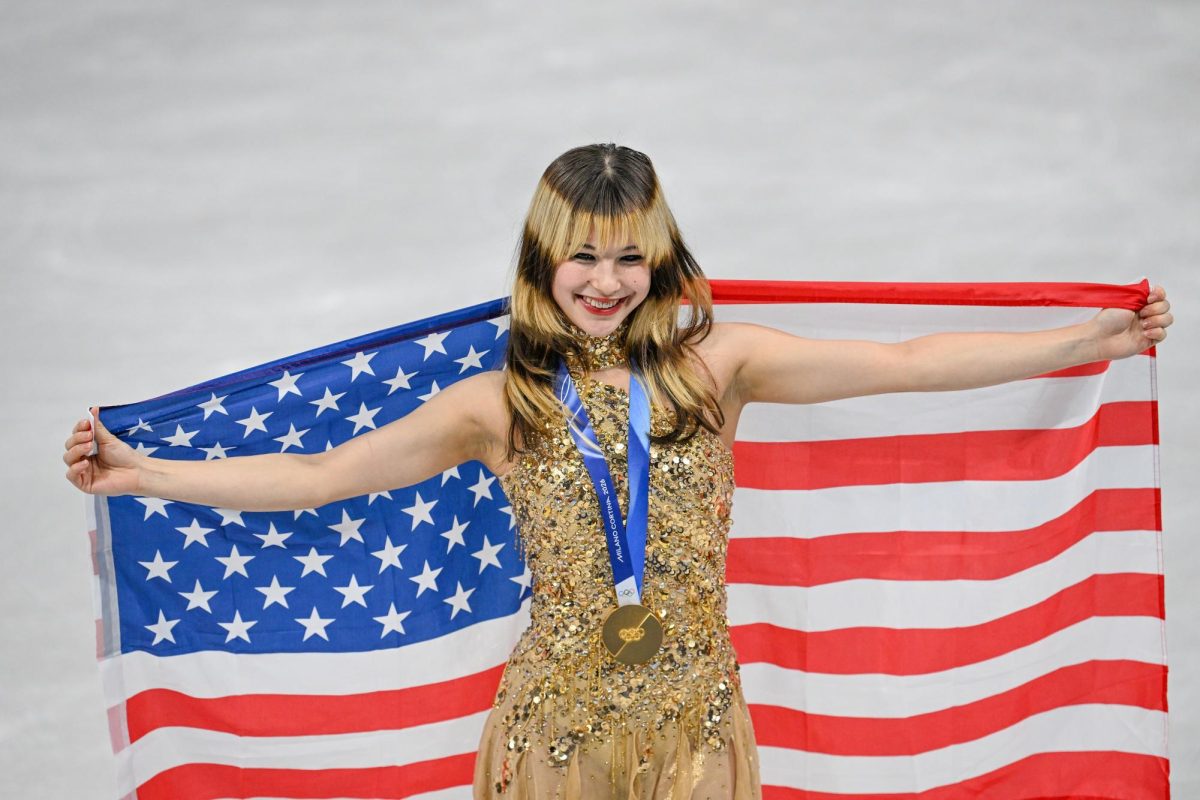
Twenty-year-old Alysa Liu stunned audiences to take gold in women’s figure skating at the Olympics last week — a feat made more impressive by her career-best total score of 226.79 points. Her hiatus only allowed her to get better — something that all young athletes can learn from.
Athletes struggle to make the decision to take a break, motivated by time, age, or even athletic ability. But young athletes should learn from Liu’s story and incorporate a break to find joy in their sport from a new perspective.
Having skated since the age of 5, Liu is the definition of a child prodigy. At 13, she was the youngest U.S. women’s champion in 2019, going on to win the same title again the following year. Then, she made the tough decision to retire at just 16 years old.
When adolescents don’t explore other parts of their identity, the one idea they are attached to can consume them — as it did for Liu — and create an identity crisis when that relationship falters. In the context of sports, it could mean that a part of their life is defined by expectations rather than curiosity to grow and find fulfillment. Liu is an elite athlete, but her experience is universal.
Like Liu, I started playing sports at a young age. At 8 years old, my time and energy was predominantly devoted to improving at the sport. The burnout and detachment that she describes experiencing was a feeling I found all too familiar.
Back when I played basketball, my world revolved around the sport. Every night was spent not just watching an NBA game, but analyzing players’ techniques to figure out how I could implement them. All I could think about was: “How much time until practice?”
Athletes at any level can understand the pressure and burnout that led Liu to take a break. I’m no Olympian like Alysa Liu, but even so, around 2020, the pressures of competitive club sports got to me. I was no longer enjoying the game; I only wanted to win.
Liu’s Olympic win proves that allowing herself to step outside of her sport only deepened her relationship with it. Watching her win as a truer version of herself, undeterred by doubts, was cathartic.
After my time in competitive basketball ended, I learned about the psychology behind an athlete’s relationship with their sport and where I may have faltered. Liu’s journey is a prime example of how taking a break can work in an athlete’s favor.
Liu’s commitment to figure skating early in life aligns with the concept of “identity foreclosure,” where individuals — often adolescents — prematurely commit to an identity, set of values, or career path without exploring alternatives.
Knowing she wanted to one day make it to the Olympics, once she won the bronze medal in 2022, Liu said in an interview with Elle magazine, “‘Well, I did it. There’s nothing else holding me to this sport. Now, I’m free.’”
During her two-year break from skating, Liu studied psychology at UCLA, hiked to the Mount Everest base camp, and explored the parts of herself that were not an athlete. She ultimately regained the same joy and curiosity she once found in the sport, but instead of it being forced onto her, she rediscovered it herself after taking an alternative route.
I held a similar mentality when deciding to set aside basketball, though it was an ankle sprain that first led me to take time away. During the first month of recovery, I indulged in side quests and hobbies that I otherwise would not have had the time for. I painted the wall in my room, drew for several hours every day, and finally picked up a few books. I had disassembled the constraints of identity foreclosure by having time to explore other interests.
My break didn’t last very long, however. After that month, I got straight back into it, with biweekly physical therapy paired and basketball practice. I had to regain my stamina and approach basic skills with the same athletic ability of a “beginner.”
I would later find that this was essentially the practice of “shoshin”, a Zen Buddhism term applied in sports psych that emphasizes maintaining a beginner mindset. It is essential for letting go of judgment or the definition of what is right or wrong.
Earlier in Liu’s career, her coaches micromanaged her every move; When she returned on her own terms, she approached her training with a clean slate — a true beginner mindset — and one that she would also control. The shoshin mindset ultimately led her to regain autonomy in her skating.
When I reflect back on my time with basketball, I know I pushed myself to limits that were unsustainable and unrealistic. The standards that Liu’s coaches had set for her were similar to what I was setting for myself. Even when I was injured, I forced myself to perform at the same level.
The perfectionist standards that I held myself to were toxic and became a breeding ground for places of improvement that became the sole focus over being present in the moment and enjoying the game. I needed to regain control of my mental strength to excel as an athlete.
Sports psych’s Self-Determination Theory is the notion that having intrinsic rather than extrinsic motivation — doing it for “the love of the game” instead of accolades or trophies — is essential for success.
I ultimately left basketball because I couldn’t escape my mental cage, and I don’t think my story is the only one. Liu and I differ — besides the olympics thing — because she got it back. She took a break.
Young athletes should use her approach as a blueprint to build a healthier sporting culture, and take a break when they need it.
For me, setting aside basketball allowed me to finally pick up that musical instrument. I bought my first electric guitar, a Fender Stratocaster, a few months after I stored the basketball in the closet. I started exploring more music, going on hikes, journaling, and taught myself embroidery. The rock band I started last year, my love for writing and decision to join the Guardian, would not have culminated had I let basketball be my whole personality.
I haven’t yet returned to basketball. In the years after I quit, I avoided even watching the sport. But now, after 5 years, I slowly find my love for basketball returning when clips of the WNBA cross my feed (go Valkyries!).
Learn from Liu’s experience: You don’t need to be on the grind 24/7. Remain dedicated and driven, but know that you are more than your sport. Expand your mindset — indulge in hobbies, think like a beginner, take control — and your athletic abilities will expand with it.