


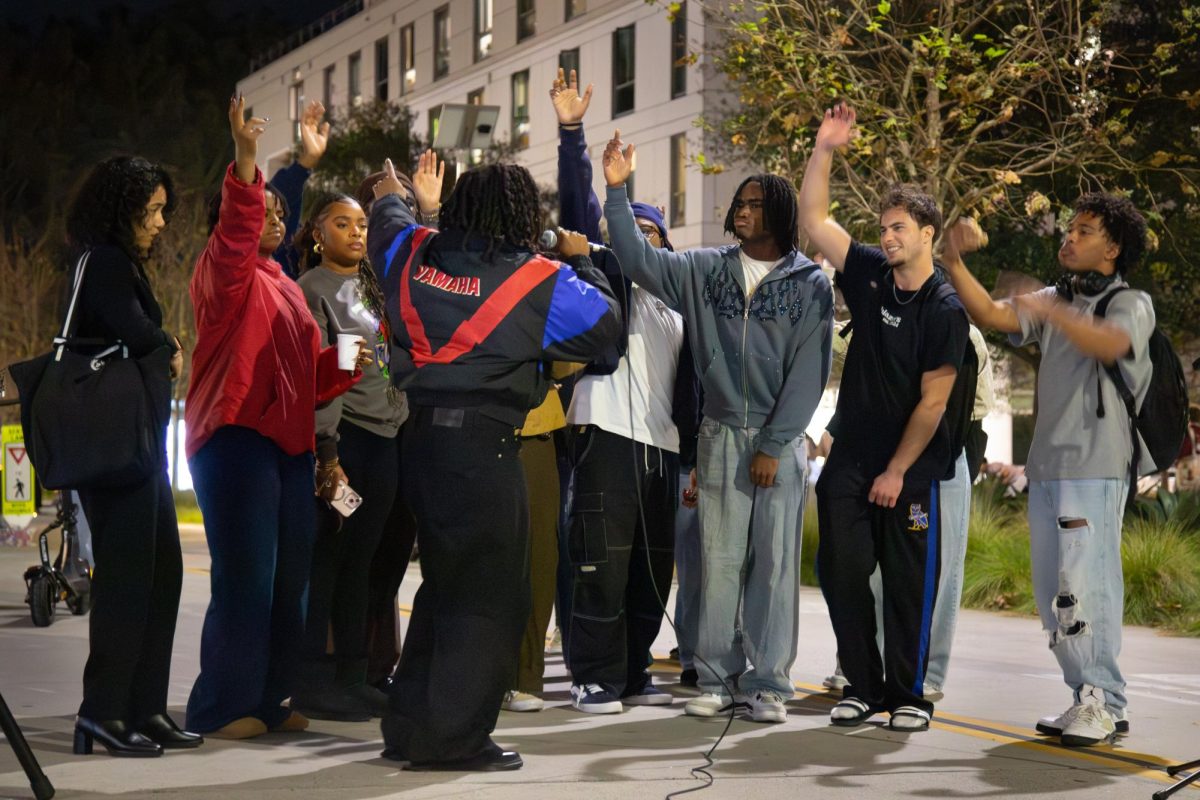
Music and movement filled Sixth College’s West Lawn this past Tuesday evening at “Let It Flow,” an annual Black History Month event that celebrates the Black diaspora through visual and performing arts. This year’s theme, “Rose from Concrete,” is a statement of the beauty that has emerged despite historical struggle and hardship. Vocal performances and dance routines brought bursts of energy to the space, while a live graffiti installation steadily transformed a blank surface into a layered, colorful tribute to Black creativity and expression.
About 10 minutes before the event started, there was already a long line of eager students wrapped around Sixth. Despite the cold weather, conversations buzzed around me, and excitement about the free swag was evident.
Designed to be both a celebration and a point of connection, the event brought together Black student organizations, artists, and performers into one shared space. Groups tabled throughout the venue, introducing students to their missions, upcoming programs, and community resources. Attendees received stamp cards at the entrance, which they could complete by visiting each table in exchange for food and merchandise.
The event began with a land acknowledgment recognizing that UC San Diego sits on Kumeyaay land — a statement frequently heard at campus gatherings. Repetition can sometimes make institutional acknowledgments feel routine, dismissive, and performative. But in this setting, the words carried a different weight. Framed alongside a celebration of Black history, art, and cultural expression, the acknowledgment felt less like a scripted formality and more like an intentional grounding of the evening in broader histories of displacement, resilience, and survival, setting a tone of reflection before the first performers took the stage.
I began the night by following the crowd from table to table. Across clubs like Black Voices Collective, the Black Student Union, and even more identity-specific organizations like the Nigerian Student Association, one message was clear: At an institution with such a small Black student population, visibility is everything. Their presence at “Let It Flow” wasn’t just about recruiting more members to their organization; it was about creating points of recognition and connection — making sure Black students could see themselves represented, supported, and part of a community. Each table functioned as both an informational hub and a statement of presence, reinforcing that Black student life on campus is active, organized, and expansive.
The standout moment of my night, however, was my conversation with Maxx Moses, a Black graffiti artist from New York whose work many students have encountered on campus, whether they realize it or not. He is the artist behind the large-scale murals at Sixth College’s Wolftown and Eighth College’s Sankofa Hall — works that have become part of the everyday visual landscape for students passing through those spaces.
At “Let It Flow,” Moses worked on a live canvas piece, a much smaller scale than his usual murals. When I first approached the scene, the piece felt simultaneously finished and unfinished, carrying beauty in motion rather than completion. Moses explained that he was “feeling the piece out” over the course of the event, reading the crowd’s energy and gradually translating that atmosphere into color and form.
Moses described graffiti as a medium shaped by controversy and stigma, often dismissed or criminalized, and that he aims to reclaim it as something intentional and powerful in his work. His installation mirrored the night’s theme — growth, resilience, and artistry emerging from unwelcoming conditions.
The flow of the evening revealed a quieter tension between intention and participation that complicated the event. The stamp card system — designed to encourage attendees to visit each organization’s table — succeeded in drawing steady foot traffic, but it also shaped the way many students engaged with the event for the worse. Movement between tables often felt fast and transactional, and I watched students bypass the event’s purpose in lieu of completing their task. Lines formed quickly and conversations too often got cut short as attendees focused only on completing their cards for food and merchandise. Performances and art installations, though central to the event’s purpose, occasionally competed with the bustle of circulation.
Still, even within that hurried rhythm, moments of genuine connection broke through. I watched as some students lingered in conversations, asked questions, and returned to performances after making their rounds through the tables. This contrast highlighted the ongoing challenge for campus cultural programming: balancing accessibility and incentive to participate with deeper engagement with the material. “Let It Flow” created the opportunity for connection with Black artistry and student organizations, even if not every attendee chose to experience it at the same pace or depth.
Events like “Let It Flow” don’t just showcase talent; they test how a campus chooses to show up for it. Between the music, murals, and student organizers, the night made one thing unmistakable: Black creativity and community are not in short supply at UCSD — attention is. Incentives may draw people to the line, but art gives them a reason to stay. When the crowd slowed down long enough to look, listen, and engage, the purpose of the night came fully into focus — not as a transaction, but as a celebration.



Issadora Saeteng • Feb 17, 2026 at 9:22 pm
Makes me happy that such events and black connection is especially present on such an underrepresented group. We had Black students union to encompass all black students so it’s kinda disappointing to learn a separate Nigerian students group exists creating division with a already smaller group but at least the representation is still there, still flowing and connecting. I miss my cultural connections and communities within UCSD that really added to my whole experience for better and for worse too!