

Serena Williams showcased her GLP-1-attributed 34-pound weight loss in telehealth company Ro’s superbowl campaign, “Healthier on Ro.” However, this campaign was far from healthy.
GLP-1 — glucagon-like peptide 1 — is a natural hormone released by the small intestine to suppress appetite. Drugs like Ozempic, Wegovy, and Mounjaro are the pharmaceutical mimicry of natural GLP-1 hormones, called GLP-1 receptor agonists. Though made to treat serious conditions, direct-to-consumer telehealth companies like Ro market these GLP-1 agonists using a tale as old as time: Healthy equals thin. Behind the facade of health-conscious language, these companies capitalize on weight insecurity, often encouraging users to sacrifice their health in pursuit of skinniness.
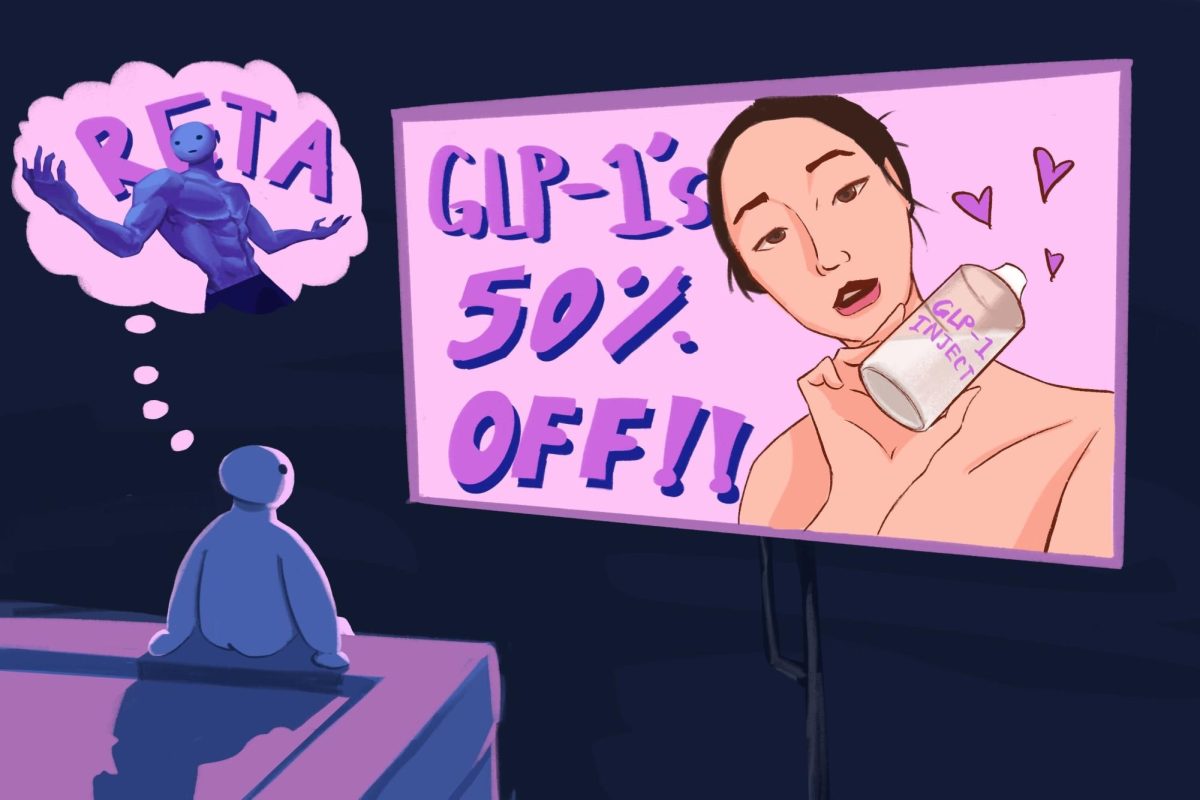
A recent conversation with a friend revealed the extent of these companies’ reach. They mentioned considering starting these drugs for aesthetic purposes like their housemates who were already taking them, joking that sometimes there “is more retatrutide in the fridge than food.”
None of the aforementioned people need to take any medication. Yet, the social pressure of beauty standards weigh on them, like they do on all of us. The marketing of GLP-1s validates our insecurities by medicalizing weight loss.
These marketing campaigns frame difficulty losing weight as the result of physiological barriers. The message is: “GLP-1s help people get to the healthiest versions of themselves.” These companies say your health is the issue, but that’s not what they mean. They’re feeding into existing insecurities by implying that any body larger than thin is unhealthy. And then, they sell you the “solution.”
An increasing number of telehealth companies are making GLP-1 agonists easily accessible at a lower price point and more convenient methods of obtaining prescriptions. While the drugs themselves have potential benefits for some, modern telehealth companies — in a bid to sell to all — are weaponizing language around health and medicalizing insecurity to turn a profit.
Further evidence of this lies in how these GLP-1 agonists have actually affected users. In an interview with The New York Times, Ozempic user Renata Lavach-Savy shares how the medication actually hurt her health. Before starting Ozempic, she worked with an intuitive-eating nutritionist who helped her develop a positive relationship with food.
Then, one day, her doctor suggested Ozempic. It ended up not only ruining her relationship with food, but also left her fatigued, depressed, and medically malnourished. Lavach-Savy is not the only one who has had a bad experience with GLP-1 medications. Users consistently report symptoms of depression, nausea, vomiting, and even organ dysfunction.
Lavach-Savy wasn’t initially seeking out this medication; she accepted her doctor’s suggestion because she thought it may benefit her in ways she didn’t understand. Instead, it ruined her health and undid the effort she spent on healing her relationship with food.
These companies aren’t marketing health; they are selling thinness. As a business decision, it makes perfect sense: When all the big influencers and celebrities have the same, “ideal” body type, the viewers at home are primed to purchase products that promise the same look. But these medications are not the solution to our insecurities. Body dissatisfaction is often not medical — it’s the result of corporate manipulation.
What we really need is a more honest understanding of health. This requires that we challenge beauty standards, practice self-love, and recognize that our well-being is defined by far more than our weight or the way we look.



Issadora • Feb 17, 2026 at 9:30 pm
Saying you’re medicalizing health and weight or body size is physical is still ignoring that health and weight are far beyond skin deep. Obesity is often a medical issue that incudes psychological issues yet no one wishes to acknowledge that. These drugs are only included as medicalizing yet without them, suddenly it’s only about will power, self control and doesn’t seek to help all with body issues. The drugs are seeking to make profit off body insecurities, true… but ignoring all of the other issues that add to body insecurity such as fatphobia, blaming people on their unacceptable weights and encouraging disordered eating are the real issues that deserve attention, even medicalization if it helps people to improve themselves and their overall health.