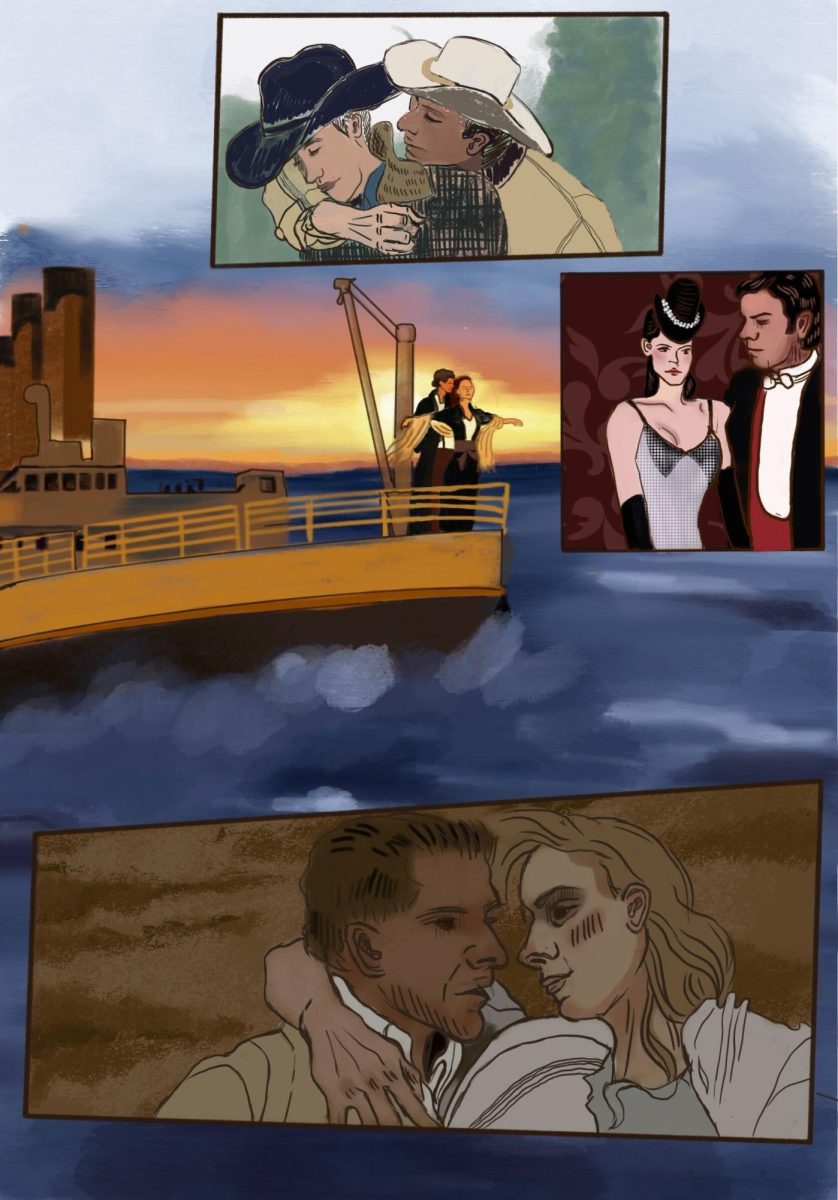
The epic romance genre in film seems to have blown away with the fair-weather winds. Sweeping romances like “Titanic,” “The English Patient,” “Brokeback Mountain,” and “Moulin Rouge!” have been left behind in the 1990s and early 2000s, associated with one-line punches and high-stake settings often frowned upon in the present Hollywood mainstream. Only a few impassioned orators today still whisper the remnant memories of great love stories, drowned out by the modern conglomerate tides of sequels, franchises, and rom-coms.
Picture this: An unsinkable ship drowns amid bloodcurdling screams and the scraping of titanium. A plane on fire crashes into the empty sands of the Sahara Desert. A bond forged in mountain-top serenity is violently broken by a tire iron to the face, laid to rest in the disturbingly quiet shadows below. Terminal illness reaps tragedy in front of a crowded room begging for more.
The loudness of such images invigorates Michael Ondaatje’s words in his 1992 novel “The English Patient,” which speak no greater, more indomitable truth than this: “New lovers are nervous and tender, but smash everything. For the heart is an organ of fire.”
Are audiences truly tired of the idea of an “epic” love? Well, the chemistry read is back, and it’s a painful report: We’re just not into it. More than ever before, modern romance films have reverted to simpler, sillier ideas of what pure love means. Rom-coms easily incorporate these laughable archetypes and overflow with shallow storylines that lack emotional depth and sincerity. In turn, we mirror them.
We drone on about a “loneliness epidemic,” desiring a fulfillment that reflects our deepest desires. Meanwhile, we prove these desires insincere by divulging in — let’s be honest — utterly surface-level representations of romantic love in rom-coms.
Don’t get me wrong: I love romantic comedies. I loved Heath Ledger as Patrick Verona in “10 Things I Hate About You.” However, I truly fell for Ledger’s performance as Ennis Del Mar in “Brokeback Mountain.” That’s something entirely different.
On-screen love should not be confined by external boundaries to one “silly” place in our hearts; it should send us into our innermost caves, where our darkest fears are trapped, until we are able to step out and embrace our authentic selves — not in an act of self-sacrifice to the other, but of self-surrender to our most lovable flaws. A primal part of ourselves understands this.
The rom-com genre, under scrutiny, collapses in on itself. Romantic comedies, which must overproduce happy endings and popping colors, could not possibly convey the depth of human love that grand stories like “Brokeback Mountain” do. Not only does “Brokeback Mountain” depict queer love with brutal honesty before queerness came into conversation — both within the film’s time period and in the industry at the time of its release — it shows us how valuable it is to see romance authentically portrayed as something entirely intrinsic to the fullness of the human experience.
When Ennis visits the childhood room of his love Jack Twist (Jake Gyllenhaal), the lonely scene brims with his presence. The room evokes purity of soul and exists untouched by the outside world — only by Ennis. He leaves with Jack’s old jacket, in which lies his own shirt, and hangs the conjoined pieces of clothing with the famous final utterance of “Jack, I swear.” It hangs there forever, an eternal flame and protected artifact of purity that could not be erased by even the world’s darkest shadows.
This is the depth the epic romance genre inspires that the rom-com just can’t muster. Some things are best left unheard or unseen, but completely felt. Dull and dark on the surface, epic romances carry your heart to faraway places and reawaken your fiercest, most fiery desire to consume feeling and possess all. They’re a candle in the dark, a drum line to the heart, and a vibration of strings within the ribs. They define love as purity of soul and rule over memory, forever young. The epic romance does all of this without desperation, while the rom-com is a hopeless attempt at flaunting something that does not beg to be seen.
Texts like the war story “The English Patient,” the tragedy “Titanic,” and the musical drama “Moulin Rouge!” all convey the same theme of Jack and Ennis’ epic romance — namely, the gravitational and prophetic forces of love that are so memorable and distinct to our species.
Through a simple shot or item preserved in time, these other magnificent stories have branded our own memories, subconsciously or not, to form an unforgettable iconography that brings true love to life: Count László de Almásy leaving the Cave of Swimmers with Katharine Clifton pressed to his chest, his face contorted by a feeling of debilitating pain that burns away any recognition of who he once was; Jack Dawson and Rose DeWitt Bukater flying at the mast of the Titanic, a memory that floats on in perpetual dominion of the ocean; and Christian and Satine acting like fools as they sing “silly love songs” in the courtyard of the Moulin Rouge, a place that Christian will return to in his subconscious as he inks the words “The greatest thing you’ll ever learn is just to love and be loved in return.”
Life is temporary; love is forever. The heart possesses the greatest capacity to love. When you love someone, you become bewitched by visions of their past, present, and future selves; to fall in love is to be reinvented into something more beautiful and intertwined with life. A lot of life may seem dark and dull, but it is those feelings — transitory yet immortal in memory and storytelling — that make it all worth it. Why not become inspired by grand films that eternalize those feelings? Why not take love seriously?
This is a plea to bring the epic romance back to theaters. I’ll never let go of its grasp.