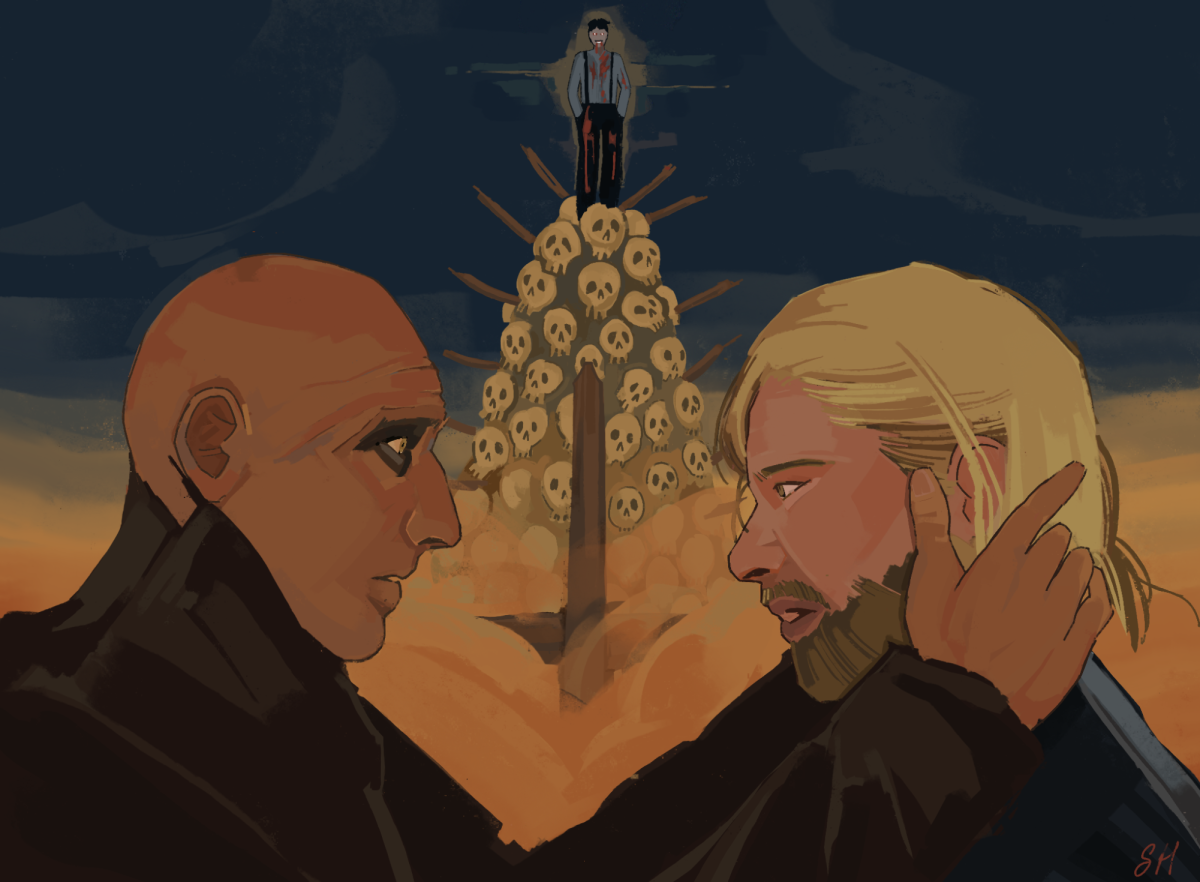
Philosopher George Santayana once famously said, “Those who cannot remember the past are condemned to repeat it.” This sentiment is what informed Dr. Ian Kelson’s (Ralph Fiennes) momentous decision to take cult leader Sir Lord Jimmy Crystal’s (Jack O’Connell) head in his hands in “28 Years Later: The Bone Temple” — not to project fatherhood or idolatry onto his loveless aggressor, but to make a last-ditch effort at healing his terribly disordered life.
Nia DaCosta’s fourth installment of the “28 Days Later” horror franchise is introspective and captivating in ways that its predecessors are not. The series takes place in a dystopian, zombie-infested world that collapsed 28 years earlier when a virulent disease known as the Rage Virus broke out of a London lab. “The Bone Temple” picks up on the third film’s strange cliffhanger, when young protagonist Spike (Alfie Williams) is captured by Crystal’s Satanic cult of Jimmies — or the Fingers on his Fist, as he likes to call them. In this continuation of a story about rebuilding institutions and commemorating the past, Kelson’s Bone Temple stands erect at the center of a lonely English forest as a clinical sanctuary and ossuary to humanity’s innate sameness. Here, he discovers a cure for the virus through an unexpected connection with Samson (Chi Lewis-Parry), an alpha zombie who shows promise in his recurrent visitations.
When Crystal’s barbaric group discovers the Bone Temple, he mistakes the iodine-covered Kelson for Satan. Believing himself to be the antichrist and the devil his father, the cult leader confronts the doctor in hopes that he will approve of his works of “charity” — which involve torturing, skinning, and disemboweling innocent people in the name of Satan, or Old Nick. The Bone Temple henceforth becomes a battleground between divergent philosophical extremes of good and evil, embodied respectively by Fiennes and O’Connell.
As a legacy actor known for his roles as reclusive, morally complex characters, Fiennes has perfectly mastered the Shakespearean act. Take Amon Goeth in “Schindler’s List,” Count László de Almásy in “The English Patient,” and Cardinal Lawrence in “Conclave” as three career-defining examples. O’Connell, who arguably had his breakthrough into the Hollywood mainstream last year with Ryan Coogler’s “Sinners,” rides Fiennes’ precedent incredibly well in “The Bone Temple.” In a recent interview, he commented that working with Fiennes involves learning that will “come at you in buckets” — and O’Connell catches every single drop of Fiennes’ artistic nectar. The two thrive off of each other’s performances, flaunting a chemistry of opposites driven by biblical undertones. O’Connell’s Remmick from “Sinners,” a vampire who also feasts on people’s pain in the name of a higher purpose, is certainly watching over Crystal with pride.
Fiennes and O’Connell’s characters had both survived in a post-apocalyptic world prior to the moment when Kelson took Crystal’s head in his hands. However, they did so under directionally opposite lunar orbits, which had catalyzed their individual life trajectories to finally collide in front of the Bone Temple. Kelson chose to heal bodies and minds, seeing every individual — zombie or otherwise — as originally human and equally special. He is educated and clearly recalls what happened in the world before its breakdown. “Memento mori,” the doctor says, which translates to, “remember you must die” — a seemingly bleak outlook on life that reminds us of where we came from and to where we must go. Crystal, on the other hand, exploits a cynical view of the world that places him at the top. Sowing destruction posed as “charity” during a world crisis, he chooses to perpetuate illness and division in an attempt to forge his own history.
We can find parallels between this moment and today’s sociopolitical climate, which is why DaCosta’s film and the actors’ performances should be getting more attention at a lulling box office. In a climactic, transient convergence between the forces of Kelson and Crystal — humanity and primalism, good and evil — the fallout defines the entire film. It mirrors other crossroads that the human race has faced throughout history, when the possibilities of self-survival and self-destruction carefully interface under circumstances that have debilitated foundations and certainties. The film’s ending conveys its central message to remember that we are all the same, built from the same biological foundations. This is a divine fact of life, backed by history and science, which should become our greatest source of conviction. “It is just us,” Kelson admits at the end of the film, so we might as well “put on a great show” of goodness rather than evil toward one another.