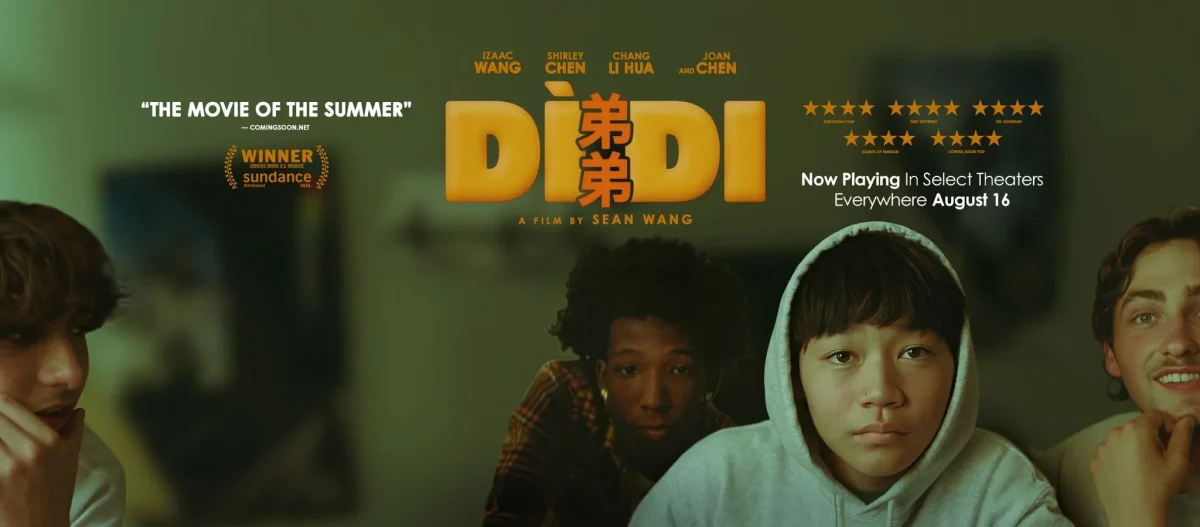
Directed by Sean Wang
Starring Izaac Wang, Mahaela Park, Shirley Chen, Joan Chen
Rated R
Release Date: July 26, 2024
Sean Wang’s semiautobiographical film “Dìdi,” whose name derives from the romanized Mandarin word for “little brother,” is a delightful look at adolescence and its accompanying growing pains. “Dìdi” was screened at The Loft as part of its “TV Dinner” series last Tuesday, where I experienced it for the first time alongside other UC San Diego students; I watched the room transform into a movie theater with the audience’s shared laughs and cringes.
We meet Chris Wang (Izaac Wang), a boisterous 13-year-old Taiwanese boy obsessed with making YouTube videos, as he navigates the transition between middle and high school in 2008. Between run-ins with security guards, comments from overbearing family members, and drafting the perfect instant messages to his crush, Chris struggles to carve out his own path as he fends off criticism from, well, seemingly everyone in his life.
Drenched in deliciously warm lighting and interspersed with handheld camcorder footage, “Dìdi” evokes nostalgia for my own childhood. Wang’s careful direction and cinematography feel like reflecting on a familiar memory; the film features glimmers of Chris’ life through vibrant shots of his home and backyard, montages of mini golfing with his friends, and brooding scenes of suburban streets.
Like many coming-of-age stories, Chris’ centers on that all-too-familiar plight of balancing what others want for him with what he wants for himself. Captivating and, at times, excruciating, his tumultuous journey finds him alienating friends and family when he rejects their expectations, before ultimately reconciling with his loved ones by coming to terms with his self-image.
I was delightfully surprised to see that “Dìdi” was set in my hometown of Fremont in the Bay Area’s East Bay, and even more amused that Chris and his friends attended my middle school. Though I finished middle school exactly 10 years after this film took place, many of Chris’ struggles mirrored my own.
Chris’ often dramatic actions both in person and over the internet remind me of my desperate attempts to be liked and seen as an adolescent, burdened by the pressure of others’ expectations and my fear of loneliness. Chris’ awkward attempts to impress his crush, Madi, seem motivated less by his feelings for her and more by the peer pressure to “work on his game.” His pursuit of Madi turns into a way to score points in his friend group, leading to uncomfortable decisions and embarrassing moments. The audience’s nervous laughter and groans at his actions reminded me of how concerned 13-year-old me was of how others perceived me — bumbling around, wary that everyone around me would think I was as cringeworthy as I felt.
During this crucial time, when everyone and everything seemed to be changing, not knowing where I belonged was horribly anxiety-inducing. Chris’ confidence teeters back and forth as he drifts from his friends and family. He temporarily finds an avenue to explore his creative passions by befriending and filming local skateboarders before he loses that, too. At the film’s climax, Chris has an explosive altercation with his mother, Chungsing. He runs away, finding himself completely alone and terrifyingly unsure of what the start of the new school year will bring.
These overwhelming feelings of unease plague Chris’ journey at every step, reminding me of how difficult it was for me, too. Figuring out not only what I wanted for myself but also standing confidently behind my decisions was no easy feat. In this way, “Dìdi” perfectly captures the challenge of maintaining authenticity in the face of external expectations.
Chris returns home the next morning, and — though afraid that her disappointment outweighed her care for his safety — he heartbreakingly asks his mother why she didn’t go looking for him. Chungsing explains to her son that her inaction was not motivated by broken trust, but by complete faith that he’d return to her. This one moment of absolute belief in him gives Chris the permission to reflect on times he acted against his own desires and to embrace the parts of himself he suppressed in fear of mockery or disdain.
Watching this film in my final year of college made me reminisce on my own turbulent and, at times, cringeworthy journey to accept myself during this pivotal period of my life. The themes and struggles depicted in “Dìdi” are a comforting reminder to my younger self that, despite fear of isolation, finding solace within and staying true to yourself is key to weathering the terrors of adolescence.