Participating Artists: Jamil Baldwin, Rahul Basu, Sophia Cleary, Walker Hewitt, Izzai Martinez Angulo, Aambr Newsome, erika roos, Andrew Wharton
Curatorial Advisor: Selene Preciado
Exhibit Dates: Jan. 15 to Feb. 13
Mandeville Gallery’s latest Master of Fine Arts exhibition, “To Hold is To Be Held,” opened last Thursday, Jan. 15, drawing in a large and eager crowd of students, faculty, and art appreciators alike. The exhibit explores the idea of a frame not merely as a border, but as a container that shapes how viewers interpret images and objects. Across photography, sculpture, video, and mixed media installations, the participating artists interrogate how memory, ritual, and institutional structures shape both what we see and how we are seen.
The exhibition asks viewers to consider the reciprocal relationship between observer and subject, suggesting that to look is also to be looked back upon.
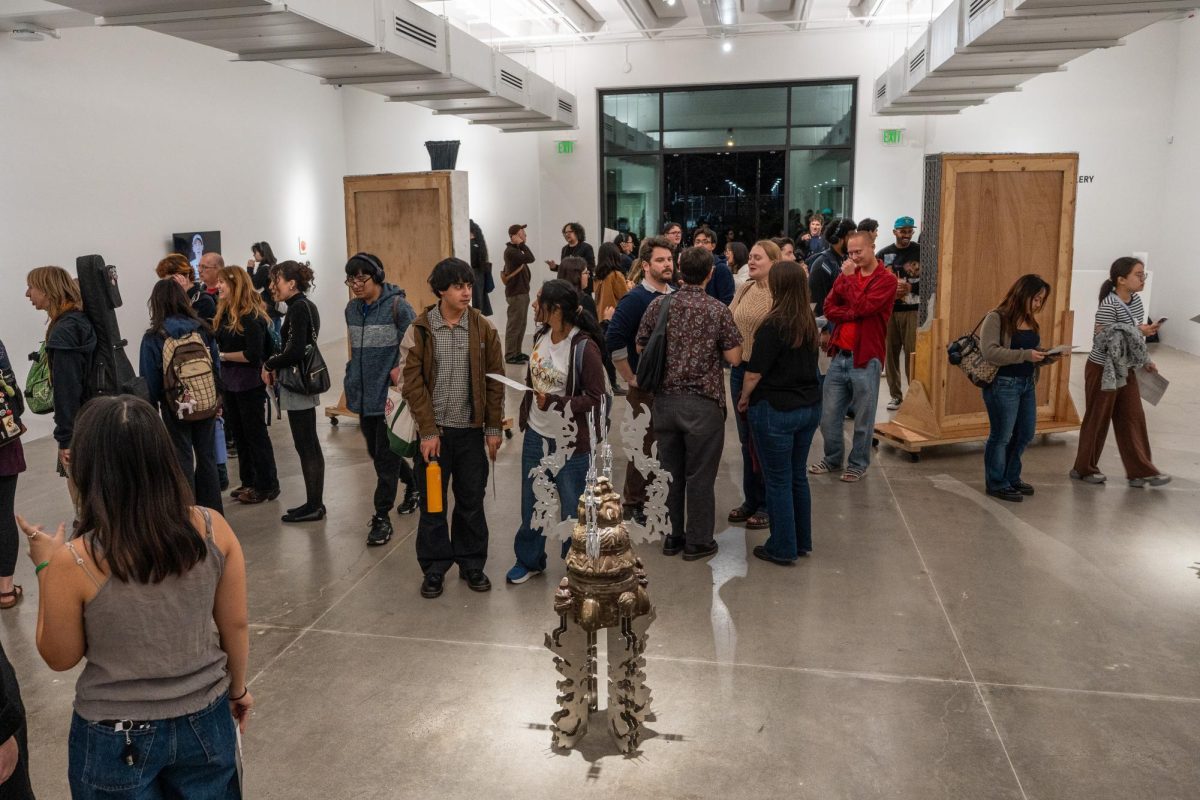
By the time I arrived, the gallery was dense with tightly clustered bodies and overlapping conversations. Navigating between the works required a kind of polite choreography — constantly saying “Excuse me,” craning over shoulders, and squeezing past small groups mid-discussion. Yet, this congestion unintentionally mirrored the exhibition’s own conceptual emphasis on containment, framing, and the complicated act of holding space.
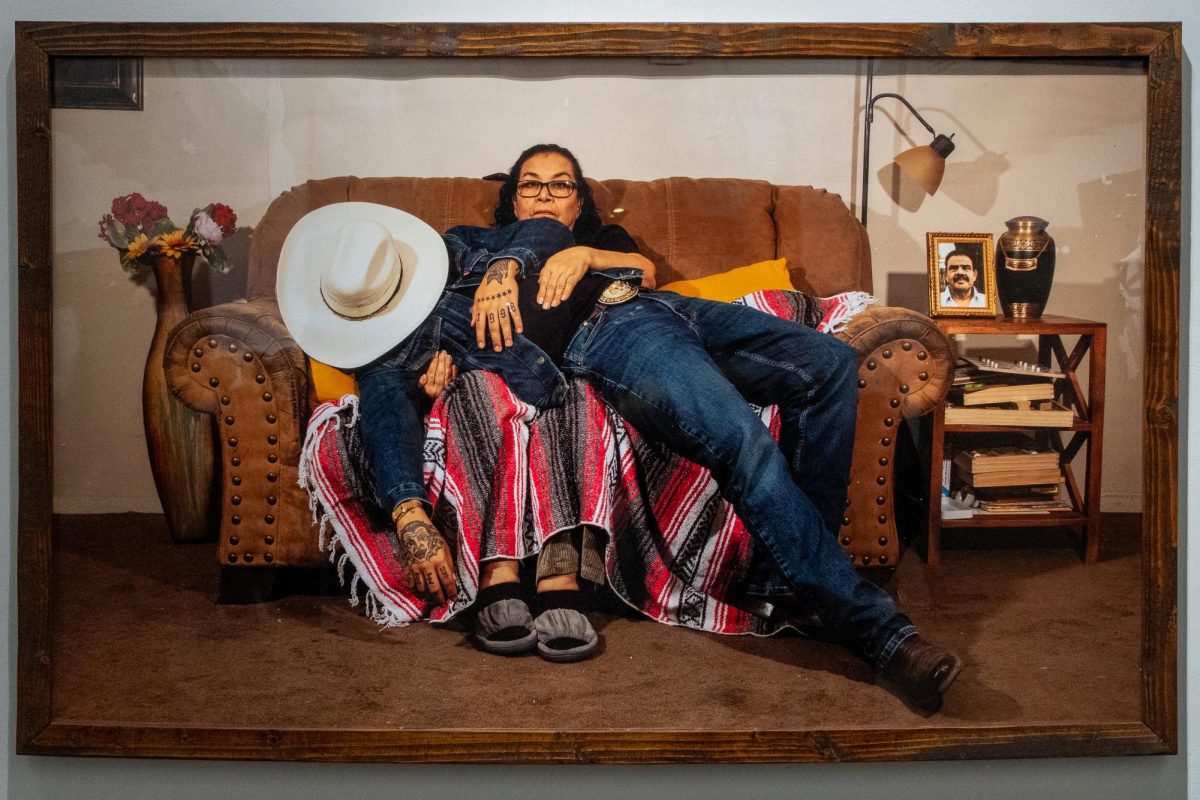
As people filtered past me, I found myself lingering longest in front of Izzai Martinez Angulo’s “Yo Jamás Sufrí, Yo Jamás Lloré.” The piece reimagines religious iconography through a contemporary, culturally specific lens. The large photograph depicts an older Hispanic woman seated on a couch, holding a man sprawled across her lap, his face obscured beneath a cowboy hat. The composition evokes the “Pietà,” Michelangelo’s famous marble statue of Mary cradling the body of Christ.
However, Martinez Angulo replaces biblical imagery with symbols of Mexican domestic life and labor: denim, boots, tattoos, and the cluttered intimacy of a living room. The handmade wooden frame further reinforces this devotional quality, transforming the photograph into something closer to a household altar. Its raw edges and visible construction marks evoke the physical labor embodied not only in the frame itself, but in the generational work, sacrifice, and care suggested by the image.
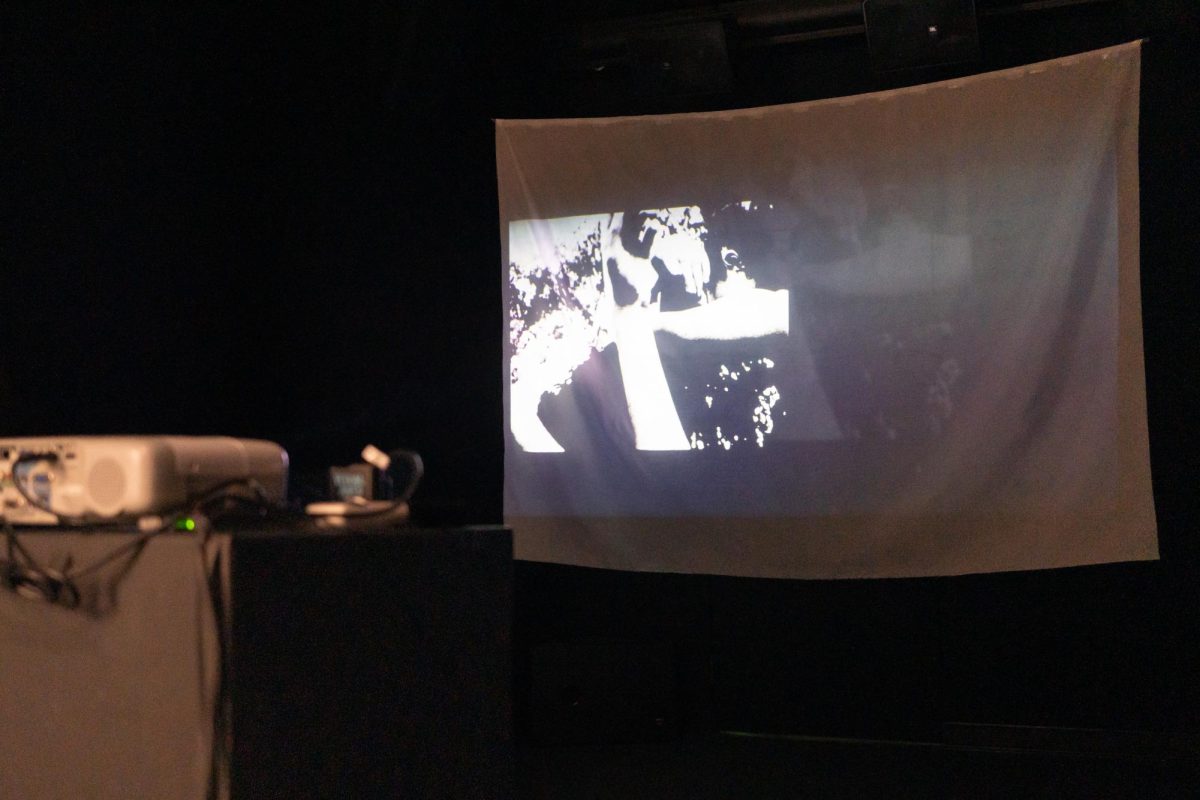
While many featured works centered on memory and domestic space, Sophia Cleary’s video installation, titled “Malediction,” directly addresses institutional presence on campus. The looping video shows Cleary wearing UC San Diego apparel as she reads Triton Alert headlines in a monotone, teleprompter-style delivery. Viewers must put on headphones to hear the audio, creating a moment of forced intimacy with the barrage of campus safety notifications.
Cleary explained that the piece emerged from her growing disturbance with the frequency of Triton Alerts, which she described as feeling like a daily curse — hence the title “Malediction.” She noted that, while these systems are designed to protect students, they also carry emotional weight, constantly reminding us of danger and instability. Although Cleary created the piece before the exhibition’s theme was finalized, its focus on institutional containment and psychological burden aligns closely with the show’s broader exploration of what it means to be held — and harmed — by the systems meant to provide safety.
Despite the exhibit’s conceptual strength, the opening-night crowd complicated the viewing experience. Installations that relied on spatial awareness, quiet observation, or physical proximity were difficult to experience amid the flow of foot traffic. In a show so invested in framing, containment, and bodily presence, the overcrowding became an unintended intervention of its own. The gallery space itself began to feel like another container under strain, holding more bodies, voices, and attention than it was designed to accommodate — an ironic echo of the show’s central concern with being held, unfolding in a space that, at times, struggled to contain its audience.
Still, “To Hold is To Be Held” reflects a growing ambition among student artists at UCSD to move beyond aesthetic experimentation and into critical engagement with lived experience. Even amid the challenges of opening night, the exhibition succeeds in provoking reflection on how we carry memory, occupy space, and navigate institutional systems. By the time I stepped out of Mandeville Gallery, what remained in my mind was not just the work itself, but the questions it raised — about who gets held, who does the holding, and what is lost or preserved in the process.