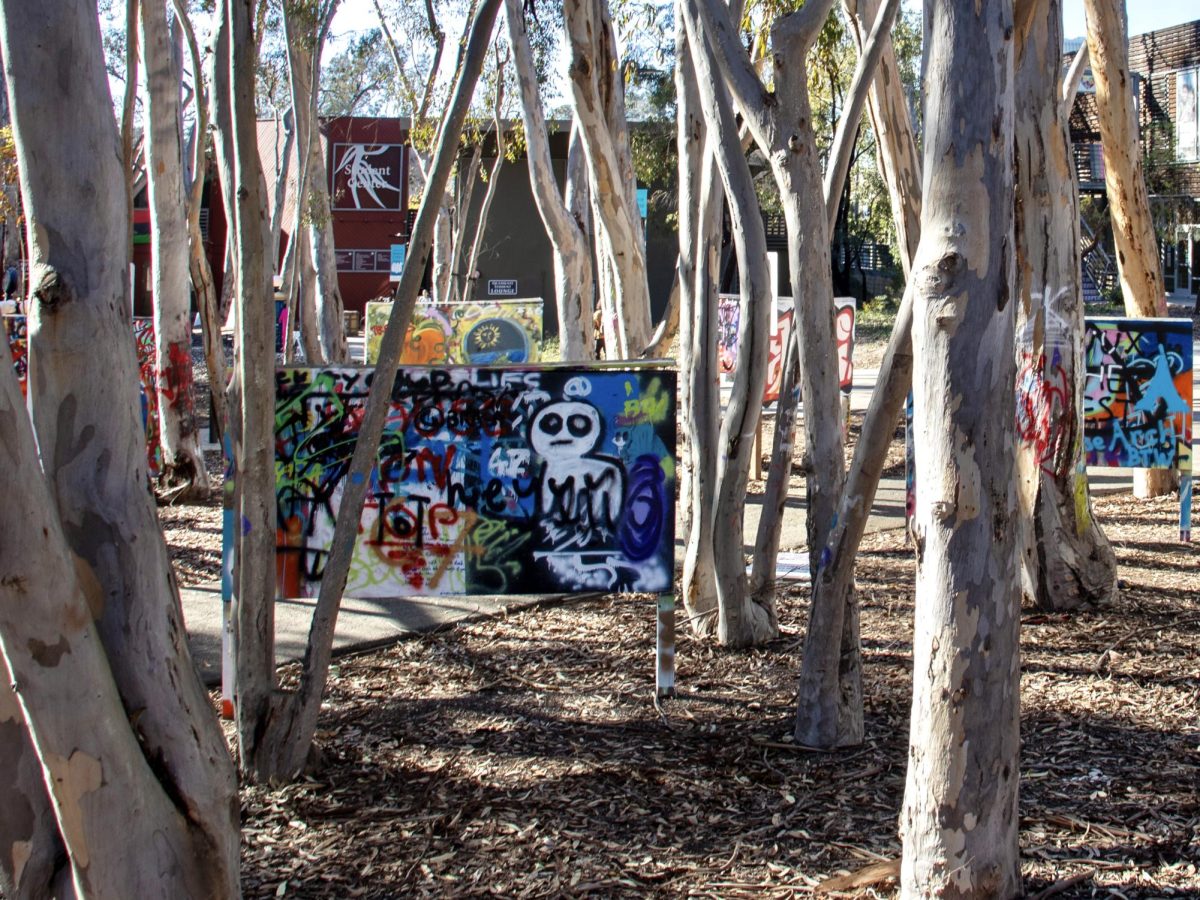
Since its construction in 2014, UC San Diego’s Graffiti Art Park has been home to an abundance of art.
A regular at the art park from Chula Vista who wished to go by the name Jay has been painting at UCSD since 2018 despite not being a student. For Jay, it is one of the few places he can safely paint in a relaxed and friendly environment.

“I’ve got spots on businesses that let me paint, but they’re not in the safest areas,” he said. “It’s hard to focus on your art when people might run up on you.”
With an immense lack of designated places for graffiti art in San Diego, the park stands alone in providing free space to support creatives, both students and regular San Diegans alike, looking to express themselves with cans of spray paint.
According to the official University Centers page, the park is an assertively self-regulated space where artists aim to produce art — not vandalism — thereby forming a shared community space.
A graffiti canvas has existed at UCSD for nearly 50 years, albeit in different forms. Emerging sometime in the 1980s, the stairwells of Mandeville Hall provided an endless canvas for graffiti artists looking to make their mark. Looking at old videos, Mandeville’s walls are unrecognizable, covered in vibrant graffiti. Although unauthorized, the University made few attempts to stop students, to the point where Graffiti Hall became just as iconic as other campus sights like the Sun God statue. However, in 2013, the University finally shut down Graffiti Hall, citing security and safety concerns. It painted over the walls, installed security cameras, and put up “No graffiti” signage — needless to say, many students were upset.

The same year, The UCSD Guardian published an article in which the author wrote, “We’re more than disappointed. In losing Graffiti Hall, we have lost an important outlet for students, removed a campus symbol, and broken a long-standing UCSD tradition: that of embracing and encouraging many different art forms.”
In response to its closure, one year later, University Centers and UCSD student Kyle Heiskala created the Graffiti Art Park, composed of eight wooden canvases tucked among eucalyptus trees, with the hopes of satiating students’ hunger for self-expression.

The Graffiti Art Park was inspired by Writerz Blok in southeast San Diego, the “first legal graffiti art park in the nation.” In 2021, Writerz Blok shut down after 22 years to make way for new housing projects. Since then, there has been no news of a new legal graffiti art park, making UCSD the only sanctioned place for graffiti art in San Diego.
While it is the only graffiti park in San Diego, existing in the great shadow of Graffiti Hall, the art park has faced judgement for its attempt to regulate art and expression to a few wooden boards. In a 2024 op-ed published by The Guardian, Contributing Writer Reanna Roblin wrote, “[The venue] has sterilized the underlying message and offered a gentrified version of the rich history of graffiti.”
Only time will tell if the Graffiti Art Park can fully shed its complicated reputation and become a true beacon of art and creativity for a community of artists often ignored. UCSD’s Graffiti Art Park may be a far cry from the glory days of unfettered creative expression on campus, but for artists like Jay, however, its small, double-sided plywood walls still do their best to embrace those eager to create.
“We need more places like this,” Jay said. “For young kids interested in progressing their art, they don’t have places to do that anymore.”