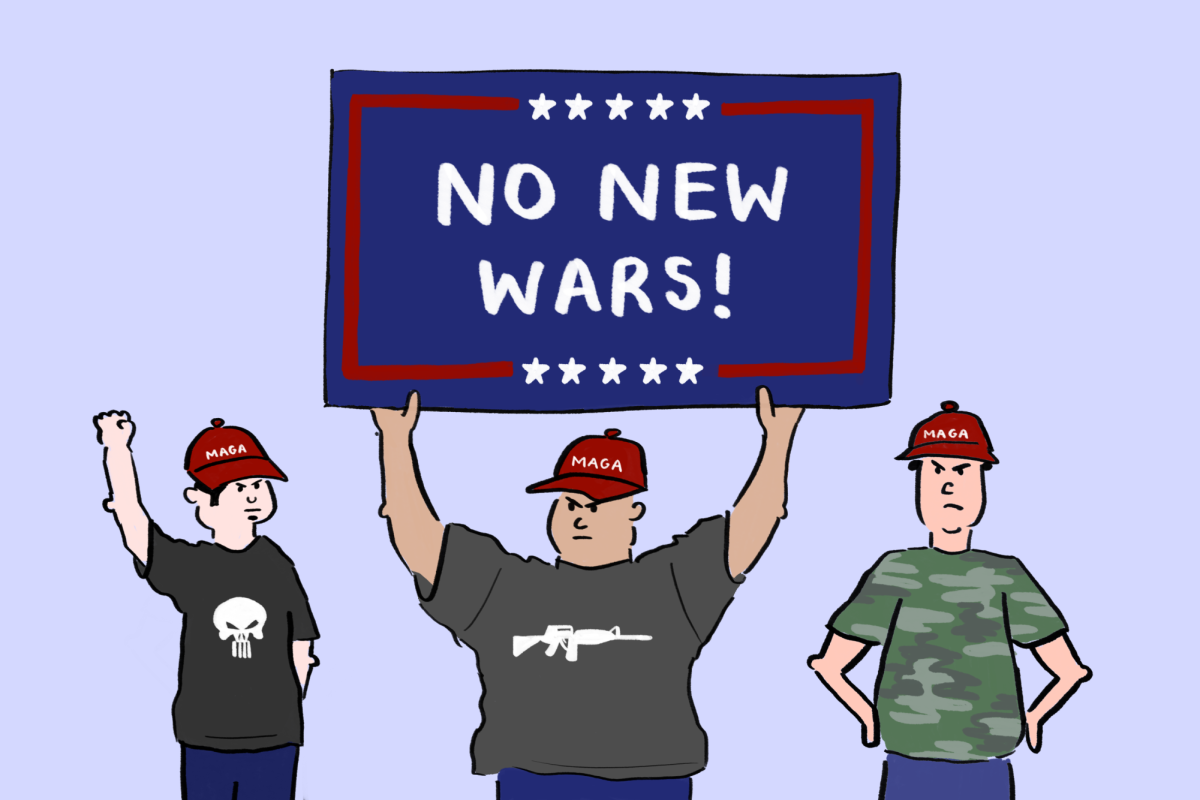
After decades of prolonged conflicts abroad, hesitation about military engagement has become increasingly common in American political discourse. Or so it seems.
Figures on the American right — namely, Donald Trump — have previously argued against nation building and foreign intervention. This message spread across conservative campaigns, right-wing media outlets, and online political spaces, warning against foreign entanglements and mocking liberal interventionism. But this posture collapses the moment that violence becomes politically rewarding, drawing praise and political support from conservative voters and commentators. The eruption of right-wing enthusiasm over the United States’ military operations in Venezuela reveals the truth: The modern American right is not anti-war.
This fundamental contradiction creates an illusion of restraint at a time when genuine restraint is urgently needed. When a movement embraces the rhetoric of nonintervention yet consistently rewards escalation, it strips military force of its political cost. Violence becomes easier to justify, more normalized, and far harder to oppose.
What makes this contradiction more than an ordinary political inconsistency is the role anti-war sentiment is supposed to play in a democracy. Public skepticism of military action functions as one of the few remaining constraints on executive power, raising the political cost of escalation and forcing leaders to justify the use of force. Without opposition to unilateral intervention, military action becomes more difficult to challenge, and there is a danger of losing meaningful political brakes on war.
The clearest way to test whether the American right is truly an anti-war movement is to observe how it reacts when unprovoked force is actually used. One of the earliest signs that this posture unravels under pressure came last fall. In September 2025, the U.S. military began striking boats in the Pacific Ocean and off the coast of the Caribbean, claiming that the ships they struck had drugs and narcoterrorists on board. Despite the serious legal and ethical questions about using lethal force against vessels without searching them first, Republicans broadly celebrated the strikes. Polling indicated that a supermajority of Republicans supported striking boats suspected of containing drugs without court approval. Few paid attention to whether the intelligence identifying the boats as drug-carrying vessels was accurate, or what precedent such strikes may set for unchecked executive power.
When the operations expanded into a full-scale campaign centered on capturing then-Venezuelan President Nicolás Maduro and controlling the nation’s oil resources, support did not waver. Instead, it intensified; polling of registered voters reveals that more than 75% of Republicans support the U.S. taking over Venezuela’s oil sales. This reaction to military force abroad in pursuit of oil flies in the face of the isolationist language fashionable among many conservative circles.
Consider how this contradiction plays out among right-wing commentators. Podcaster Matt Walsh, who has cultivated a reputation as a skeptic of intervention, enthusiastically hailed the operations in Venezuela as a “resounding victory.” Walsh justified intervention by rejecting international law altogether. In doing so, he signaled a worldview in which American power should not be constrained by global norms or the sovereignty of weaker nations.
Walsh’s sudden shift reveals how easily the language of restraint gives way to the politics of domination when American force is being exercised in a way the right finds satisfying. Military intervention becomes appealing when its consequences are externalized, producing destabilization abroad without political cost at home. Force can be exercised decisively while the human, diplomatic, and regional fallout remains distant from the American public.
That same pattern is laid bare in the political evolution of Tulsi Gabbard. As a Democratic congresswoman and 2020 presidential contender, Gabbard built much of her public identity on opposing regime change wars and warning that U.S. intervention in places like Venezuela, Syria, and Iran would be disastrous. But as she moved into Trump’s political orbit, endorsing him in 2024 and now serving as his director of national intelligence, that anti-interventionist posture became far less central to her public role. Despite promising that the administration won’t engage in regime change, Gabbard publicly praised Trump after U.S. military operations in Venezuela. The same right-wing commentators and politicians who warn endlessly about the tragedy of foreign wars and entanglements suddenly have no trouble celebrating them when those wars promise dominance, profit, or alignment with the prevailing political winds.
What all of these cases point to is a simple yet uncomfortable reality. The American right presents itself as weary of war, but consistently embraces military force when violence is framed as strength or when it advances American power and prestige. For many Republican voters, military escalation carries little personal cost while offering a sense of national pride and decisiveness.
Recent conflicts overseas serve as clear illustrations of this pattern. When the U.S. moves toward confrontation, the loudest voices on the American right shift from skepticism to approval with remarkable speed. Polling, political behavior, and elite commentary all point to the same sentiment: Military power is central to the identity of the modern conservative coalition.
The rhetoric of restraint echoes through conservative talk shows and social media from time to time, but when the U.S. actually uses military force, it is greeted less as a tragedy and more as a demonstration of national will. When it comes time to choose between caution and force, the American right has always made its true ideology unmistakable.