At its Tuesday, Jan. 13, meeting, the San Diego County Board of Supervisors advanced an ordinance that, if passed, would restrict federal immigration agents’ access to nonpublic areas of county property — such as administrative rooms and restricted offices — if the agents do not have a signed judicial warrant.
The ordinance would also require the county chief administrative officer to report any access of nonpublic county property for immigration enforcement activities to the board within three business days.
In a partisan 3-1 vote, the board approved the first of two readings of this ordinance, the Civil Liberties Enforcement and Accountability Rules ordinance. The board will take its second and final vote during its Jan. 28 meeting. It is expected to pass, given no new amendments are brought forward.
The ordinance expands on existing sanctuary policies, reinforcing the county’s stance against administrative cooperation with federal immigration enforcement activity in San Diego. The protections established by this ordinance are already codified in state law; Senate Bill 54 prohibits state law enforcement officials from assisting federal immigration agents unless a judicial warrant instructs local officers to do so.
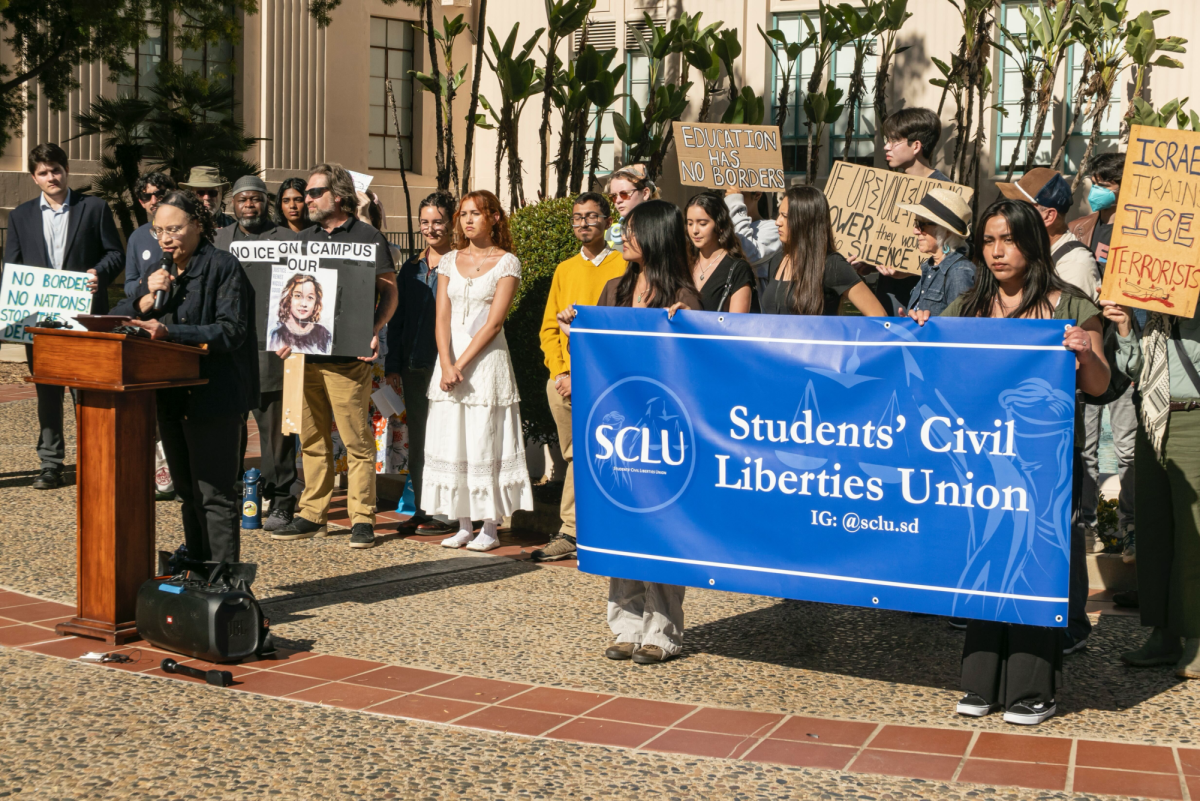
During the vote, around 20 student activists and community members rallied outside the County Administration Center in favor of CLEAR, calling for broader community organizing and collective action in response to heightened immigration enforcement in the city. Speakers included members of the San Diego Students’ Civil Liberties Union, the Justice Workshop, Movimiento Estudiantil Chicano de Aztlán of San Diego State University, high school students with the Youth Migration Justice Collective, and other community activist groups.
“We are building neighborhood solidarity networks all over the city of San Diego, so we can again protect our neighbors, protect our immigrant communities, and uphold justice,” Daniel Soria, executive director of the San Diego SCLU, said.
Democratic supervisors Terra Lawson-Remer, Paloma Aguirre, and Monica Montgomery Steppe voted in favor; Republican Supervisor Joel Anderson was the only dissenting vote. Republican Supervisor Jim Desmond was absent.
Several San Diego residents gathered inside the meeting room during the vote; they held signs that read, “YES on CLEAR” and urged the board to vote in favor of CLEAR.
Board Chair Lawson-Remer spoke on the significance of the ordinance.
“The CLEAR ordinance draws a clear line; it says our public buildings need to be places of care and not fear,” she said. “It says federal agencies must act transparently. The CLEAR ordinance makes it abundantly clear that no one operates above the constitution, above the rule of law.”
The board’s vote on Jan. 13 marks a broader effort by California toward sanctuary policies that restrict local involvement with federal immigration operations.