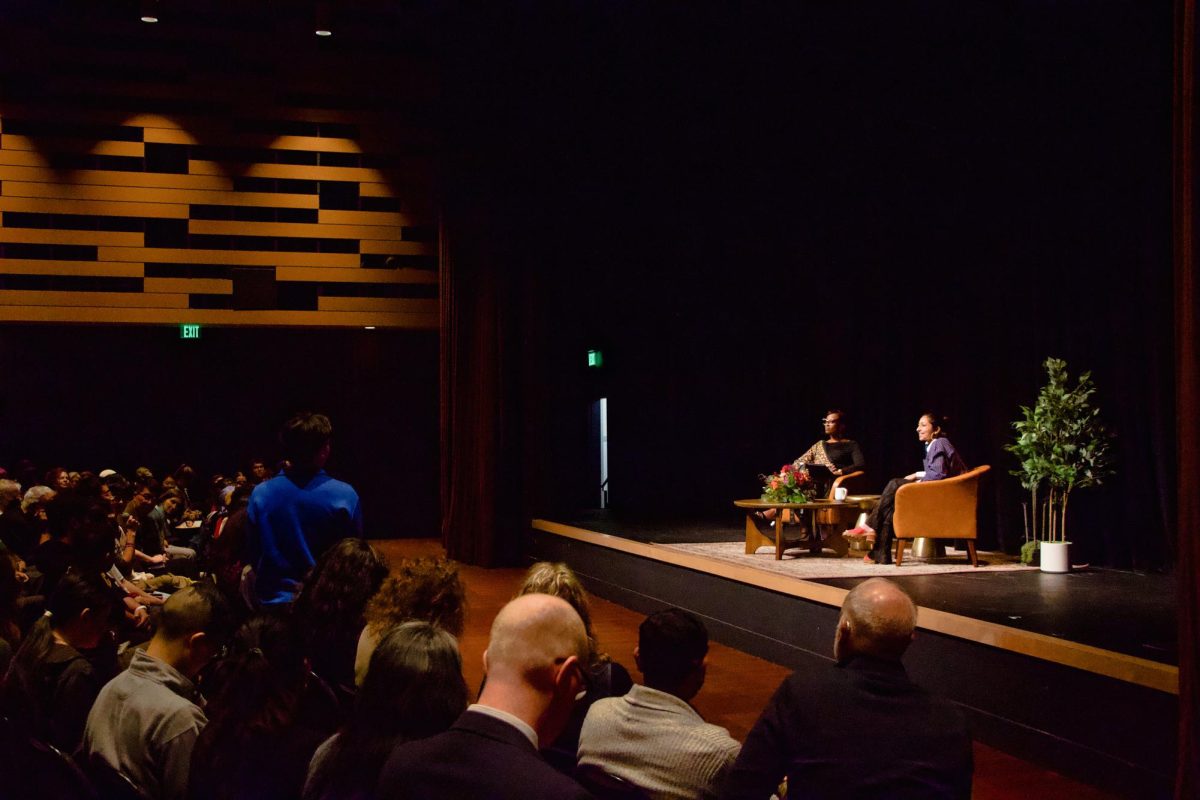
Priya Krishna isn’t your typical food writer: She’s quick, funny, and allergic to pretension. On Thursday, Nov. 6, at Price Center, Krishna reflected on food and journalism not as separate crafts, but as ways of asking questions about identity and taste. During the hour-long discussion, she returned again and again to a core principle: Curiosity, not authority, is what makes storytelling meaningful.
I first encountered Krishna’s work through the Bon Appétit Test Kitchen during the COVID-19 era, where her dry humor, inventive recipes, and appearances of her charismatic father made her stand out among a lineup of polished personalities. In recent years, since that glossy YouTube era and its very public reckoning, I’ve followed her work with quiet admiration. Her current reporting, specifically her “On the Job” video series for The New York Times, feels like a natural evolution: less about spectacle and more about empathy.
For Krishna, curiosity isn’t just a professional skill — it’s an ethic. She described the process of learning new cuisines as one might learn a language: through patience, mistakes, and the humility to start from zero. It’s an attitude that resists the traditional role of the food critic as the arbiter of taste. “Everything is delicious to someone,” she said with a smile. “If we can learn to be empathetic and curious around food, I think we can become more empathetic and curious people about everything.”
This worldview also shapes her skepticism toward the idea of “authenticity” — a word she called both overused and misleading. “Authenticity is a myth,” she told the audience. “Food is inherently dynamic.” She explained how recipes evolve with migration, memory, and access — how even within one family, dishes change across generations. Krishna illustrated this perspective with a story about her mother: a software programmer who routinely came home from work, poured herself a glass of wine, blasted ABBA, and cooked freely, blending French techniques learned from Julia Child’s PBS shows with American ingredients to create innovative Indian dishes. That fluidity, Krishna argued, is authenticity — not purity but participation.
Her reflections on identity and representation brought these ideas full circle. When asked about her identity as an Indian woman reviewing restaurants for The New York Times, Krishna acknowledged the weight of visibility and the responsibility it carries. “It is very different being an Indian woman reviewing a restaurant, frankly, than being an old white guy reviewing a restaurant,” she said. “It has been very important to present my identity first and foremost, to not shy away from it, and really talk loudly and frequently.”
Moreover, she was quick to note that progress isn’t only about who is at the table but also what is amplified. Representation, for Krishna, is less about token inclusion and more about normalization: writing about communities, cuisines, and chefs not as novelties, but as part of the everyday fabric of food culture.
Her current work, she said, aims to reflect that vision, exploring the overlooked labor behind restaurant kitchens, hospitals, schools, grocery stores, and more. “My series ‘On the Job’ is the most important work I do because it really celebrates and gives the glossy video treatment to the people who do the jobs that we take for granted, that can feel really invisible, but can allow us to do what we do,” Krishna said. It’s a quieter kind of advocacy — one rooted in the belief that curiosity and care can be radical in their own right.
By the end of the talk, the image of Krishna’s mother jamming at the stove and cooking without fear of imperfection lingered in my mind. Krishna, too, seems to move through her work that way: improvisational yet intentional, blending intellect with warmth. “If it’s delicious to you,” she said, “that’s what matters.”
In that moment, it felt like she wasn’t just talking about food, but about storytelling itself — messy, evolving, and delicious in its imperfection.