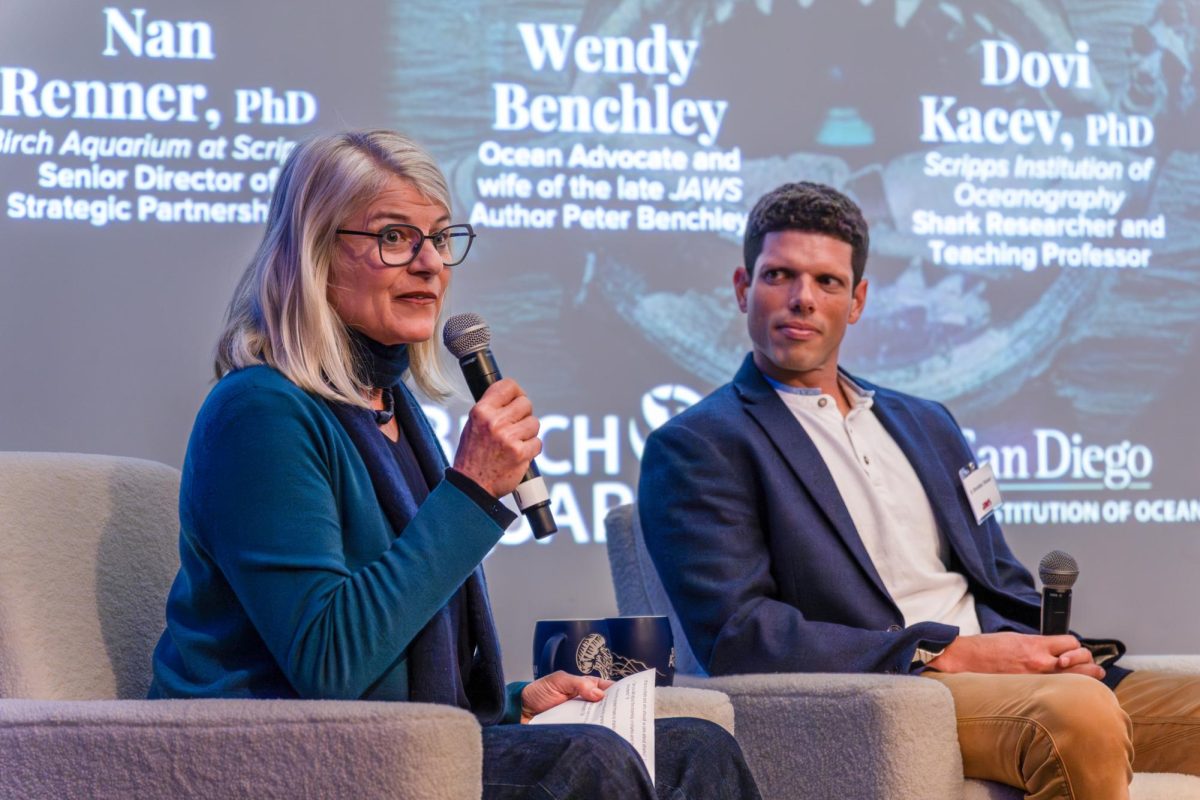
On Wednesday, Nov. 5, Wendy Benchley, the wife of late “Jaws” author Peter Benchley, joined Birch Aquarium for a special anniversary event reflecting on the film’s enduring impact in popular culture and marine science. Since the release of Steven Spielberg’s “Jaws” in 1975, Wendy has dedicated much of her life to speaking up for the very creatures her husband’s story vilified.
What began as a story that instilled fear has transformed into a vessel of inspiration, hope, and action for ocean conservation.
“‘Jaws’ did scare people,” Wendy said with a small laugh. “It tapped directly into our primal fear of being eaten by a monster; there’s no doubt it scared the living daylights out of most of us, but it also increased fascination.”
It was this fascination that led Wendy to the Birch Aquarium, where she gave a reflective presentation on the impact of “Jaws” and how “Jaws @ 50” demonstrates that storytelling can turn fear into engagement with ocean conservation.
In 1974, when “Jaws” was filming in Australia, Peter and Wendy went cage diving with great white sharks for the first time. The experience, Wendy said, was absolutely beautiful. What they once saw as ruthless predators, they now understood as majestic creatures essential to our planet’s prosperity. This firsthand encounter stayed with the Benchleys, and Wendy recalls that they “were really horrified” by audiences’ fearful response to “Jaws.” The Benchleys responded by devoting their lives to protecting the ocean; many people took the fear they experienced as an invitation to hunt sharks, but the Benchleys felt a responsibility to defend them.
For Wendy, this turned into years of environmental advocacy, including fighting to stop the building of an incinerator in New Jersey that releases harmful pollutants. More recently, Wendy was an executive producer for the documentary “Jaws @ 50,” which she believes is “making people think again about where we are with the ocean and what we need to do.” Reflecting on the words of marine biologist Slyvia Earle, Wendy reminds us that “action is the antidote to despair,” and when despair feels overwhelming, taking action can help keep hope alive.
After Wendy’s presentation, she joined Scripps Institution of Oceanography scientists Dovi Kacev and Brendan Talwar in a lively and hopeful panel discussion on how far ocean conservation has come, how much further it still has to go, and the role “Jaws” has played in raising awareness about threats to the marine environment. Wendy praised “the younger generation,” saying that they are “gonna take care of this world for us” by translating interest into storytelling and action to advocate for ocean conservation.
The discussion delved into what makes sharks so extraordinary; Kacev and Talwar described them as “an incredible group of fishes,” with new species being discovered nearly every year. Not all sharks are the apex predators we imagine them to be; most of them are not even a meter long and live more than 200 meters below the ocean surface. Each species reveals a piece of the ocean’s larger story. The “most important legacy” of “Jaws,” as Wendy noted, is that “it opened the door to understanding sharks and their role in ocean health.”
While this perspective provides insight into what is at stake in shark conservation, the tone of the evening was anything but despairing — it was one of determination. Wendy, Kacev, and Talwar all believe that true conservation extends beyond data and research, finding its strength in collective action and a shared care for the ocean. “Good management starts with science,” Kacev explained, “but conservation needs all skill sets.” From artists and educators to policymakers and storytellers, everyone has a role in shaping a sustainable future.
As the evening came to a close, the message was clear: To transform hope into real, effective change, we must understand sharks, respect their role in the ocean, and work to protect them. The discussion reminds us that in the face of serious ecological threats, storytelling, science, and community work through initiatives like “Jaws @ 50” can transform fascination into meaningful progress.