Rating: ★★★★½
Directed by Delicia Turner Sonnenberg
Starring Andréa Agosto, Stephanie Berry, Crystal Dickinson, Sean Boyce Johnson, Matthew Elijah Webb, Cornell Womack
Playing May 12 to June 7
With a Pulitzer Prize for drama and a Tony Award for best play in its back pocket, it’s safe to say that expectations were high for the La Jolla Playhouse premiere of “Purpose” from the moment the production was announced. Upon watching the performance live on stage, it became increasingly apparent why this show was so acclaimed. An effortless fusion of comedy and drama, this tale of family tension that only grows and festers before it explodes is a work of art that feels painfully real in today’s highly tense climate.
“Purpose” takes place over the course of a single night in the illustrious Jasper household, a prominent Black family led by the stalwart pastor and civil rights icon Solomon “Sonny” Jasper (Cornell Womack). After a visit from youngest son Nazareth “Naz” Jasper’s (Matthew Elijah Webb) friend Aziza Houston (Andréa Agosto), the world-renowned Jaspers are forced to grapple with the hypocrisies and truths their family has kept buried for decades.
The entire show is masterfully anchored by Webb, who enraptured the audience with witty quips about political correctness and poignant monologues retelling his personal struggles. Webb is accompanied by the Shakespearean-trained Womack, commanding the stage with his booming voice and strong physicality. Womack completely captures the essence of a prominent historical figure, making it all the more shocking when he eventually breaks down as the tensions in his family reach a high.
Stephanie Berry is utterly transformative as the poised, proper hostess and matriarch Claudine Jasper. She spends much of the first act as a pseudo Mrs. Bennet, trying to set Naz and Aziza up in comically over-the-top ways. Act 2, however, shows her brought to tears defending her love for motherhood and coming to terms with the toxicities underlying the Jaspers’ seemingly idyllic family dynamic.
Every member of the cast manages to perfectly capture the dichotomy of making completely valid points in one sentence, then pivoting to something that cannot be defended in the next: We go from sympathizing with their struggles to feeling disgusted by their dismissive attitudes in the blink of an eye. The show thrives on this delicately balanced nuance, creating a group of people who are more similar than they may let on.
It’s a special type of chemistry among the cast, one where each person thinks of themselves as a paragon of morality, particularly marked by the stark generational gap. On the one hand, we see the senior Jaspers’ difficulty accepting their eldest son Solomon “Junior” Jasper’s (Sean Boyce Johnson) mental health struggles in an increasingly more open world. On the other, we have Aziza barreling in like a spitfire with her Obama-era optimism, while she fails to consider the practical implications of her impulsive decisions.
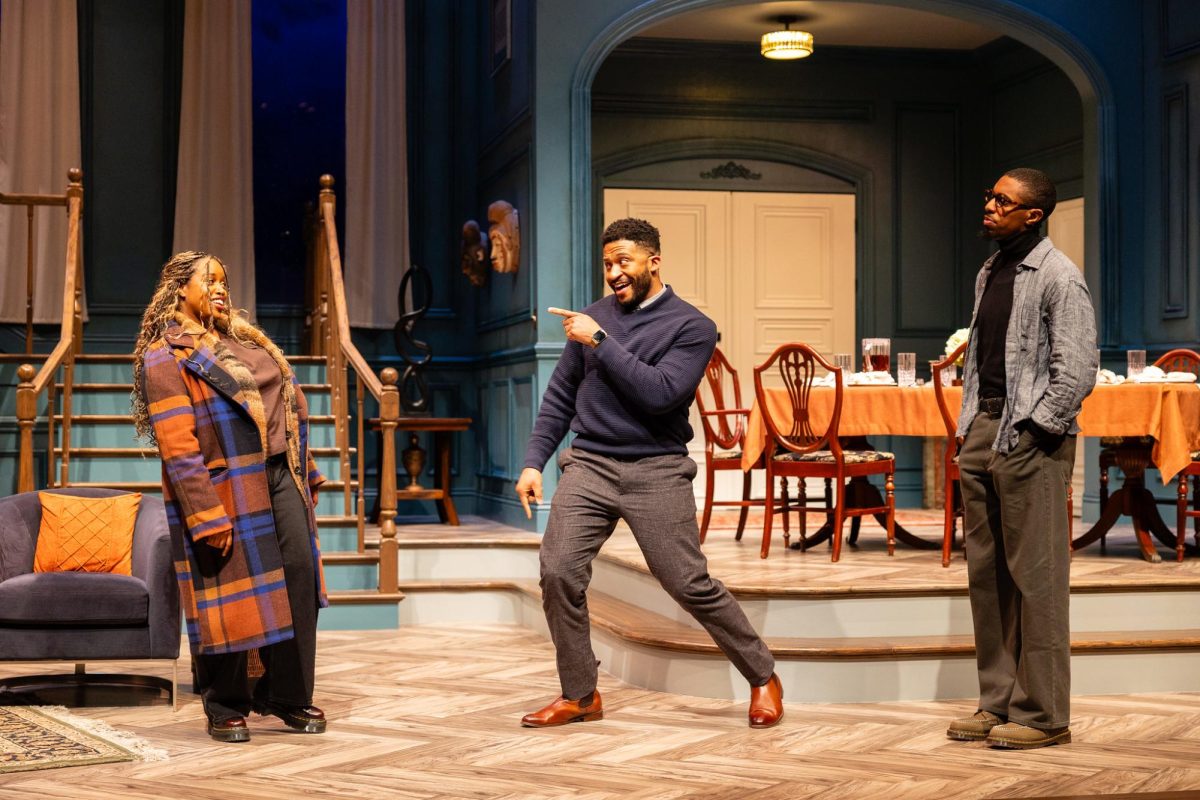
The show’s technical elements contribute to its realism. The set, designed by Lawrence E. Moten III, takes place entirely inside the Jaspers’ living room, featuring real-life donated artwork and ornate sculptures that make the room feel lived in by a family of this stature. Overhead, the family is illuminated by Sherrice Mojgani’s intimate lighting designs, which turn on and off in tune with the story’s emotional beats. As the family’s arguments get more and more intense, the chandeliers get brighter and brighter; as Naz breaks off to ruminate on his asexuality, he is lit solely by a pink spotlight that washes everything else out.
Branden Jacobs-Jenkins’ highly lauded script takes on difficult topics with thoughtful insight, exploring the intersection between class and race and questioning what it means to be a “Famous Black.” No line feels out of place — the show successfully jumps from topical jokes about the “Barbie” movie to serious conversations about prison violence in mere minutes without either moment feeling unearned.
The heart of the show, however, seems to be Junior’s woefully underutilized wife Morgan (Crystal Dickinson). Coming from a working-class family, Morgan calls out the Jaspers’ thinly veiled hypocrisy: how they propped her up as a prize, parading her around as a symbol of the Black working class and using her as a vehicle to carry out their own crimes, only to leave her with nothing in the fallout.
We wait on the edges of our seats for someone, anyone, to take accountability for their transgressions, yet scarcely anyone ever does. These characters are simultaneously deeply privileged in some ways and systematically oppressed in others. Oscillating between sympathetic and amoral, they’re compelling yet unredeemable all at once. Above all, they’re human.
As the plot unraveled, the audience was laughing and gasping, reacting as one in a truly communal experience. For a show with such a restricted setting, it doesn’t feel boring at all. Despite the nearly three-hour runtime, the performance was paced so well that I found myself wondering whether the first act was truly over at intermission. Barring a few noticeable line flubs and the distracting overuse of the word “literally,” the show went on seamlessly, certainly deserving of the honors it has received.
With the power of its strong cast accompanied by the heft of its witty script, every element of “Purpose” came together to craft a must-watch production, both thematically and artistically.