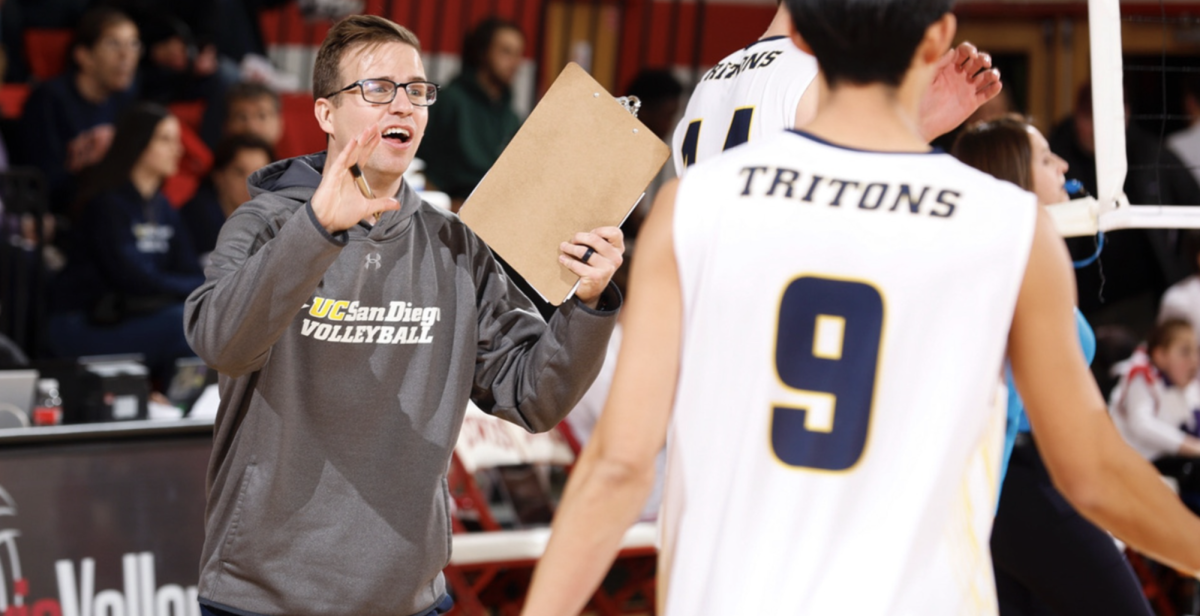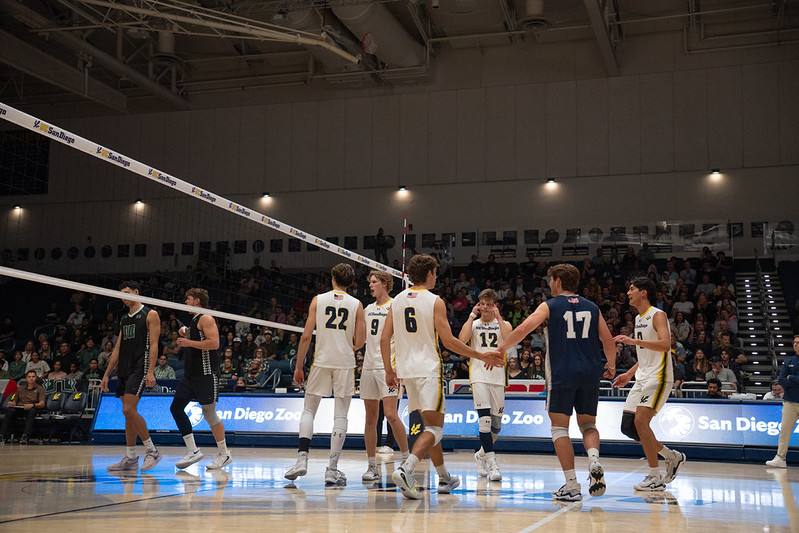
No. 11 UC San Diego men’s volleyball (13-14, 3-7 Big West) spent a majority of the 2026 season searching for a steady identity. The loss of three All-Big West athletes — along with six other graduating players — left the Tritons scrambling to rebuild the core that drove last year’s 18-12 campaign and offensive power. By March, the team had settled into what head coach Brad Rostratter called its “best volleyball” — but the surge came far too late to change UCSD’s 13-14 record and dismal 3-7 conference performance. No. 5 seed UCSD exited the Big West championship in a second-round loss to No. 1 seed Hawai’i, capping off a season short of last year’s overall performance.
“We were a bit of a rollercoaster team … emotionally, you know, we needed to try to find more of a baseline, right?” Rostratter said to The UCSD Guardian. “And like, that comes from a lot of different things. Yes, we had an older team, [but] we didn’t have a ton of personalities that had really led a group and, like, been in charge.”
The Tritons kicked off the 2026 season with three home wins before falling to No. 8 BYU, No. 1 UCLA, and No. 7 Loyola Chicago. Five-set losses to No. 12 UC Santa Barbara and Princeton stung the team’s confidence, but also marked the moments that began the team’s improvement.
“The most growth came after … we lost to Santa Barbara, we lost to Princeton, and I think we came back and beat Northridge in five — maybe at Northridge,” Rostratter said. “And really that was just more of, like, maybe more of a boiling point to where we all kind of, as a group, recognized, like, hey, we need to get our stuff together and change some things.”
Even with one of the toughest game schedules in the nation — packed with top-10 opponents and Big West heavyweights — UCSD stayed competitive. The Tritons handed Hawai‘i a 3-1 upset at home after dropping the first match of the series and later swept UCSB in the opening round of the conference tournament.
“That gap [between UCSD and top teams] is getting smaller, whether it be the top Big West teams to, really, the top teams in the nation,” Rostratter said. “And with just how competitive we were within every match … I thought we had opportunities where we could have won those matches, or won a match. … We let it slip away. So for sure, it’s narrowing that gap, and I think it really starts with our ability to apply consistent pressure, and the biggest way to do that is by hitting the ball hard.”
As the Tritons looked to steady their tactical identity, another challenge emerged: the team’s lack of a consistent structure. That became obvious in the week-to-week lineup changes.
“In our 20 some odd matches, we probably had about 20 different lineups with the mixture of middles, the mixtures of pins, mixtures of setters, the mixtures of liberos,” Rostratter said. “And part of that was intentional, because we knew we had such a competitive group. But I think that didn’t help the on-court leadership really develop the way it needed to.”
Among the challenges the team faced, UCSD particularly struggled with serve reception. Hawai’i put up a notable 11-point serving run — punctuated by the Tritons’ inability to stably receive the serves — during the Big West semifinal game that ended UCSD’s postseason run.
The team’s greatest strength, defense, emerged toward the end of the season. With 6-foot-9-inch redshirt senior middle blocker Jim Garrison in front of the net, blocking heavily improved. Garrison is graduating with a program record of 282 career blocks. In a fitting end to his Triton career, he was recognized with All-American and All-Big West honorable mentions.
“[Garrison’s] so cerebral and so smart, and has watched and seen so much volleyball that, like, playing a really tough position like middle blocker at this level is very difficult, and he makes it look very simple at times,” Rostratter said. “And it helps to be 6 foot 10, but also helps to understand tendencies, situations, and being able to read the setters within that.”
Junior outside hitter Sebastiano Sani, who transferred from Long Beach State, complemented Garrison’s defense with offensive firepower, allowing UCSD to match the Big West’s top teams. Named to the All-American second team and All-Big West first team, Sani will be going overseas to pursue professional offers.
“For Seba, obviously his size and his ability to hit the ball from a high point really was kind of, like, the key to his success,” Rostratter said. “But then you pair that with he’s also obsessed with volleyball. … I think having that drive and having that passion like those guys do kind of helps set the standard of, like, yep, we want to have more and more of them each and every year. And we want to, we want those guys to be driven to meet those standards.”
By the end of April, UCSD became a team defined by its disciplined defense, steadier serving, and a competitive edge that carried the Tritons to play their best volleyball of the year. While the surge came too late to change their spot in the conference standings or their postseason run, it raised the bar for the men’s volleyball program.
With nine athletes graduating this year, Rostratter is focused on maintaining this season’s momentum. With incoming talents — two of which are international recruits — he’s hoping to diversify UCSD’s playing styles and maintain the identity and strength that the team found this season.
“UC San Diego is a sleeping giant for men’s volleyball, and my goal is to awaken that giant,” Rostratter said. “And, like, we want to be known for our men’s volleyball program, and we want to be known as one of the best programs in the nation, right? And we still have a long way to go and get there, but we feel like we’re on that track. We’re on that trend, and we want to keep pushing that envelope and striving to be competing for national championships each and every year.”