Rating: ★★★½
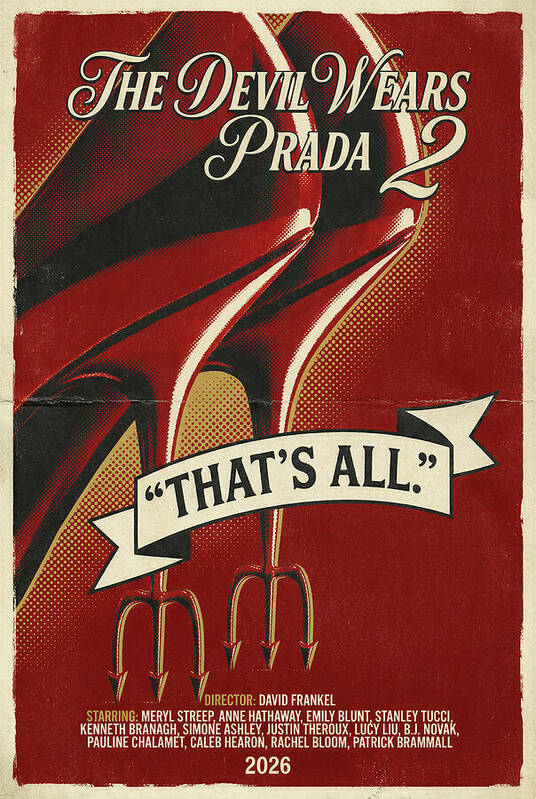
Directed by David Frankel
Starring Meryl Streep, Anne Hathaway, Emily Blunt, Stanley Tucci
Rated PG-13
Release Date: May 1, 2026
The year is 2006. Nintendo just released the Wii, Disney Channel is birthing talented young stars left and right, and the cool, silver-haired Miranda Priestly (Meryl Streep) has intimidated the nation’s aspiring young journalists and models with the release of “The Devil Wears Prada.” Based loosely on longtime Vogue editor Anna Wintour, Priestly — editor-in-chief of fictitious high-fashion magazine Runway — has become a pop culture icon in the years since for her snappy, quotable dialogue and signature coiffed bob. The gorgeous outfits showcased in stunning montages, beautiful hairstyling and makeup for the entire cast, and the glamorous locations and events Priestly and her assistant Andrea “Andy” Sachs (Anne Hathaway) visit made this film quickly become a cult classic.
“The Devil Wears Prada’s” cultural staying power is undeniable, asking audiences how much of themselves they would sacrifice to achieve career heights long before films like “Whiplash” entered the zeitgeist. Two decades later, “The Devil Wears Prada 2” hit theaters, promising more of the delicious drama and glossy peeks into the world of high fashion we all adored, starring the entire original main cast.
“The Devil Wears Prada 2” is what you would call a “legacy sequel.” These sequels, filmed years after the release of the original, used to be few and far between, generally well received, and thoughtfully executed — think “Tron: Legacy” or “Creed.” In the modern film landscape, studio executives are realizing nothing sells more than nostalgia, and we get “legacy slop” movies like “Happy Gilmore 2” or “Freakier Friday.” But banking on nostalgia for a popular movie released years ago can only get you so far. Rather than simply trying to bait audiences into emotional responses by reheating exact moments from an original film, a good legacy sequel must accomplish the following:
- It must expand upon the original’s world, raising the stakes and furthering character development rather than rehashing the same plot.
- It must smoothly address the large time gap between films. Often legacy sequels will answer this by shifting the focus of the new story to the next generation — see previous examples.
- It must remember what made its predecessor appealing without being overly reliant on references to the original.
By these standards, “The Devil Wears Prada 2” is, surprisingly, a good legacy sequel. I came into it quite skeptical, as much of the film’s marketing seemed to place an emphasis on referencing the original’s sharp catchphrases, like Priestly’s signature “That’s all.” However, “The Devil Wears Prada 2” passes the first two requirements with flying colors. After having left Priestly and Runway, Andy finds herself back at the office of her former boss as a features editor on a long-shot mission to save not just her new job but the entire company from extinction.
The film kicks off by reintroducing us to Andy –– now a chic, accomplished journalist with stylish suits and effortlessly wavy, waist-length hair –– as she makes her way through New York City to a journalism award ceremony. “End Of An Era” by Dua Lipa plays in an opening scene tastefully reminiscent of early 2000s chick flicks. We soon learn that despite winning a prestigious award at this event, Andy and all her newsroom colleagues have just been fired en masse via group text.
Out of work and angry about the current trend toward devaluing journalism, Andy rejoins Runway after Irv Ravitz (Tibor Feldman), Runway’s owner, brings her in to fix a PR disaster. There, she finds that despite Runway’s long legacy in the fashion sphere, it, too, is on its way to becoming defunct. “Runway hasn’t been a print magazine for a long time,” Nigel Kipling (Stanley Tucci) tells Andy defeatedly during their reunion, sighing as he calls the once-lauded publication fodder for people to “scroll while they pee.”
“The Devil Wears Prada 2” shines in raising the stakes for all of our beloved characters in both a believable and relevant way. The threat this time is neither Priestly’s terrifying “dragon lady” persona nor is it merely the fear of Runway going out of business –– it’s the imminent obsolescence of art and journalism altogether. This plotline is a genuine expansion of the original’s world, grounding itself by condemning a very real problem that all artists, writers, and creatives are facing today.
I was frankly impressed by this stance and wished it was taken a bit further. Besides an incredibly memorable exchange between Priestly and Silicon Valley tech billionaire Benji Barnes (Justin Theroux), the film places just a bit too much weight on the personal betrayal of Priestly and Andy by another main cast member. This latter moment played like it was meant to be one of the film’s biggest emotional points, but I personally would have liked it to lean more heavily into the themes of the former –– a continuing decry of what automation of writing and art will mean for the future of humankind.
However, for a big budget blockbuster, these ideas were refreshing, bold, and, most importantly, accessible to the general public. If this film helps continue to turn public opinion further away from generative AI and opens more eyes to the importance of journalistic and artistic integrity, then so be it. I, for one, am completely in support.
Yet this film is not without its flaws. For one, it never lets you forget that it is a sequel to a beloved, iconic film. Andy spends plenty of time adorkably reminding both in-universe characters and theater goers of the events of the first film. In one particularly annoying moment, she prattles off the major highlights of her brief tenure to Amari Mari (Simone Ashley), Priestly’s new assistant, in a way that only serves to spoonfeed audiences, as if to say, “Hey, remember this moment from the first movie?” At the very least, this kind of behavior, though very in your face, makes sense for Andy’s perky and affable personality.
In contrast to Andy, Priestly’s character seems to be dialed back to an almost absurd degree –– between groveling with sponsors to recover from the aforementioned PR nightmare and slowly coming to terms with potentially losing her empire, you could hardly even call her devilish in this sequel. While these choices may serve to humanize Priestly’s character, it sometimes feels as though the original Priestly, who we loved to hate, no longer exists.
Additionally, the amount of product placement was at times ridiculous. Some choices seemed deliberate and added to the storytelling, such as the appearance of the more budget-friendly Mrs. Meyer’s branded hand soap in Andy’s bathroom in opposition to the high-end Aesop bottle spotted in Priestly’s Hampton residence. However, other items like the always perfectly centered Diet Coke cans were laughably blatant product placement. In moments where the film needed us to focus on conversations between characters, these clear advertisements felt jarring and distracting.
Despite these shortcomings, “The Devil Wears Prada 2” was a fun romp that was able to justify its own creation. Full of glitz and glam and nodding to the exquisite outfit montage scenes famous in the original entry, this film is at times very visually appealing. Backed by a female-led soundtrack with the likes of Lady Gaga, Doechii, and Laufey, as well as an entertaining original score, “The Devil Wears Prada 2” is a treat for both eyes and ears. Against all my expectations of what a legacy sequel could be, it is oddly an important film for the current era. While its highs come short of touching the 2006 original’s, “The Devil Wears Prada 2’s” strength is in its clear defense of human creativity as a whole, and that is something to be excited about.