

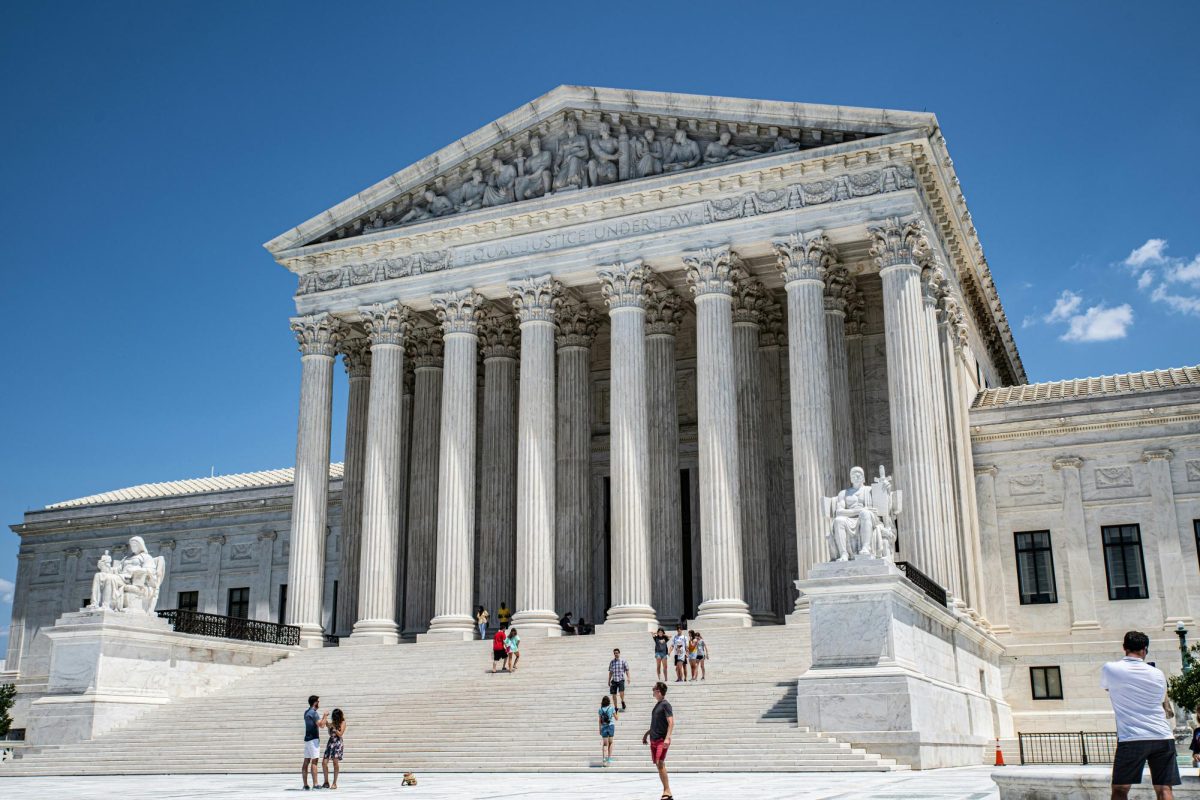
On April 29, the United States Supreme Court overturned a Louisiana district court measure to redraw the state’s congressional electoral maps to more equitably represent its population.
In a 6-3 decision, the Supreme Court ruled in Louisiana v. Callais that Louisiana’s proposed congressional electoral map was unconstitutional because the districts were redrawn based on race. Legal scholars have criticized the landmark decision for weakening Section 2 of the Voting Rights Act of 1965, a civil rights measure that prohibits racial voter discrimination. States are required by federal law to redraw congressional district maps every 10 years after the census.
Justice Samuel Alito delivered the majority opinion, arguing that Louisiana’s new map was a racial gerrymander.
“Partisan gerrymandering claims are not justiciable in federal court,” Alito said. “In a racial gerrymandering case like the one before us, race and politics must be disentangled.”
The Guardian reported that Alito cited inaccurate demographic statistics from a Department of Justice brief, which misrepresented Black voter turnout in recent years.
“Black voters now participate in elections at similar rates as the rest of the electorate, even turning out at higher rates than white voters in two of the five most recent Presidential elections nationwide and in Louisiana,” Alito wrote. However, data from the Louisiana secretary of state’s office reflected that Black voter turnout has consistently failed to meet white voter turnout since 2012.
Louisiana recently modified District 2 and District 6 on its electorate map to accurately reflect two of the state’s largest Black population centers — New Orleans and Baton Rouge — as majority-minority districts, predominantly composed of racial minority voters.
After the Supreme Court’s decision, Louisiana postponed its congressional primary to give its lawmakers time to redraw the electoral map.
Zoltan Hajnal, a political science professor at UC San Diego’s School of Global Policy and Strategy, spoke to The UCSD Guardian about the VRA’s uncertain future as a result of the Supreme Court’s decision.
“[This decision] essentially eliminates the last remaining elements of the Voting Rights Act, so it means, essentially, the end of the Voting Rights Act and its ability to influence representation in America,” Hajnal explained. “What that means — in practical terms — is likely the end of many majority-minority congressional house districts in the nation and, in particular, probably the elimination of almost all majority-minority districts in the South. … In particular, in the South, it means a major decline in descriptive representation and major declines in the degree to which Black and Latino voices are heard in Congress.”
The Supreme Court’s ruling comes as President Donald Trump signed executive orders that delegitimized longstanding federal diversity, equity, and inclusion and disparate impact standards, which protect equal opportunities for students and workers.
“The majority of Supreme Court justices either don’t believe … or care that racial discrimination and racial exclusion occur,” Hajnal said. “It … suggests that the court may be choosing along partisan or ideological lines, rather than evaluating the extent to which different types of voices are able to be heard in the political arena.”
While the VRA stands on substantial legal precedent — Thornburg v. Gingles (1986), Shaw v. Reno (1993), Bush v. Vera (1996), and Cooper v. Harris (2017) — this change has already altered court decisions.
Last week, the Tennessee and Virginia state legislatures invoked the Callais precedent to pass measures that would break up majority-minority representation in their maps.
California, Florida, Missouri, North Carolina, Ohio, Tennessee, Texas, and Utah have already received judicial approval for their congressional district electoral maps.
Alabama, Illinois, Indiana, Kansas, Maryland, New York, South Carolina, Virginia, and Louisiana are yet to submit their district maps for judicial consideration.


