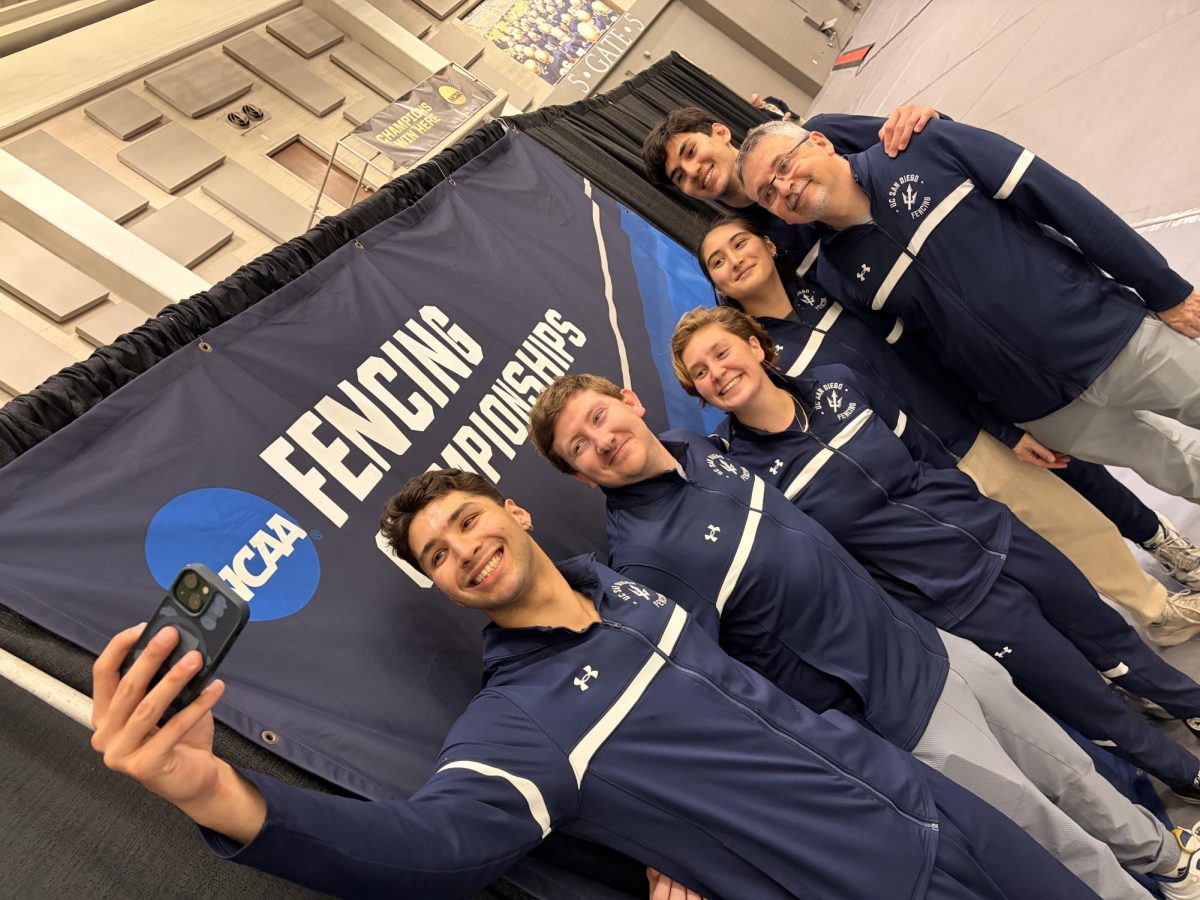
The NCAA fencing championships, hosted by Notre Dame from March 19 to March 22, pitted the top 24 athletes from each discipline against one another. UC San Diego fencing — one of only two Division-I fencing schools on the West Coast — sent four athletes to make a name for itself among NCAA fencing powerhouses like Notre Dame, Harvard, Princeton, and Stanford.
The championships kicked off on March 19 for the women’s weapons, with sophomore Katherine Kim and freshman Piper Randolph competing in foil. On the men’s side, senior Sunny Sharma and freshman Nurzhan Abzhanov competed in epee for the Tritons.
Notre Dame took home the women’s and men’s national fencing champion titles for its fifth victory in the past six years. The Tritons placed 16th on the women’s side and 17th on the men’s. In a field that included Olympians and world-ranked fencers, three of the four Tritons finished in the top 12 to walk away with All-American honors.
“Five years ago, there wasn’t a single Olympian in NCAA Championships,” Sharma said in an interview with The UCSD Guardian. “And across all the weapons, there were like, what? Fifteen? Sixteen?”
Kim elaborated on her experience competing against these highly-ranked opponents.
“It’s not, like, intimidating,” Kim said. “More just, like, exciting to know that you can compete with people that have, like, such, like, grand experiences that you haven’t had yet. It’s like, ‘Oh, let’s kind of test ourselves.’”
Both Sharma and Kim participated in last year’s competition as well. Sharma placed 21st, one spot outside of All-American honors. This year, Sharma fought his way to ninth in his last collegiate fencing competition.
“There wasn’t, like, a bout where it was like, ‘Oh, like I could have done this or that,’” Sharma said. “I felt like I really prepared, and the result was, like, exactly what I deserved, you know.”
Despite the improvement that Sharma achieved and expects to see in the coming years, he’s also careful to note that progress isn’t always linear. Just as Triton fencers improve, the NCAA fencing field gets more and more competitive.
“It’s going to get harder, but you should relish in that fact,” Sharma said. “You should enjoy the fact that that’s only going to make you better — not just as a fencer, but as an athlete, as a person, as a human, as a student, in all aspects.”
Kim placed seventh at the 2025 nationals meet as a freshman. This year, she aimed to finish in the top four, though she ultimately won 12 of her 23 bouts to take 11th.
“It was disappointing to not, like, beyond that, to not reach that goal again,” Kim said. “But, like I said before, there’s just lots of things that you can’t control … Everyone there is the best from where they come from. So, like, for example, just because maybe you’re not doing the best does not mean that you are, like, the worst, of course. Like, you are there because you are among the best, so it’s really exciting no matter what.”
Freshman duo Abzhanov and Randolph could rely on returners Sharma and Kim as they entered the most physically demanding fencing competition in the NCAA. Abzhanov rounded out the All-American Tritons with a 12th-place finish, winning 11 of his 23 bouts throughout the two-day competition.
“When day two started, I was already, like, exhausted,” Abzhanov said. “I was just, I had to push myself every bout. So, it was more about … pushing myself, rather than, like, worrying about the results.”
Randolph won six of her bouts to take 22nd.
“Performance-wise, I did not do as well as I’d hoped,” Randolph said. “Going to nationals was a huge accomplishment and exciting, exciting goal of mine. I think performing at nationals was not the best, but being able to have that experience and cheer on Katherine, who did amazing, and the rest of the team was really exciting. And I feel honored to be part of that experience, especially as a freshman, because I know a lot of the team didn’t get that opportunity this year. And it kind of set a fuel, a fire underneath [me] to perform better next year, to get to that same opportunity and go further.”
The team’s nationals performance capped off a remarkable season that saw the Tritons win four individual MPSF titles, one individual NCAA West Regional title, and the first women’s MPSF conference title.
Sharma won the men’s epee championship for the second straight year at the NCAA West Regional meet in Texas on March 7. At the MPSF fencing championship on March 8, Kim and Abzhanov took first in their disciplines, while Sharma advanced to the semifinals and placed third.
With the national championships now behind them, the Tritons are spending the offseason in different ways. Kim and Randolph have a break from competition. Sharma and Abzhanov are fencing internationally, representing the U.S. Virgin Islands and Kazakhstan, respectively. The men’s epee pair will compete at the International Fencing Federation Grand Prix in Colombia from May 8 to May 10. After that, Sharma will participate in other world championships until August.
Kim competed for both Team USA and UCSD last season. Last year, her international schedule conflicted with almost all of UCSD’s meets. But in order to be eligible to compete in the NCAA West Regionals competition, Kim had to fence at least 21 bouts as a Triton. Though athletes usually fence eight bouts per meet, Kim did 26, taking third at her first collegiate meet.
“I basically fenced every single school, like, I did not have a single break,” Kim said. “So, I did all of my bouts then so that I could qualify for regionals. Because, usually, it’s split up between the three [meets].”
Kim went on to take second at the 2025 MPSF Championships, part of the first UCSD squad to win the MPSF team championship. She was the 2025 NCAA West Regional foil champion, and she finished seventh at the 2025 national championship. This year, she decided to step back from the international circuit to focus on her collegiate season. Boasting a 34-10 record, Kim became captain of the women’s foil team and the 2026 MPSF women’s foil champion. She netted an All-American Honorable Mention for the second straight year.
“I really wanted to, like, be the best captain I could for my squad,” Kim said. “So, that came with challenges and lots of growing opportunities and ways to bond with my team members.” In a moment of characteristic modesty, she looked at Randolph as she said, “I hope I did a good job.”
In a sport like fencing where athletes compete individually at all competitions except for NCAA meets, that type of team bond is crucial.
“Fencing is like a loner sport,” Abzhanov said. “You basically have to always put yourself first when it comes to your practice, your competitions … But when you come to a college program, it’s important to elevate your teammates and your team, as well as yourself.”
Sharma, captain of the men’s epee team, believed that the team pushed each other to success this season.
“Seeing the freshman come in from all weapons, from both sides … coming in hungry and just pushing all of us that were on the team, I think that motivated everyone,” Sharma said. “I think that pushed everyone to be their best, and it was just a joy to see how good the team was.”
Sharma graduates next month. He leaves behind a squad that has already raised expectations for UCSD’s D-I fencing program.
“When I’m gone and I look back and the team is doing even better and getting even stronger and we’re getting better results and we’re having more people qualify, I can be proud that, you know, I played a part in that,” Sharma said.
He knows that the team is in good hands — Kim stepped up as captain of the women’s foil team this year, and Randolph and Abzhanov, for their part, have navigated everything from collegiate meets to finding their own motivation for training and competing every day. They’ve emerged with grounded, optimistic outlooks ahead of next season. And as much as they love the sport, all four have priorities outside of fencing.
“I don’t want to just be known as an athlete — I want to do other things too,” Kim said. “This is a very common thing for college athletes, I think. You spend so many years, like, devoting yourself to a sport. But obviously, like your sport isn’t everything … It’s not something that can be fixed in one season, though. This is like a multiyear process. It’s like asking someone, ‘Who are you?’ You’re not going to figure out who you are in like a day, you know, or like a year … Fencing isn’t everything, but it is a large part of me, and I really like it.”
For Sharma, pursuing fencing beyond college is also a matter of practicality. It’s not a career that most can rely on as the sole source of income, so professional fencers often practice and compete while having full-time careers.
“If I step away from this sport, or you know — god forbid, touch wood — get injured, I want to have something I can do for the rest of my life,” Sharma said. “Because, you know … most [athletes] retire by like 30, 35, unless you’re like Lebron. What do you do for like the next 60 years? I want to coach, but I want to have the option to provide for my family in another way.”
Randolph, a freshman, has struggled with balancing collegiate fencing competition and training with her joy for the sport. Over the past seven months, her goals shifted from chasing better results to enjoying herself throughout intense tournaments and practice schedules.
“You’re here for college, and you’re here for fencing and … you’re a D-I athlete, but what sparked this interest was an 8-year-old who found sword fighting and the physical chess aspects [of fencing] really exciting,” Randolph said.
“I really like what you said about 8-year-old you,” Kim said to Randolph. “I feel like that’s something we need to remind ourselves of sometimes. Do it for 10-year-old Katherine. Do it for 8-year-old Piper.”
Randolph, Abzhanov, and Kim will be back in action this fall. The 2026-27 fencing season will kick off at home on Sept. 19 with the annual BladeRunner tournament.