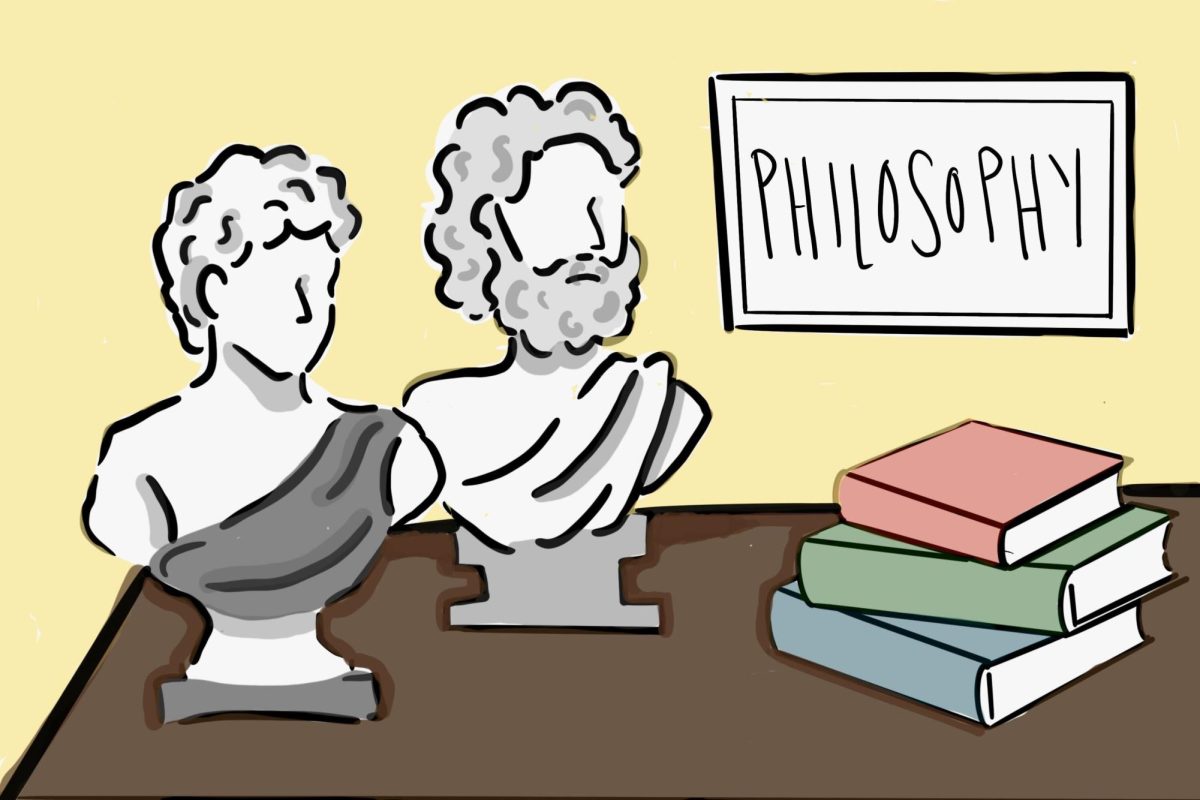
As you juggle midterms with Sun God festivities, you may find yourself asking questions like: Why am I pulling an all-nighter right now? Is my procrastination intrinsic to my being? Does any of this even matter?
Students and philosophers alike have been debating the answers to these questions for ages, drawing on shared human struggle to develop frameworks that address these internal battles. The stress of exams often has me thinking in accordance with a philosophy without even realizing it. Keep reading for a ranking of the philosophies least to most likely to help you conquer midterms, based on my personal experiences.
- Determinism: ‘I was always going to fail this class.’
Determinism argues that your life has been predetermined since birth, and there is nothing you can do to change it. The invention of social media caused your procrastination, and the grade you received on that exam was inevitable.
A determinist Triton knows that despair after bombing an exam is useless because a long, causal chain of events out of their control led up to that exact moment. However, they might also not realize that they can still save their grade if they start now!
Survival rating: 3/10. It helps reduce unnecessary guilt once you’ve already received a less-than-ideal grade, but it doesn’t change the reality of impending exams.
- Nihilism: ‘Nothing matters, including this exam.’
Nihilism tells us that life has no objective meaning, purpose, or intrinsic value. Although bleak, it does point out an important truth: The midterm you just bombed that’s worth 40% of your grade is not a reflection of your worth as a human being. Instead, it is a single isolated event in a universe filled with millions of people facing far greater struggles.
A nihilist Triton may experience relief from the pressures of attending an academically rigorous college, but they might also feel reduced motivation. After all, if nothing matters and life is meaningless, then why study or even show up to take the exam at all?
Survival rating: 4.5/10. You might have heard the sentiment “We’re on a floating rock, nothing matters” and decided not to take life too seriously, but maybe your goals should be taken seriously!
- Stoicism: ‘I will only focus on what I can control.’
One of the core principles of stoicism distinguishes between what we can and cannot control, teaching that suffering comes from trying to control the latter.
You cannot sway your professor’s harsh grading decisions or change the tiny desks in your lecture hall that make writing in your blue book impossible. However, you can choose how you study, manage stress, and learn from your mistakes.
A stoic Triton is able to process the complex emotions that come with the chaos of college. They don’t focus on what they could have done differently; they focus on what they can still do now.
Survival rating: 8/10. It fosters a proactive emotional state, great for building resilience and staying calm under pressure.
- Existentialism: ‘School is meaningful to me, so I choose to work hard.’
Existentialism says that we create our own meaning in life. The central principle of existentialism — “existence precedes essence” — claims that we must create meaning in a meaningless universe by living authentically to our values.
Suddenly, midterms are not a burden but an opportunity to prove to yourself that you can study, even when it’s difficult. In this way, you give your stress a purpose.
An existentialist Triton may experience nausea from the constant responsibility of choice but recognizes that this also gives them the dignity of freedom.
Survival rating: 9.5/10. Victim of finals week no more! Instead, choose to be the kind of person who takes action.
Stay strong, Tritons! Philosophy can’t push your deadlines back, but it can change your outlook on them. We will always be working toward or through something, so instead of waiting to achieve a goal to be happy, learn to enjoy the journey! If you can do that, no matter what your grades are, you’ve mastered the art of living.