Rating: ★★★★
Directed by Antoine Fuqua
Starring Jaafar Jackson, Miles Teller, Colman Domingo, Juliano Valdi, Nia Long
Rated PG-13
Release Date: April 24, 2026
In the quietly humming streets of Gary, Indiana, two black loafers tap to a hidden rhythm in the surrounding atmosphere. A young boy sits on a dimly-lit porch, seeking refuge from his helicopter father. As sharp shadows protrude out of darkening corners and claw at the lights, his melodic voice shakes the windows. Four walls won’t hold him tonight.
Behind the boy towers an exaggerated silhouette, crowned with a sleek fedora. It reaches toward him, bearing a sparkling flame in one hand and several others atop its restless feet.
The boy’s shoulder twitches. As if sensing a man behind him in the mirror-like polish on his shoes, he looks out across the nighttime — and “the city winks a sleepless eye.”
Here patiently sits the boy who will be king.
Michael Jackson, King of Pop and one of the greatest superstars of all time, yielded unparalleled talent. A man who often felt disconnected from reality, Jackson grew up in the paparazzi-ridden ’80s and ’90s with eyes on him constantly. People around the world craved his ungloved touch, and ever since Jackson’s death in 2009, it was inevitable that a film would attempt to peel back the illusory layers of fame. The long-awaited biopic “Michael,” directed by Antoine Fuqua and starring Jackson’s nephew Jaafar Jackson, released on April 24.
Following the typical biopic formula, the film tracks Jackson’s early days in the Jackson 5 to his “Bad” era rebrand. Fuqua paints a rose-colored story about the baptismal making of a king, which may disappoint the critical and dismay the cynical. To the best of its ability, however, “Michael” channels the inimitable shadow that followed Jackson around in real life and is bound to please die-hard fans of the “Thriller.” Any moonwalker will easily shift a practical three-star rating up to a flying four.
Gaps in the storyline aside, Fuqua masterfully spotlights MJ’s dazzling silhouette. Through careful adaptations of Jackson’s iconic performances, Fuqua succeeds at transporting viewers into the singer’s world. Intentional close-ups on MJ’s stylistic motifs, such as his black shoes and fedora, foreshadow Jackson’s prophetic power. When a young Jackson (Juliano Valdi) performs for the first time with the Jackson 5, Fuqua lets the camera sit with his dancing black loafers — enrolling the audience as peripheral observers who excitedly await the King.
Fuqua’s experience directing action-packed movies like “Training Day” and “Southpaw” served this film well. Jackson was a high-energy performer known for being detail-oriented and quick-moving. Fuqua, familiar with powerful action shots, stays with MJ’s fluid body movements and carefully coordinated vision for his performances.
Jaafar Jackson cannot go without praise either. The 29-year-old steps into MJ’s consummate outline with admirable grace. He masters the superstar’s high-pitched talking voice, facial expressions, and smooth dance moves. Jaafar Jackson’s performance brings nuance and restraint to the attention-grabbing persona that the public often misunderstood. MJ’s life off the stage, which was purposefully enshrouded in darkness to maintain privacy, was shown to be introspective, understated, and peaceful.
The film falters in representing some of Jackson’s career moves. It heavily focuses on his childhood in the Jackson 5, during which he butted heads with his father Joseph Jackson (Colman Domingo) while honing an artistic identity independent from that of his brothers. Though emotionally impactful, this plotline starts to tire when MJ grows into his “Thriller” era at age 24. Almost every moment of struggle in the film falls back upon his father, as if Michael Jackson’s only obstacle to success was being stuck under Joseph Jackson’s commercial guardianship. A more substantive story should have incorporated further insight into Michael Jackson’s artistic process, collaborators, and adult experiences on his trail to megastardom.
The darker side of Jackson’s reputation — specifically the child predator allegations from which he was acquitted in the 1990s to 2000s — is lost in the film’s heroism and charisma. Yes, this is essentially a starry-eyed first installation of a two-part story that ends on a rather despondent note, but the film’s persistent optimism toward the King’s rise to the throne may come across as evasive idolism to many viewers. After all, every human — superstar or not — has flaws that are integral to their identity and survival. Showcasing Jackson’s hidden faults more clearly might have resonated better with the audience.
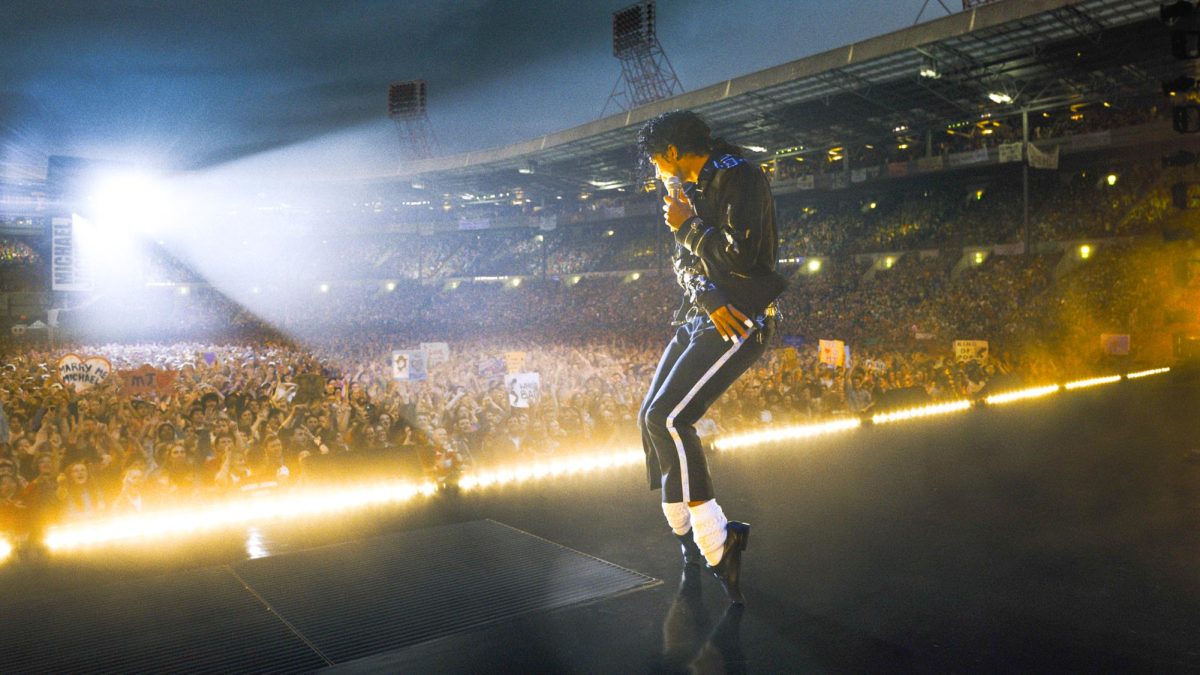
The best moments in the film happen when a young MJ sings at the recording studio for the first time and when his older self performs “Human Nature” in front of an uncontrollably obsessive crowd. In the first scene, the recording producer listens in starstruck awe to the expressive voice of Jackson’s younger self, envisioning the boy’s silhouetted future projected outside his little frame. As life goes on and more eyes are drawn to Jackson’s allure, audiences in the movie theater are finally able to see what that producer immediately picked up on in the recording studio: Jackson, now a grown man, produces a physical effect so profound that a viewer’s body heat will perceptibly spike.
Through a colosseum-spanning starpower that now transcends the barriers of time, “Michael” brings his larger-than-life silhouette back in every audience member’s eyes. The man, though gone from this earth, is now mirrored once again in the dilating pupils of today’s onlookers.