

On the evening of Jan. 29, Megan Becker received an alarming call. Her son, Kyson Becker — who plays for UC San Diego’s men’s water polo team — had been involved in a car accident.
Megan and her husband Eric Becker tracked Kyson’s location on Find My iPhone and found out that he was admitted to Scripps Memorial Hospital. The Beckers immediately drove from their home in Newport Beach to La Jolla, discovering every parent’s worst fear: At around 7 p.m., Kyson was riding his e-scooter on his way to water polo practice when he was struck by a vehicle. Kyson, who was not wearing a helmet, suffered a fractured skull, cheekbone, nose, C6 and C7 vertebrae, and a traumatic brain injury.
“It was really scary,” Megan said in an interview with The UCSD Guardian. “First of all, [he] had a fractured spine. I mean, that’s scary in itself because you don’t know what the implications of that are going to be. … Also, we didn’t know what his cognitive ability was going to be, and with brain injuries, it’s just, time will tell. You don’t know.”
After two weeks in the intensive care unit, Kyson’s condition improved, and he was transferred into acute rehab. Eventually, he moved into graduate housing at the La Jolla Family House, where the Beckers remained for the rest of Winter Quarter as Kyson recovered. At the start of Spring Quarter, Kyson returned to his dorm and continued classes while doing physical therapy.
“Eric and I spent two weeks in the ICU, basically sleepless,” Megan said. “Like, we didn’t leave. We slept in recliner chairs next to Kyson’s bedside. In the middle of the night, when the nurses aren’t coming in every 30 seconds and things are a little bit calmer, we both had time to reflect and kind of both at the same time woke up one day, and we’re like, ‘We need to do something. Something good has to come of this.’ And so, we both kind of came up with a similar idea of promoting helmet safety.”
This idea became Headstrong Ride Smart, a nonprofit the Beckers founded in March to promote helmet safety and awareness on college campuses. While at UCSD, Megan noticed that very few e-scooter riders wore helmets. She believes that Kyson’s injuries would have been significantly less severe if he had worn a helmet, as Kyson did not break any bones below his neck.
“He may have still broken his neck, but certainly neck bones heal,” Megan said. “If he had been wearing a helmet, that would have been it. He scraped knees and toes and possibly a broken neck, but now, he’s got a bigger challenge ahead of him. … He is definitely a miracle, and he’s putting in the work, but he’s definitely got a ways to go with his recovery.”
The Triton Athlete Council and UCSD Athletics quickly supported the Beckers’ cause as the student-athlete community reeled from Kyson’s accident. In February, the TAC hosted a helmet-painting and helmet giveaway event in collaboration with Headstrong Ride Smart.
“The admin at UC San Diego have been incredibly supportive,” Megan said. “Everybody’s been incredibly supportive of the movement and asking how they can help. … Even when I was in the hospital, [Director of Athletics] Andy Fee came out to visit, and he’s like, ‘I know that there’s some kids at TAC that are really wanting to do something about this and spread something.’”
TAC third-years Tate Meaux and Kyla Bruhn connected the Beckers with Big West officials, who are now in early talks with Headstrong Ride Smart in its mission to encourage more athletes to wear helmets. Becker’s accident was the second major incident of the school year in the conference, following a fatal accident late last year at Cal State Fullerton. Two Titan women’s soccer players were riding e-scooters when they were struck by a truck on Sept. 27; Lauren Turner tragically lost her life on Nov. 7, and Ashlyn Gwynn suffered a traumatic brain injury. At the time of the accident, neither person was wearing a helmet.
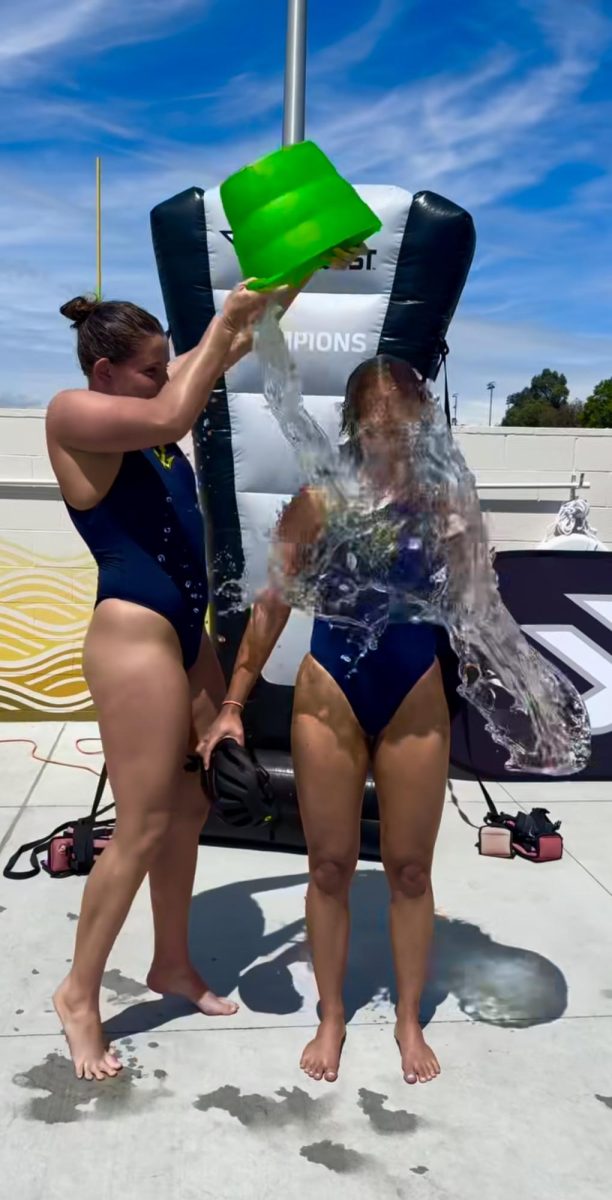
In April, Headstrong Ride Smart announced the Brain Freeze Challenge in collaboration with the Big West. The idea is modeled after the 2014 ALS ice bucket challenge and a later iteration of the challenge by the University of South Carolina’s MIND club, which aimed to combat mental health stigmas. The premise is simple: A participant films themself getting a bucket of ice water poured on them, shares the video on social media, and nominates other people to do the challenge.
“My younger son was like, ‘Well, you could do something like the ice bucket challenge. That really went viral, and it went viral not just once for ALS, but it went [viral] again, so why don’t you kind of do a take on that?’” Megan said. “And so, we kind of put our heads together and came up with the Brain Freeze Challenge.”
The challenge kicked off at the Big West women’s water polo championship in Long Beach on April 10; Bruhn was the first athlete to participate. Since then, it has spread through the UCSD and Sacramento State student-athlete communities.
“Doing the challenge was a fun opportunity to participate in something very real,” UCSD women’s soccer redshirt freshman forward Ava Tibor said to The Guardian. “We’ve had serious injuries on our campus, and this past fall, our women’s soccer community lost one of our own in a tragic accident. Accidents will happen, and if this encourages even one more person to wear a helmet, it’s worth it.”
The Beckers hope that the Brain Freeze Challenge will inspire more students to wear helmets when riding an e-scooter and bring attention to a common issue on college campuses. With the darkest times of Kyson’s accident now behind them, the Beckers look ahead at helping raise awareness so that other students and parents know how to protect themselves from potentially life-threatening accidents.
“The last few months have been every parent’s biggest nightmare,” Megan said. “I know if every parent had their way, their kids would wear a helmet just like they always wear a seatbelt. … Sending your kid off to college and that next chapter of their life is really hard for every parent because you just wanna wrap them up in bubble wrap forever. I don’t know, [wearing a helmet] is just like such a simple thing that kids can be doing to protect their story.”


