

Humans spend endless hours ruminating on the past, regretting our mistakes, and wallowing in nostalgia. Then, we eagerly look forward to the future, carving out goals and ambitions that would make us the people we aspire to be. Whether or not we meet those goals, the regret still bubbles back up, and the loop goes on and on.
Third-year studio art and astrophysics double major Nora Hagkull’s solo exhibition “Circular Stories” explored ideas like time and the life cycle. Hagkull turned these abstract concepts into tangible visuals that prompted thought-provoking questions about the ways we experience time and what it means to live a fulfilling life.
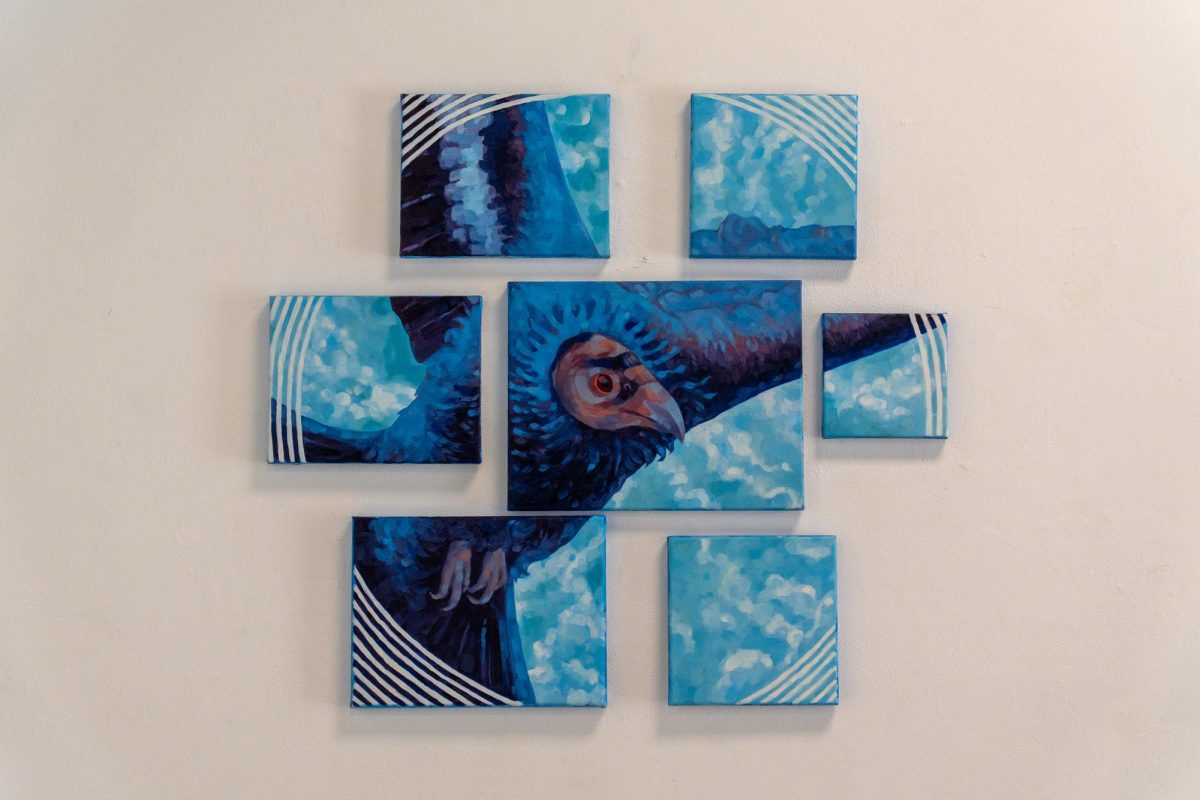
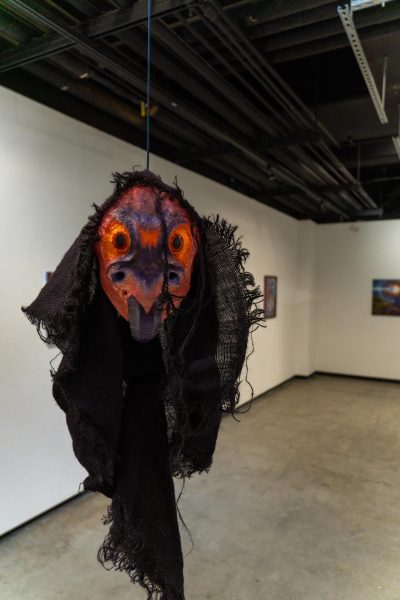
Stepping into UC San Diego’s Adam D. Kamil Gallery on Wednesday, I immediately noticed prominent bird-related imagery in many of the pieces, such as a clay condor mask and drawings of birds. Hagkull chose to center the exhibition around the California condor “as a symbol of resilience and rebirth” because of its gradually rising population due to recent conservation efforts.
As I continued to walk around the space, I noticed a series of recurring motifs, such as flora, fauna — like the condor — and the celestial, each divided into segments of the gallery. Hagkull deliberately placed similarly-themed imagery in close proximity to contextualize the subject matter of each individual piece.
“I wanted the themes to play on each other,” Hagkull explained in an interview with The UCSD Guardian. “Some of them can be pretty abstract, like the Big Bang, but you might not see that at first, so I wanted to be around the other space stuff.”
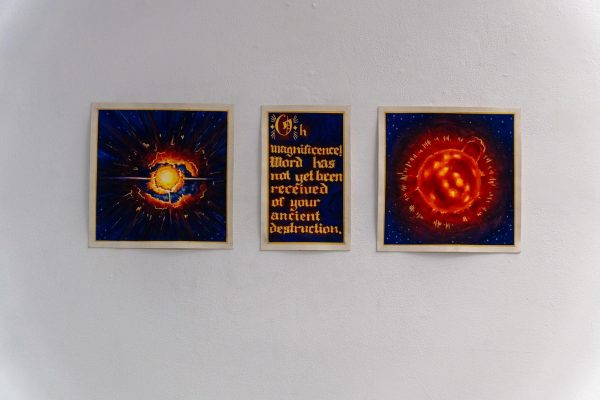
One notable part of the gallery was the eye-catching celestial section, which used bright colors to simulate stars and supernovas, showcasing how all of us on Earth view the same sky. To me, Hagkull’s work seemed to focus on the universal human experience; in an era of seemingly never-ending discord, Hagkull’s emphasis on the broader universe hones in on the elements that bring us together.
The topics Hagkull decided to explore have been prevalent in their work for years. They have always been fascinated by decomposition and the life cycle, and their work on the cyclical nature of astronomy in college offered a way to visualize that.
“[The exhibit is] about how time can be a circle, how things that happened in the past can influence the future, and how thinking about the future can influence the past, and how all of that applies to the many cycles around us, like the cycle of life,” Hagkull said.
Hagkull’s willingness to experiment with layers and textures in their artistic practice was a way of taking their work to the next level. For example, their piece “Too Late” — alcohol markers and oil pastels on paper — layered separate drawings to create the illusion of birds flying off the page. “Decomposition” used embroidery thread with colored pencils and watercolors to make the decomposed skull in the image feel like something I could reach out and touch. This masterful use of layers and textures made the whole project feel more lifelike, as though the images depicted would be waiting for me as soon as I left the gallery.
I also appreciated the numerous personal touches peppered throughout Hagkull’s work: Their cat, Scribbles, featured prominently in several drawings, while “Summer Grapes” — oil paint on canvas — depicted the view from their backyard. Hagkull ended up achieving a more intimate effect by centering their past experiences and providing a direct glimpse into their artistic thought process.
Hagkull’s favorite section of the gallery was a multipiece collection showcasing the same image from three angles, positioned so that it was the first thing people saw upon entering the gallery. Titled “Redshift (Past),” “Memory,” and “Blueshift (Future),” Hagkull drew from the astronomical concepts of redshift and blueshift — how light shifts its wavelength based on an object’s changing distance — to illustrate the same bird looking at itself through a portal created by oil paint on canvas.
I was impressed by Hagkull’s ability to evoke reflection over time through these pieces; they served as a comprehensive introduction to their larger theme of the constant loop that is the life cycle. The exhibition, in general, felt conceptually polished, something that Hagkull learned through their time at UCSD.
“I think the art program places more of an emphasis on concept over technique, so it made me focus more on getting a cohesive concept behind all of my art,” Hagkull said.
In meeting that goal, Hagkull certainly delivered. Each piece felt intentional, with a clear vision of its message and how it fit into the larger exhibition. Hagkull seamlessly weaved together a stream of swirls and colors, creating an almost eerie feeling that left me questioning my own place in this world, as well as my own relationship with the inevitability of time.
While “Circular Stories” closed on Friday, Hagkull’s work is available for viewing on their Instagram.



Kai • Apr 15, 2026 at 2:34 pm
This work is so beautiful!