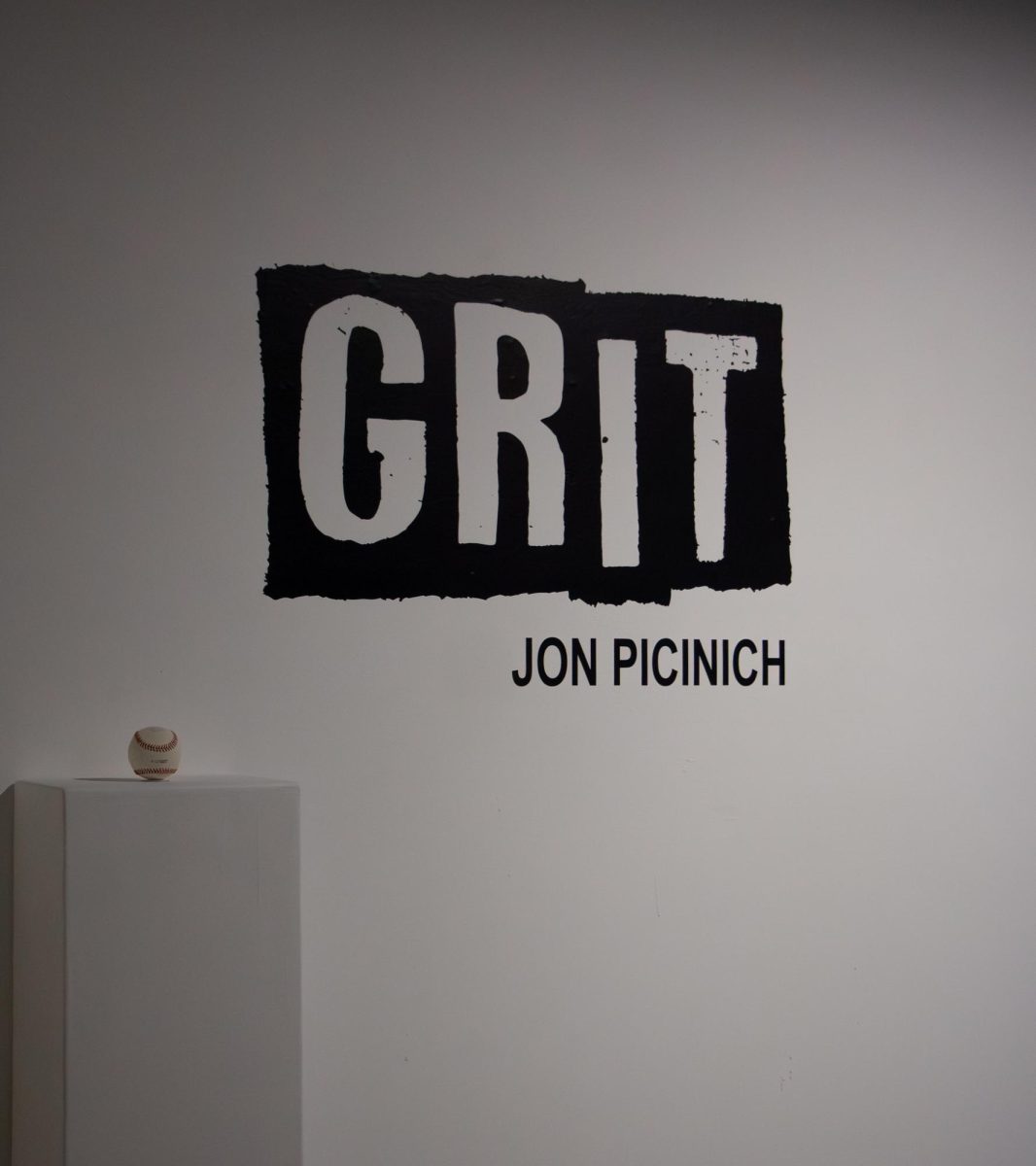
Jon Picinich, a fourth-year student and artist at UC San Diego, packs a punch with his new solo exhibition, “Grit.” Literally. In a world where masculine strength is often associated with destruction, Picinich brings the issue to the forefront of his audience’s mind by working with the traditionally masculine symbols of punching bags and basketball hoops. His gallery combines visual and performance art, grappling with what it means to be an athlete.
For Picinich, exercise is a disciplined act that helps him clear his mind. “It’s about thinking more about where we find our identity,” Picinich said. “And for me, that comes from self-awareness and self-regulation.”
As a studio art major and former athlete, Picinich’s objective was to incorporate these two backgrounds into his work. Following years of playing basketball, when he quit before college, he was left with a longing for a new outlet. He said he occupied the space in his mind that used to be reserved for sports by creating “Grit.”
When I entered the Adam D. Kamil Gallery, the first things that caught my eye were the stagnant punching bags. Two canvas bags hung solemnly from the ceiling, their middles bruised with graphite knuckleprints. A white cloth was spread under one of them, where Picinich had done his performative boxing practice the day before.
“I treated [the performance] as a training session,” Picinich explained. “I structured it in 15 three-minute rounds with one minute rest, which is how championship boxing matches are structured.”
Picinich chose punching bags for his display because they are a stereotypical symbol of masculinity. He hoped to stimulate a conversation about the differences between strength used for violence and strength used for physical exertion, reminding his audience that the line between exercise and physical aggression is thin. By turning a generally threatening symbol into art, I felt like he achieved this goal.
His piece “Punch Kick #2,” graphite on paper, was born from Picinich’s desire to test his physical strength. Abrasive lines from dark handprints, footprints, and knucklemarks overlapped on the entire 84-by-74-inch length.
The artistic process for “Punch Kick #2” was repetitive. Picinich spent days in front of the suspended paper with a mixture of graphite powder and water on his hands.
“It required me to stand up on a stool and punch, and jump off the stool, and kick the wall, and then land and get back up on the stool,” Picinich said. He did this until he was exhausted and the markings covered the entire paper.
I understood this piece to be a physical manifestation of the passionate fever of training — I could sense the artwork’s motion and chaos even while standing across the room. Almost all of Picinich’s pieces were products of momentary discomfort. I sensed that his message was to emphasize the long-term reward after a period of difficulty. When looking at the abrasive marks, I could imagine the peaceful post-exercise state of mind that must have followed when Picinich finished the project.
As an athlete myself, I have rarely come across art that explores an athlete’s state of mind when training. I resonated with Picinich’s need to release energy, and I loved that he turned it into an art form.
Around the corner were two projectors, each showing a performance video. The one that especially stuck out to me was “4,” Pinicich’s very first performance piece. The video, shown on a loop, was projected onto seven basketball hoops hung on the wall, which were repurposed from Picinich’s backyard and high school.
“I wanted to find ones that people had used and carried the life of a basketball hoop,” Picinich said.
In the video, Picinich carried the hoops 15 miles on foot from his house in Rancho Bernardo to UCSD. This feat balanced out his interpretive graphite pieces, giving the audience a place to see footage of Picinich during his artistic process. This piece spoke to his dedication to being satisfied with both how his art looks and feels for him.
“Grit” reminded me of the layered effect that occurs when we incorporate multiple interests into one project. In his case, Picinich was left with a room full of art on top of burning muscles.