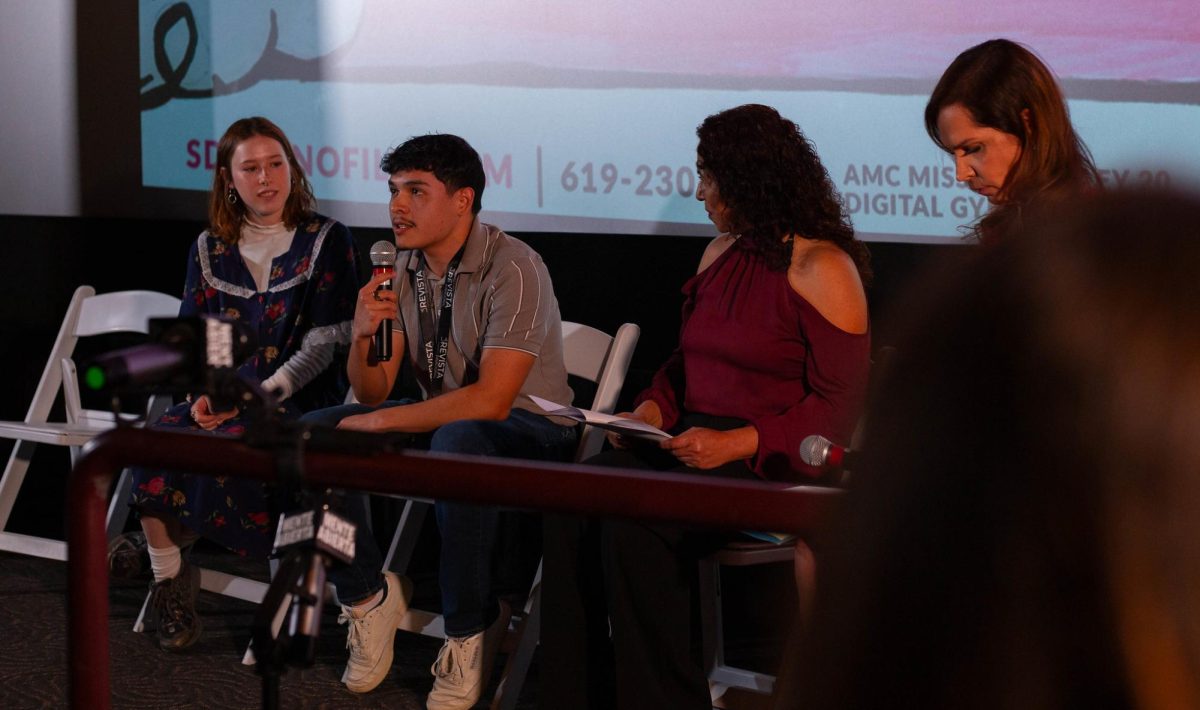
The 2026 San Diego Latino Film Festival celebrated the power of art in overcoming adversity, carrying forward the rich legacy of Latino art. This year’s program showcased stories spanning historical reflection, social commentary, and creative experimentation, each project a testament to the diversity of Latino artistic expression. Through screenings, panels, and artist discussions, the festival underscored the enduring necessity of Latino storytelling in shaping and informing cultural discourse in America. Read our coverage of select narrative and documentary feature films below.
Narrative features
‘Santa Zeta’ — By day, Zoe (Nekane Otxoa) is a charismatic travel influencer, documenting unconventional adventures for millions of followers. By night, she becomes something far more unsettling — a vigilante hunting pedophiles, driven by a relentless need to avenge her younger sister’s rape and murder. Her search ultimately leads her back to her hometown in Spain, where she’s forced to confront a horror far closer than she ever anticipated.
Director Antonio Muñoz de Mesa crafts a tense, unflinching thriller, holding audiences in a constant state of unease — suspended between discomfort and intrigue. “Santa Zeta” pulses with adrenaline, refusing to let viewers look away as it exposes cycles of abuse that persist in plain sight. Its brutality is not gratuitous but confrontational, challenging the silence that often surrounds such violence. In that sense, the film feels daring in a way mainstream Hollywood rarely attempts, pushing boundaries both thematically and emotionally.
- Thi Tran, Senior Staff Writer
‘Face Love’ — In an age of trope-ified romance and inoffensive self-inserts, it’s a rare delight to stumble across a modern rom-com bursting with actual personality. Set at the start of the pandemic, British-Spaniard screenwriter Danny (Gerald Fillmore) and aspiring Mexican actress Ana (Vanessa Benavente) are unluckily separated across the globe, forced to navigate their relationship over FaceTime. Shot entirely on handheld cameras to mimic the immediacy and awkwardness of remote romance, “Face Love” is one of those very special films that breaks boundaries while honoring its roots and inspirations.
More than a straightforward rom-com, the film deftly comments on modern issues of intimacy, addiction, and the ways that technology shapes human connection. Inspired by the likes of snarky Hugh Grant humor, the entire cast delivers some of the sharpest dialogue to cut my ears in some time, eliciting gut laughter from the audience every other scene. The result is a worthy successor to the British rom-com tradition revitalized with an immigrant sensibility — a heartfelt study of love in the digital age.
- Gabbi Basa, A&E Editor
‘Eclipse’ — Brazilian filmmaker Djin Sganzerla directs and stars in this contemporary thriller centering female rage. Astrophysicist Cleo (Sganzerla) lives an idyllic life with her fawning husband (Sergio Guizé) when her half-sister, Nalu (Lian Gaia), pays her a visit with disturbing news. What follows is a slow unraveling of the picture-perfect life Cleo thinks she is living, as the weight of her pregnancy and growing distrust of her husband take hold.
Despite its intriguing premise, “Eclipse” struggles to sustain the needed suspense, with uneven pacing that prolongs moments of tension until they fizzle. Sganzerla’s performance — at times, bordering on inert — fails to fully convey Cleo’s fraught emotional state as the scales fall from her eyes. Certain traumatic storylines are introduced only to be shelved as props with no narrative or character payoff. The film touches on themes of anger, betrayal, and domestic unease, but ultimately abandons these explorations in favor of shock value.
- Gabbi Basa, A&E Editor
Documentary features
‘American Pachuco: The Legend of Luis Valdez’ — Seated in a simple wooden chapel, the father of Chicano film says to the camera, “My work speaks for itself. They just happen to speak for a lot of other people.” Such is the enormous influence of Luis Valdez. Deriving its title from the mythic narrator of Valdez’s 1979 Broadway production, “Zoot Suit,” “American Pachuco” traces his career from its beginnings in Delano, California to his pivotal work “La Bamba,” a turning point in the Chicano art movement. Director David Alvarado implements the pachuco’s hybrid slang, or Calo, to break the fourth wall, adding an immersive charm to the film.
Valdez’s rise is inseparable from the United Farm Workers’ movement — Valdez knew leader César Chávez personally and brought El Teatro Campesino to the picket lines for three years with the support of Dolores Huerta. After the screening, Valdez shared a few words of gratitude and pride, sparking an eloquent discussion with those in the theater affirming the enduring significance and ideals of the movement itself, regardless of the wrongdoings of its purported leader.
- Gabbi Basa, A&E Editor
‘ASCO: Without Permission’ — In Spanish, “asco” means disgust or repugnance. The titular late Chicano art collective sought to regurgitate the blood, sweat, and tears of East Los Angeles through provocative, interactive exhibitions. Founded in 1972 by four high school misfits — Patssi Valdez, Harry Gamboa Jr., Glugio “Gronk” Nicandro, and Willie F. Herón III — they bonded over dissatisfaction with how their art and culture were represented. Through Asco, they aimed to alter perceptions of Chicano culture, complementing the struggles of the Chicano movement in the ‘70s and ‘80s.
Performances like “The Walking Mural” (1972) turned the streets of East LA into bombastic yet silent protest spectacles, while their famed “no-movies” placed Chicano faces at the center of make-believe stardom, challenging their lack of representation in the modern artistic sphere. “I dare you,” they conveyed with every project, “to look at us, our culture. We are way more.” This documentary brings Asco’s journey and seminal work in Chicano art history into renewed light, showing it was decades ahead of its time in redefining artistic activism.
- Gabbi Basa, A&E Editor
‘Traces of Home’ — In her feature debut, Mexican-Palestinian filmmaker Colette Ghunim embarks on a deeply personal journey to help her parents — and herself — redefine the meaning of home. As her father returns to his village in Palestine in search of the house he once knew, her mother travels back to Mexico City to uncover the fate of her own father. These parallel quests unfold with quiet urgency, revealing the lingering weight of displacement across generations.
The film’s final act builds toward an intimate homecoming for Ghunim, where reflection gives way to a fragile but powerful sense of healing. “Traces of Home” is at once heartwarming and devastating, offering a nuanced portrayal of Mexican and Palestinian identity shaped by migration, loss, and resilience. In a moment marked by ongoing political tensions and conversations around diaspora in the United States, Ghunim’s work feels especially vital. Winner of the 2026 SDLFF Premio Corazón Award for Best Documentary Feature, the film is both a deserving recipient and a resonant, necessary story.
- Thi Tran, Senior Staff Writer