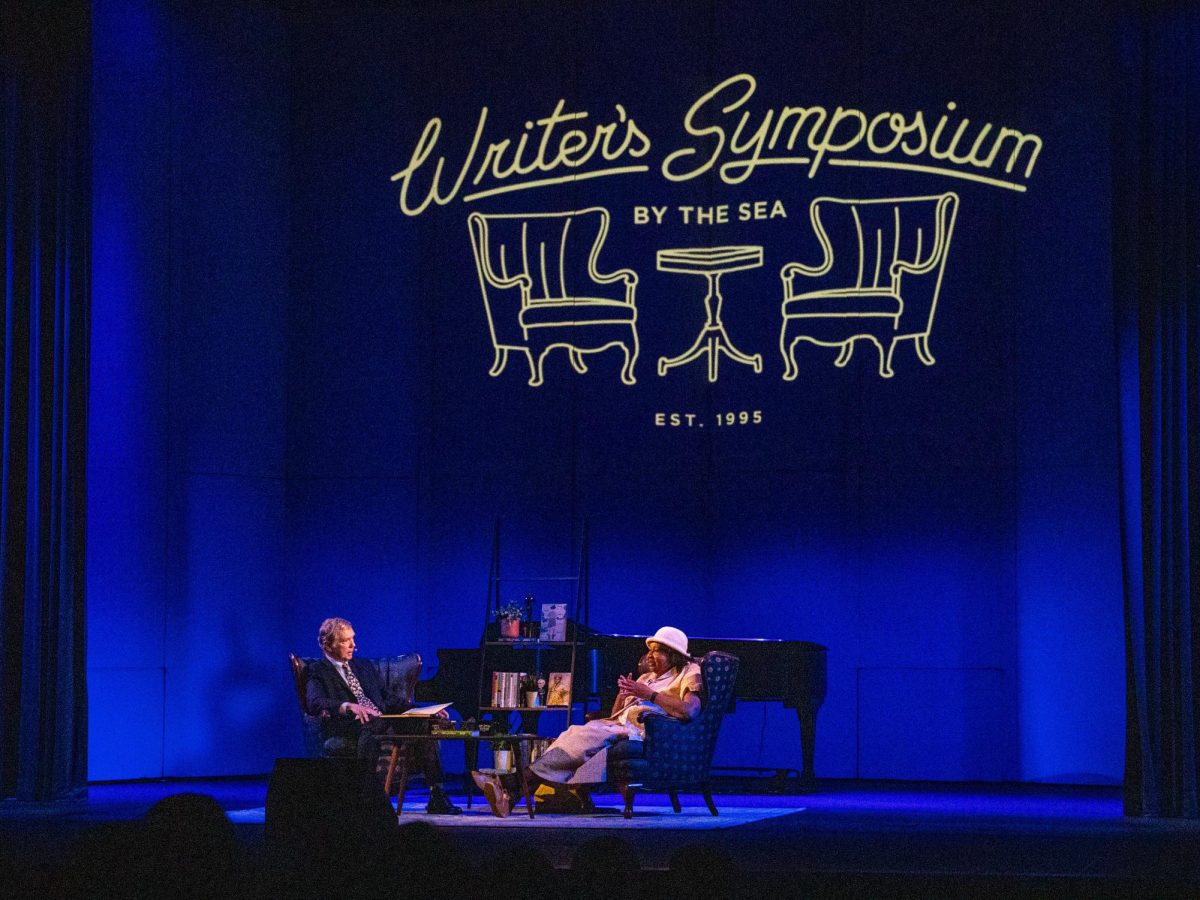
During last week’s three-day Writer’s Symposium by the Sea at Point Loma Nazarene University, journalism professor Dean Nelson sat down with three writers to discuss their careers and perspectives. Broadcast journalist Judy Woodruff, novelist and professor Jamaica Kincaid, and novelist George Saunders offered insight into the craft of storytelling and the personal and cultural forces that shape modern writing.
Judy Woodruff
Cheers instantly erupted as Woodruff walked on stage, promising a remarkable next hour. Woodruff, an American broadcast journalist, has worked in local, network, cable, and public television since 1970. Listening to her, it was clear that it was not skill alone that brought Woodruff to where she is today, but a grit and willingness to search for the truth.
Driven by the sense of wonder that has shaped her worldview from growing up an Army brat, she began her career in journalism when a college professor suggested she cover politics. She got a job as a newsroom secretary in Atlanta, which eventually led her to her major anchoring roles in Washington, D.C. After about 40 years in the industry, she stepped down from anchoring in 2022 to make her PBS docuseries, “America at a Crossroads.”
Nelson and Woodruff bonded on the panel stage over the concept of “the favorite story,” agreeing over laughter that with each new assignment comes a new favorite. Whether it be covering Jimmy Carter’s run for senator in 1970 or following a legislative chairman of Georgia around the Capitol to interrogate him about a highway tax, every story Woodruff writes is the story she’s most proud of.
As I stood to applaud her at the end of the night, I found myself quietly thanking Woodruff, not only for her lifelong dedication to the truth, but also for her ambition. As Woodruff writes in her book, “We should prod, push, insist, demand, and even behave obnoxiously at times to get information and serve the public’s right to know.” As our democracy endures relentless tests, Woodruff issues a clear call to aspiring journalists: “Jump in. The water’s fine; we need you.”
– London Barton, Staff Writer
Jamaica Kincaid
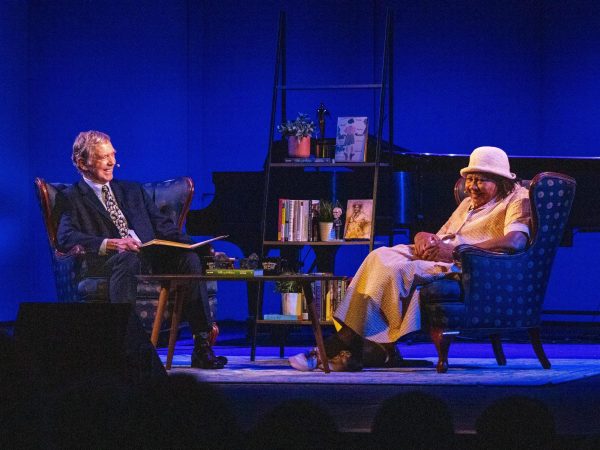
I’ve long known Kincaid from afar, through name recognition and skims of her books, but seeing her in person was a transformative experience. A professor of African and African American studies at Harvard University, Kincaid has published works ranging from short-story collections and coming-of-age novels to gardening books since 1974.
Kincaid spoke so eloquently that every sentence could be written down as a meaningful quote. Her mastery of the art of storytelling is such that a narrative unfolded in every answer she gave.
Being a young writer is a difficult career path for even the most confident of individuals, but Kincaid reminds us we must all start from somewhere. She discovered her natural voice when she didn’t worry about who her audience was, beginning with her thorough observations of New York urban life in 1974. Subject matter aside, Kincaid used her column “Talk of the Town” to refine her style, quickly garnering acclaim in the literary world for her sharp and poetic prose. Kincaid’s confidence in her craft was admirable. She explained that when she stopped worrying about readers’ reactions, she was able to produce her most truthful and detailed pieces.
In Kincaid’s short story “Girl,” a mother teaches her daughter how to be an “ideal” woman in a stream of consciousness marked by prose-poetry. Kincaid said she took inspiration from Elizabeth Bishop’s poems while writing, remarking, “It was like a door had been opened to me, saying, ‘Come in.’”
Kincaid’s image of a writer as a vessel for unconscious ideas lifted a weight from my chest. I’ve often felt pressured to write something I know is good, but Kincaid’s intuitive approach inspired me.
“A writer should never write for a reader,” Kincaid said. “Simply write.”
– Avery Heid, Senior Staff Writer
George Saunders
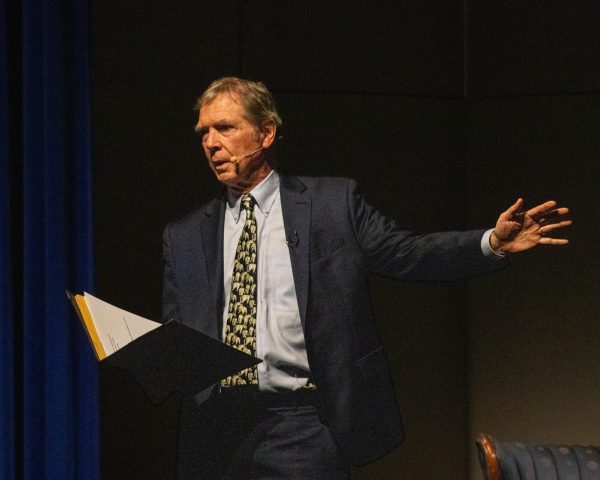
Ascending the winding roads to PLNU, I was unfamiliar with both my shadowy surroundings and the name George Saunders. I knew, at the very least, that Saunders, a best-selling author, is beloved for his self-assured narration and invigorating stories.
As I entered the dimly-lit Brown Chapel, I was immediately pulled back to my beginnings as a Catholic school student and this fleeting moment of deja vu set the room aflame. Similar to what Saunders himself would later remark during his talk, the universe seemed to settle in place “quite beautifully,” for when the author sat down, flashes of clarity followed.
Saunders shared exciting anecdotes about the experiences that shaped his writing, such as meeting his wife and raising a family. Like me, he was put through a Catholic academic system that taught tenacity and fortitude in the face of darkness and difficulty. It is clear that he understands himself and his inner universe, carrying a deep light that guides his storytelling forward.
Interestingly, Saunders began his career as an engineer, only turning to the craft of writing in his mid-30s. Feeling a pull to the mysteries of writing, Saunders learned to trust his spiritual instinct and follow an invisible string onward — a pursuit he encourages in aspiring writers. Life is confusing, but these brief moments of clarity and nostalgia, manifested in the process of composition, make it all meaningful. In Saunders’ own words, the things that are most worthy of storytelling are those that “come out of focus” but “periodically come close” back into view like glimpses of light on a turbulent, uncertain road up a dark hillside. Follow them, and your story will become clear.
– Winter Moritz, Senior Staff Writer