Rating: ★★★★★
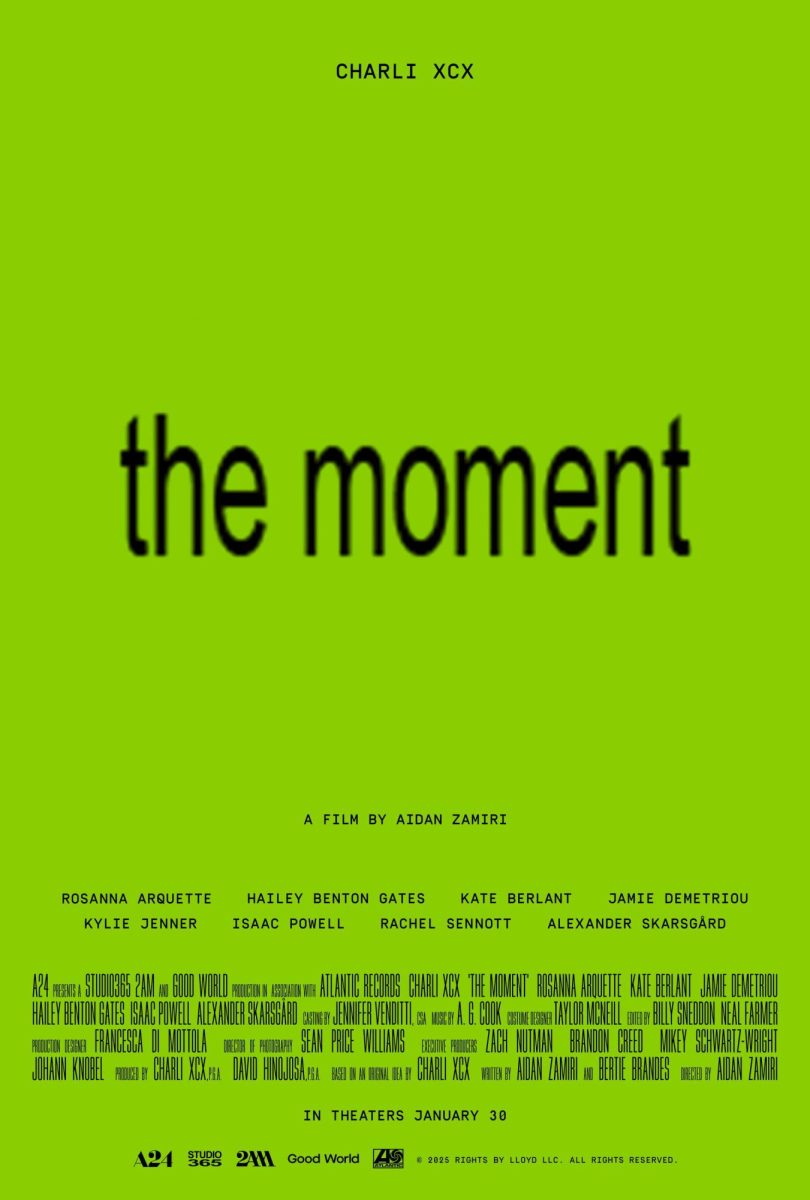
Directed by Aidan Zamiri
Producers: Charli xcx, David Hinojosa
Starring Charli xcx, Alexander Skarsgård, Hailey Gates, Isaac Cole Powell, Rachel Sennott, Kylie Jenner
Release date: Jan. 30, 2026
For over a decade, Charli xcx has existed in pop music’s margins and middle spaces — never fully underground, yet never fully embraced by the mainstream.
This is exactly the tension “The Moment” — Charli’s new mockumentary following the global explosive obsession of her 2024 career-altering album “brat”— explores. “The Moment” doesn’t frame “brat’s” success as a coronation so much as a confrontation, tracking how you respond to the world deciding to own something you created in intimacy.
I’ve been following Charli’s career from a distance since the start, aware of her niche but cult status and creative influence without ever fully entering the hedonistic counterculture she commanded. She is an artist who has quietly threaded her way through my life for years. During YouTube’s Vevo era, I rewatched the “Fancy” and “Boom Clap” music videos on loop, mesmerized by their gloss and chaos. Whenever her Icona Pop collaboration “I Love It” came on the car radio, my mom would groan, dismissing the track as pure pop slop. But I loved it anyway — my first small, private act of rebellion.
Charli xcx has always been defined more by endurance than dominance. She has built a discography shaped by risk, collaboration, and a willingness to alienate as much as it attracts. “Brat” didn’t just emerge from nowhere; it was the product of years spent experimenting without the promise of mass approval.
What’s striking about “The Moment” is how clearly Charli understands this. The mockumentary documents what happens when a deeply personal project collides with the machinery of capitalism and consumption. In the film, Charli said she made “brat” largely on her own, without the infrastructure or attention that would later descend on it: “Nobody cared then,” she said. This line lands soberly, an indictment of how value is assigned in pop culture. The work mattered to her before it was legible, but it only became important to everyone else once it could be circulated, branded, and sold.
The way meaning mutates once it leaves the artist’s hands is captured with such unflinching sincerity. The true cultural story of “brat” interlinks with Charli’s experiences in the movie as the fictionalized in-movie “brat” quickly becomes more than an album: It became an aesthetic, a meme, a costume, a marketing deck, a think piece. Each iteration multiplied its reach while flattening its complexity, until the thing that Charli made felt unrecognizable.
In a media landscape obsessed with optimization, where authenticity is something to be monetized and repeated until it loses its edge, “The Moment” feels refreshingly uncomfortable. It’s not a victory lap, nor is it a rejection of success. Instead, it’s an artist pausing mid-virality to ask what gets lost when creative labor becomes content, and whether it’s possible to reclaim authorship after the work has already escaped. For a pop star with the power to do anything, choosing self-interrogation over spectacle feels like the most subversive move of all.
The film’s final moments say it all. Over the end credits, A. G. Cook’s “Dread” warps Charli’s “I Love It,” looping “I don’t care, I love it” until the phrase collapses under its own weight. What once sounded like carefree pop indifference now feels frantic, almost defensive, rising and falling in controlled chaos. It’s a brutal callback — a reminder that pop history never stays put. It simply gets recycled, intensified, and fed back to us until familiarity turns into fatigue. By ending “The Moment” this way, Charli refuses closure, leaving us suspended inside the loop. Success doesn’t arrive as an endpoint, but as something you’re forced to keep performing, again and again.