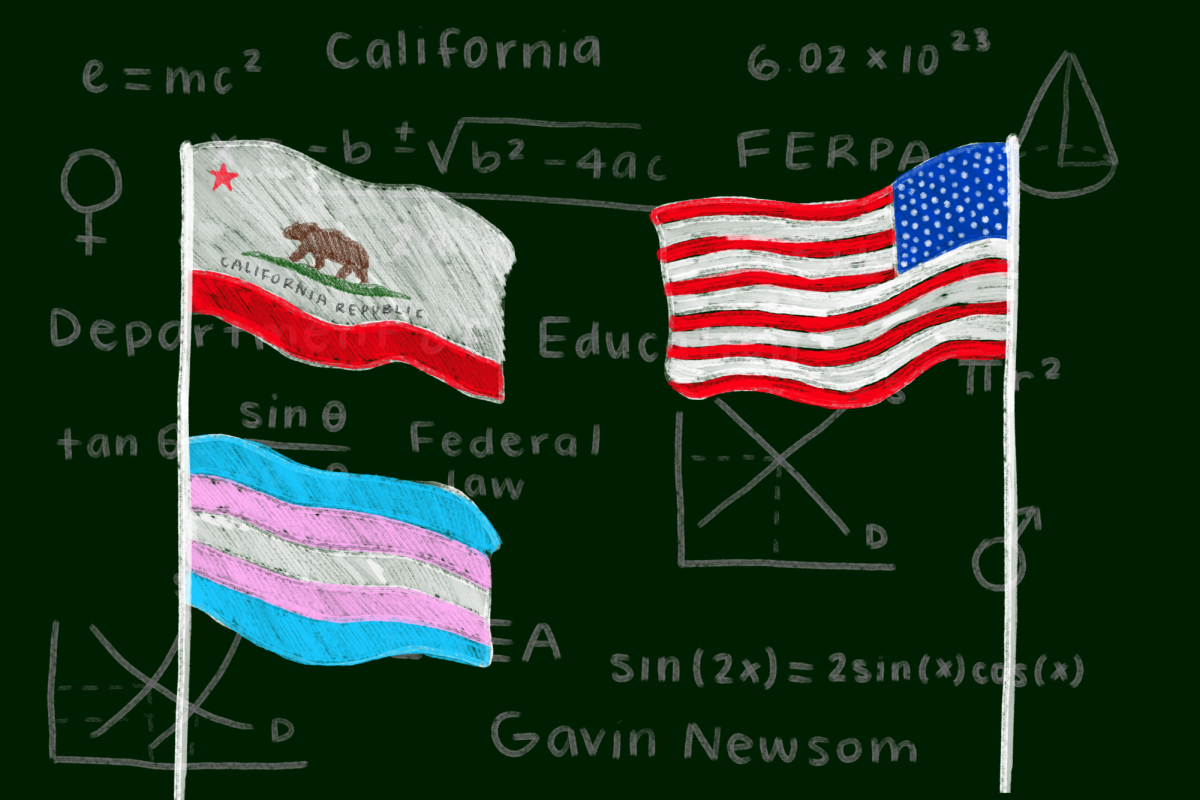
Investigations by the federal Department of Education’s Student Privacy Policy Office found that California’s policies regarding the privacy of transgender students violate the Family Educational Rights and Privacy Act. The DOE claimed that educators following California Assembly Bill 1955 violate parents’ rights outlined in FERPA.
“California has … aggressively targeted schools that follow FERPA and refuse to hide students’ ‘gender identity’ from parents,” the DOE wrote in its Jan. 28 press release.
AB 1955 prohibits an educational entity from disclosing any student’s sexual orientation or gender identity to any other person without the student’s consent. “Educational entity” includes any school, school district, county office of education, or governing board members of these institutions.
The bill, which is titled the Support Academic Futures and Educators for Today’s Youth Act, also stipulates, if required by other state or federal laws, such information about a student can be disclosed.
Passed in 1974 by the federal government, FERPA dictates what student information can legally be kept private. Under FERPA, parents have the right to access their children’s “education record,” which contains information about individual students kept by educational institutions.
The DOE stated that the California Department of Education has “coerced districts to withhold information from parents,” such as a student’s preferred name or pronouns, using laws like AB 1955. Additionally, it asks for the CDE to publicize that California laws, regulations, or policies should not be interpreted to undermine or contradict federal law and that violations of FERPA risk loss of federal financial assistance.
Section 2F of AB 1955 reads that “LGBTQ+ pupils have the right to express themselves freely at school without fear, punishment, or retaliation, including that teachers or administrators might ‘out’ them without their permission. Policies that require outing pupils without their consent violate pupils’ rights to privacy and self-determination.”
Section 2G continues: “Pupils have a constitutional right to privacy when it comes to sensitive information about them, and courts have affirmed that young people have a right to keep personal information private.”
As a path to resolution, the DOE has urged the CDE to issue a notice to all superintendents and administrators informing them that “gender support plans” or other related documentation are considered part of education records under FERPA and are subject to parental inspection upon request.
The office that made this ruling falls under the Title IX Special Investigations Team created last year by the DOE and the U.S. Department of Justice. The SIT’s stated primary goal is to “protect students … from the pernicious effects of gender ideology in school programs and activities.”
FERPA has different requirements for students above 18 years old and not enrolled in elementary or secondary school. In the University of California system, all college students are treated as adults with the ability to control, inspect, review, and file complaints with the DOE regarding the disclosure of their individual education records to others.
There is some personally identifiable information in a student’s education record that the university is permitted to release without the student’s consent, such as directory information about a student to other legitimate academic institutions. Information that is not subject to FERPA is also often subject to other policies; FERPA permits disclosure of records to parents of financially dependent students, but the UC’s systemwide policy does not permit such disclosure.
Federal and state governments have greatly increased the amount of legislation targeting transgender and gender-nonconforming Americans in the past few years. In 2025 alone, 126 anti-trans bills passed across the country, and legislatures considered over 1,000 such bills.
Among the bills being considered this year is House Bill 2616, which, if passed, would require parental consent to change a student’s gender information in all public elementary and middle schools that receive funds under the Elementary and Secondary Education Act of 1965. This includes changing a minor’s gender markers, pronouns, or preferred name on any school form or sex-based accommodations, including locker rooms or bathrooms.
Title I grants make up the majority of funds provided by the ESEA, also known as the ESSA, and are awarded to approximately 63% of all public schools across the country.
In the press release on the DOE’s investigations into California’s policies, Secretary of Education Linda McMahon concluded that the CDE has “egregiously abused its authority” in not requiring parental notice about their child’s gender transition.
“Under Gavin Newsom’s failed leadership, school personnel have even bragged about facilitating ‘gender transitions,’ and shared strategies to target minors and conceal information about children from their own families,” she wrote. “While the Biden Administration turned a blind eye to this deprivation of parental rights and endorsed the irreversible harms done to children in the name of radical transgender ideology, the Trump Administration will fight relentlessly to end it. Children do not belong to the State—they belong to families.”