

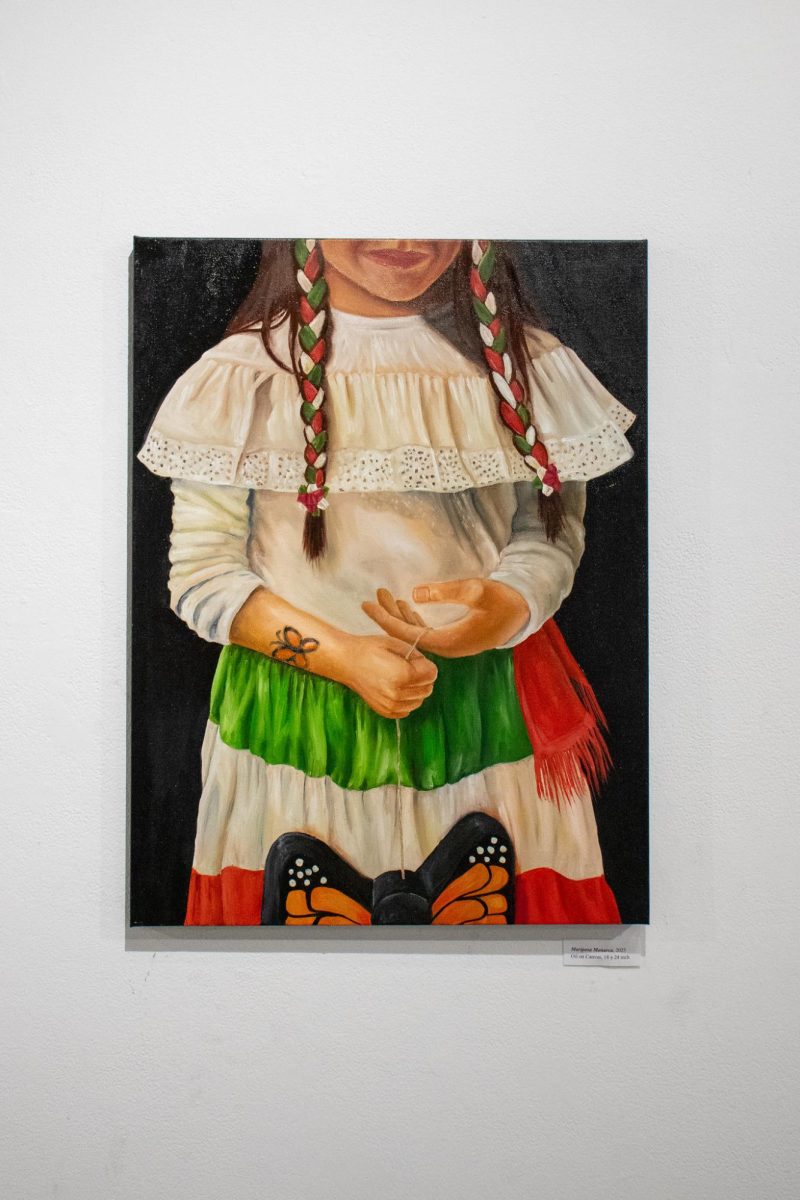
Visual artist Amber Ureña’s exhibition “Hasta La Raíz” debuted last Monday at UC San Diego’s Adam D. Kamil Gallery. Ureña spoke with The UCSD Guardian in two interviews, before and during her showing. “Hasta La Raíz” was a collection of oil paintings and graphite portraits that centered around and expressed her memories of her family and Mexican American tradition.
“Hasta La Raíz” — which translates to “Down to the Root” — honored Ureña’s Mexican heritage by reinterpreting pictures of her family from her mother’s photo album.
“Susana Ofelia,” made with oil on wood, paid a touching tribute to Ureña’s grandmother, who passed away early in Ureña’s life. The piece was based on a photograph in her mother’s album depicting her abuela holding baby Ureña in her lap.
While the leafy shrubs in the background were beautifully detailed, Ureña focused her attention on the two subjects. I could see the care she placed in every laugh line, the slight sag of the earlobe, and the glint in the subjects’ eyes.
Before the exhibit, Ureña told me that professors have joked with her, saying she tortures herself with her attention to detail. Looking at this piece, I understood what they meant: I didn’t need to see the original photo, not when Ureña had detailed every strand of hair with pinpoint precision.
Ureña also shared the significant influence Mexican culture has on her work.
Across her exhibit, she referenced Mexican symbols and traditions, such as monarch butterfly motifs and “folklórico,” to create a celebratory space for her heritage. Images of swirling, colorful skirts and worn-out dancing shoes adorned the gallery’s walls. Her love for her culture radiated off the canvasses and came to life.
The piece “Ni de equí, ni de allá” — “Not from here nor there” — especially stood out to me. An oil-on-canvas self-portrait, the piece featured two versions of Ureña facing away from each other, held together only by intertwined hair. Ureña said one was a “Mexicanized” version of herself and the other was an “Americanized” one.
I loved how Ureña embraced both sides of her identity in her self-depictions. The strands of hair literally and symbolically bridged the two portraits of herself, imagining Ureña as the living link tying the two cultures together. Both self-images stood at equal height with identical facial expressions. The symbolism reflected her desire to find a balance between her two heritages and avoid the fading of one culture that can come with adopting another.
“Although there is that disconnect between cultures, I wanted to emphasize that you have a right to be here and preserve [both] traditions,” she said. “It’s worthy of that visibility.”
Ureña is currently a fourth-year student studying human biology with minors in global health and visual studio arts. After graduation, she plans to become a global health physician working with migrant communities.
Between her STEM-heavy courseload and volunteering at a student-run free clinic in Tijuana, Mexico, art is an escape and a way to decompress. Even as her career advances, Ureña will always keep art in her practice.
“I’m never letting go of art,” she said. “It’s something I’m always going to carry with me in my life.”
Ureña uses art to express her personal experiences and values and in doing so, encourages a community to form among viewers of her work. She wants to celebrate and preserve her cultural traditions and urges her audience to do the same, however that may look.



Madi • Feb 10, 2026 at 4:44 pm
Go Amber!
Michel Alba • Feb 10, 2026 at 2:26 pm
Love this!